
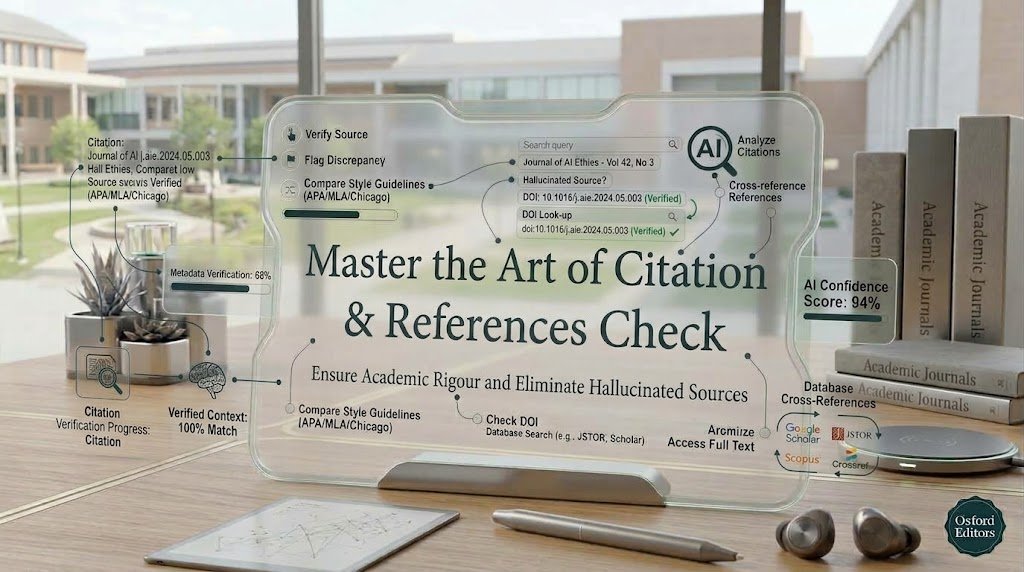
To verify an AI-suggested citation, locate an independent publication record, match its details and read the passage supporting your claim. Then check the version and any publication updates. A plausible title, a working link or a neatly formatted reference is not enough. A genuine source can still be cited for something it never says.
Treat each suggested reference as a lead to investigate. This guide gives you a practical checking routine and three fictional worked examples to verify AI Generated references. Begin by confirming that your assessment permits the AI activity involved; source verification and permission are separate questions. Follow the declaration and referencing instructions for your own task.
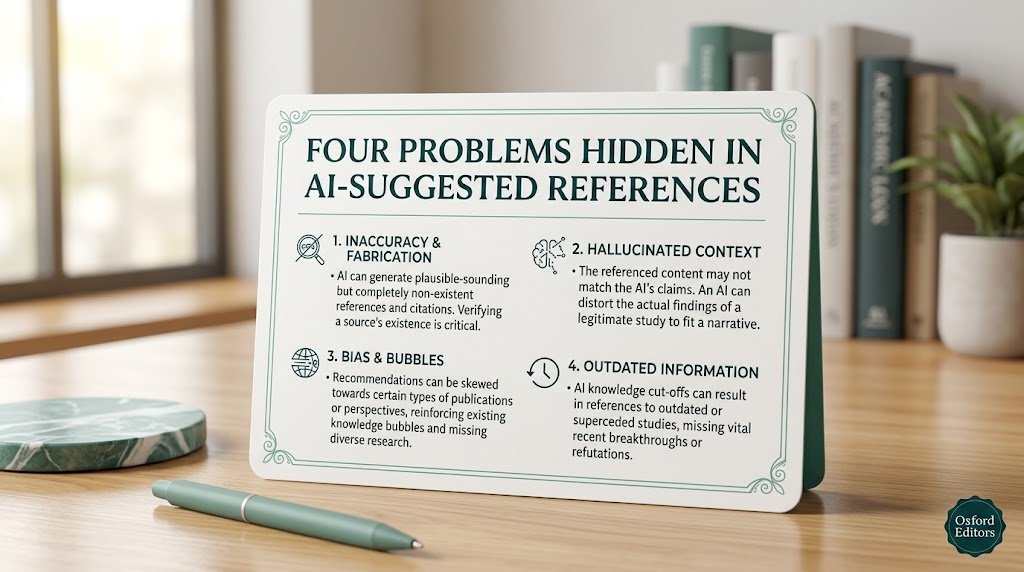
Four Problems Hidden in AI-Suggested References
UCL Library warns that generative AI can fabricate quotations and citations and advises checking original, credible sources. Oxford’s Bodleian guidance also identifies references with incomplete or combined details, and summaries that can misrepresent a real publication. Those are different problems requiring different checks.
UCL Library: checking AI-generated citations and quotations
| What You Notice | Possible Problem | Next Check |
|---|---|---|
| No matching record found | Untraceable citation, incorrect details or an incomplete search. | Try another independent route; retain an unresolved status. |
| Details do not belong together | Authors, title or publication information may be mixed. | Compare fields against the original record. |
| Identifier opens a different work | The identifier does not match the cited item. | Check the target’s title and authors; do not keep the mismatched identifier. |
| Source exists but says something narrower | The AI answer may overstate or misrepresent the evidence. | Read the relevant passage, methods and limitations. |
Table 1. Diagnose the problem before deciding whether a citation is usable.
Avoid calling a source fake simply because one search returned nothing. An incorrect title, an edition difference or a poorly indexed item can make searching difficult. Equally, do not accept a nearby result merely because it concerns the same topic. You need the work identified by the reference, or a genuinely suitable replacement you have read.
Step 1—Find an Independent Publication Record
Copy the suggested reference into a working note before changing it. Search the distinctive title words and author through your university library resources, the publisher or an appropriate subject database. If the full title gives no result, try a shorter phrase plus the author. Search independently of the AI answer rather than asking the same tool to reassure you.
Crossref’s search help supports lookup by DOI, author and title information or a full citation. Use that as one route for matching a scholarly record. It is not a complete catalogue of every book, report, webpage or other source you might cite.
Crossref Metadata Search: search examples
If a link is supplied, open it and identify what you reached: a specific publication, a search page, a journal homepage or unrelated content. Note the actual record, not just the link label. If the page is unavailable, search the title independently before concluding that the source does not exist.

When There Is No DOI
Continue using the identifiers appropriate to the source. For a book, check its author, title, edition and publisher record; an ISBN may help. For a report, check the issuing organisation and publication page. For a webpage, identify its author or organisation, title and date where available. Absence of a DOI is not a reason by itself to reject a source.
Step 2—Match the Details, Including the DOI
Compare the suggested citation with the publication record field by field. Check the applicable details rather than expecting every source to have a journal volume or page range. Some publications use an article number. Books may have multiple editions, and records can display online and issue publication dates differently.
| Field | Compare With | If It Differs |
|---|---|---|
| Title and authors | Publisher or original publication record. | Investigate whether you have a different work or an error. |
| Date and version | Publication page and the version consulted. | Resolve the date/edition rather than choosing one for appearance. |
| Journal or publisher | The actual publication record. | Check that information has not been borrowed from another source. |
| Volume, issue, pages or article number | Record and document, where applicable. | Correct from verified details; do not invent missing fields. |
| DOI or other identifier | The work reached through the identifier. | Confirm that it identifies this publication. |
| Quotation locator | The passage and numbering in the consulted version. | Use an accurate locator in the required citation style. |
Table 2. Match the source you actually consulted, using the fields applicable to that source.
Worked Example 1: The Identifier Points Elsewhere
Fictional teaching example: the AI answer lists “A. Sample, Learning With Digital Feedback, 2025”. Opening its supposed identifier leads to “B. Example, A Study of Coastal Sediment, 2021”. No real identifier is supplied here.
The subject, author and title do not match. Record “identifier mismatch”, then search for the claimed learning publication independently. Do not paste the working identifier beside the original title. If you locate the intended source, rebuild the citation from its verified record. If not, keep the reference unresolved and investigate another suitable source.
Do not silently convert the coastal article into a replacement citation. A replacement must support the sentence you want to write, not merely provide a link that opens.
Step 3—Read the Source Behind the Claim
Finding the record establishes identity, not evidential support. Open the publication and locate the passage relevant to your sentence. Check the population, setting, outcome, method and qualifications. For a quotation, compare the words and surrounding context with the original, using the correct locator for the version you read.
Oxford’s Bodleian guide recommends checking summaries against original publications, including study design and omitted limitations. It also stresses that a real source is not automatically a suitable source. Use your course’s expectations to assess relevance and credibility, rather than accepting the AI tool’s recommendation as sufficient.
Bodleian Libraries: evaluating AI-generated references and claims
Worked Example 2: A Claim Goes Beyond the Evidence
The infographic below uses invented material to show a checking method. It is not a real finding and should not be cited as one.

Reader action: underline “grades”, “all” and “improves” in the claim. Compare each with the fictional source note. They describe a different outcome, a wider population and a stronger relationship. In a real assignment, re-read the full relevant evidence and either narrow your sentence accurately or find evidence for a different claim. Do not force the citation to fit an unsupported conclusion.
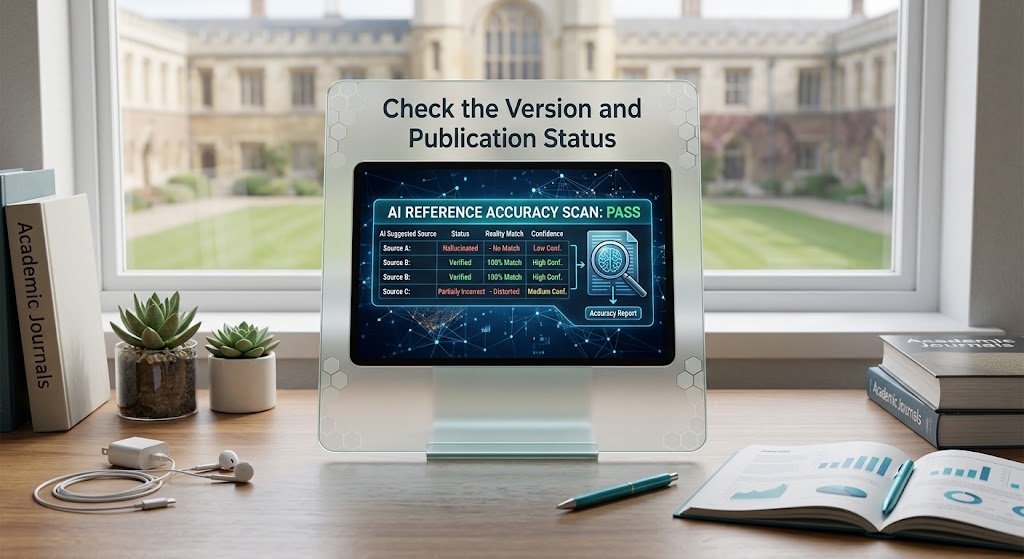
Step 4—Check the Version and Publication Status
Return to the publisher’s current publication page before finalising the reference. Look for correction notices, retractions, updated versions or other status information. If an update exists, read the notice and determine what changed; do not assume every correction has the same effect on your argument.
Crossref’s Crossmark service, where a publisher provides it, lets readers check registered corrections, retractions and updates. Use it alongside the publication page. A missing button is not evidence that nothing has changed, and the presence of an identifier or status tool is not a quality guarantee.
Crossref: Crossmark and publication updates
For a preprint, accepted manuscript or later published version, record the version you actually consulted and check whether a more appropriate version is available. If a status notice affects evidence central to your argument, ask a librarian or tutor for guidance before relying on it. Do not substitute a newer date without checking the content.
Step 5—Correct, Replace or Keep It Unresolved
Use a clear outcome rather than a single “verified” tick. You might have confirmed a publication’s existence but not obtained the passage needed for a claim. Or you may have read the passage and discovered that the proposed sentence is too strong. Record what you established and what remains to do.
Worked Example 3: You Cannot Locate the Source
Fictional teaching example: an AI answer suggests a report called “Student Feedback Habits Across Britain”, attributed to an unspecified institute. You search the title in your library system, try distinctive title words and author details, and search the claimed organisation. You still cannot identify a matching report.
Record the search routes and mark it “unresolved—not located”. Ask a librarian for help if it matters to your argument. Meanwhile, search the topic independently for evidence you can locate and read. If no suitable support emerges, remove or revise the unsupported claim. Do not invent a publisher, date or URL to complete the reference.
Requesting a direct source link from the AI tool can provide another lead. It does not change the need to repeat the independent checks on whatever it returns.
Keep a Short Citation Verification Record
| Reference / Example | What Is Established | Status / Next Action |
|---|---|---|
| Example 1: mismatched identifier | Link opens a different publication. | Correct only after locating the intended work; otherwise unresolved. |
| Example 2: overstated claim | Source note describes a narrower outcome and population. | Re-read the original evidence; revise the claim or replace the source. |
| Example 3: report not located | Several search routes recorded; no matching item found. | Ask a librarian or use independently found evidence. |
| Your own reference | Record located; details matched; relevant passage and version noted. | Write the decision and any remaining limitation. |
Table 3. Illustrative working record; it is not a university-mandated form.
Keep a brief note connecting each central sentence with the source passage that supports it. This makes later revisions easier: if you change the claim, recheck whether the same evidence still supports the new wording. A source suitable for background context may not support a numerical, causal or comparative claim.
When access is the obstacle, try your library’s access route, ask about a legitimate available version or seek librarian help. Distinguish “record found; full text unavailable” from “source not found”. Neither status justifies writing as though you have read material you could not consult.
Check the required citation style after establishing the facts. Reference managers can help organise and format records, but you should still inspect imported details and match in-text citations with the final reference list. Formatting is the last presentation step, not a substitute for source checking.
Final Word—Cite What You Have Actually Checked
A reference should lead the reader back to evidence you can explain. Before submission, be able to say which publication you consulted, where it supports your sentence and what limits apply. If one of those answers is missing, treat it as a task to resolve rather than a gap to disguise. Careful checking strengthens the link between your reasoning and your sources, whether the original suggestion came from AI, a search result or someone else’s bibliography. Get reference & citation support from academic experts.
For broader reflection on evaluating AI assistance, see our student critical-thinking guide.
AI and critical thinking: a student’s self-check
Frequently Asked Questions
Does Every Genuine Academic Source Have a DOI?
No. A missing DOI does not by itself make a source fake. Search using the title, author and publication information, and use the identifiers appropriate to the source type. A book edition, organisational report or webpage may need a different route. Confirm its identity and relevance rather than adding a plausible-looking identifier.
What if a DOI Works but Opens a Different Article?
Treat that as a mismatch, not successful verification. Compare the target’s title, authors and publication details with the citation. Search for the intended work independently and only correct the identifier from a reliable record. If you cannot identify the claimed work, keep it unresolved or find a suitable source you can verify and read.
Can I Verify a Claim Using Only the Abstract?
An abstract can help establish relevance, but it may not contain the detail needed for your sentence. Do not claim to have checked methods, exact quotations or limitations absent from what you read. Obtain the relevant text where necessary, or limit your use to what you actually consulted and what your assessment permits.
What if I Cannot Access the Full Text?
Check your library’s access route and ask a librarian about legitimate alternatives or document access. Record that you found the publication but have not checked the required passage. If you still cannot consult it, use another appropriate source you can read or ask your tutor about acceptable secondary citation practice. Do not present it as directly consulted.
Can a Reference Manager or Another AI Tool Verify Everything for Me?
Use tools to assist searches and organisation, but separate automated matches from reading the evidence. A record can import correctly while the publication fails to support your claim. Another AI answer may supply more leads, yet it does not establish that the source says what you need. Retain the final checks on identity, passage and status.