
AI is more likely to support your thinking when you attempt a task, question its suggestions, check the evidence and make your own decisions. It may be replacing your reasoning when you accept conclusions you cannot explain or cannot tackle a similar problem without it. Start by checking your assessment rules: useful study support is not automatically permitted in submitted work.
The useful question is what you can understand and do after using the tool. This guide offers six practical checks, examples and next steps. They are reflection tools, not a diagnostic test of dependence or a way to determine whether you have committed misconduct.
A 2025 study of generative AI and critical thinking surveyed knowledge workers about their use of AI. It examined self-reported critical-thinking effort and confidence, including how effort shifted towards checking and integrating outputs.
Table of Contents
ToggleThis is useful evidence about reported working practices. It is not proof that AI causes permanent thinking decline in university students. A survey of professionals cannot establish every effect on student learning. The checks below are practical recommendations, not a validated measure derived from that study.
The careful conclusion is that how you use assistance matters. We can examine whether you retain the decisions and skills a task is intended to develop, without assuming that all AI use has the same effect.

Choose one recent study task. Keep your original notes and identify what AI contributed. Try these checks in a format that suits you: speaking, writing, drawing or demonstrating a method. Retain approved accessibility support. The aim is to test your understanding, not to make access harder.
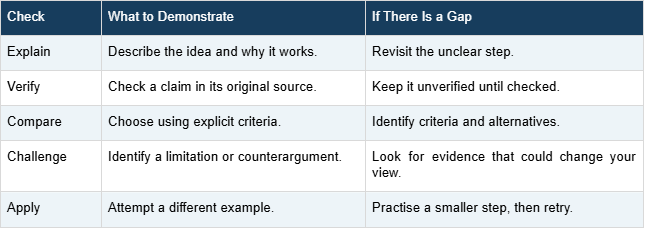
Close the AI output and explain the central idea in your own words. Include why the explanation makes sense. For an essay paragraph, state the claim and how the evidence supports it. For a calculation, explain why you selected the method, not just the order of steps.
Warning Sign: You can repeat the answer but cannot explain an important step. Next Step: Name that gap and return to your course material. Where permitted, ask for a hint or a question about the gap rather than another finished answer. Then explain the idea again.
Choose one factual claim or reference from the output. Open the original source and check whether it exists, says what the output claims, and applies to your question. A genuine paper can still be misrepresented. A reference list is not evidence that someone has checked its contents.
Warning Sign: You accept a claim because it sounds specific or includes a citation. Next Step: Mark it as unverified until you read the relevant source. If you cannot obtain that source, avoid treating the claim as established. Use appropriate library resources or ask your tutor for help.
Compare two possible answers, explanations or methods. State the criteria you will use to choose between them. For example, consider relevance to the question, strength of evidence and assumptions. Explain why one option fits those criteria better, or why the evidence does not settle the issue.
Warning Sign: Your only reason is that AI recommended an option. Next Step: Write your criteria before asking for more suggestions. Check the alternatives against your sources yourself. A confident recommendation does not remove the need for a reasoned choice.
Identify an assumption, limitation or plausible counterargument. If a claim says a policy improved an outcome, ask what else could explain the change. If an interpretation seems persuasive, ask which evidence might support a different reading. You do not need to disagree automatically; you need a basis for agreement.
Warning Sign: You ask the tool repeatedly to confirm your preferred answer. Next Step: Look for evidence that could change your mind. Where permitted, ask AI to identify questions to investigate, then verify the points yourself. Another AI response is not independent confirmation of a factual claim.
Try a fresh example without asking AI to complete it. Change the numbers in a problem, analyse another passage or explain the concept in a new situation. Decide which parts of the earlier reasoning still apply and which need adjustment.
Warning Sign: You can follow the worked example but cannot begin the new task. Next Step: Break the task into a smaller step and practise it. Use a limited hint where allowed, then attempt another example independently. One difficult attempt can reveal a learning gap; it does not diagnose dependence.
Identify a suggestion you accepted, rejected or changed. Explain why. Keep brief notes such as: “I rejected this conclusion because the source only reports an association.” The point is to make your judgement visible to yourself, rather than create extra paperwork.
Warning Sign: You cannot distinguish the tool’s choices from your own. Next Step: Revisit the outline or argument and make the decisions explicitly. If the tool selected the position, sources and conclusion, rewriting its sentences does not show that you evaluated those choices.
Table 1. Use the self-check to choose your next learning step.
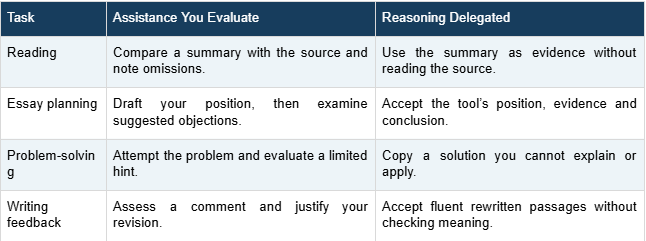
The boundary depends partly on the skill you are practising. A summary can help you orient yourself before reading, but it cannot show that you have evaluated the original text. If close reading is the task, skipping the source removes the work you need to practise.
An AI-generated counterargument can give you something to examine. It becomes useful learning when you decide whether it is relevant and supported. Copying it into an essay without that judgement leaves the reasoning with the tool.
These are illustrative distinctions, not universal permission rules. Even an activity that keeps you intellectually involved may be prohibited in a particular assessment.
Table 2. Compare where the intellectual decisions remain.
First check your own institution’s guidance. Oxford University’s responsible-use guidance emphasises critical thinking and checking outputs against established sources. At Oxford, assessment use requires specific prior written authorisation. That is an Oxford rule, not a statement of every university’s policy.
Start with a genuine attempt. Write what you understand, what you think the answer might be and where you are stuck. Where allowed, request help focused on that gap. For example: “Ask me a question about the assumption in my argument. Do not write a replacement paragraph.”
Treat the response as something to assess. Verify factual points, decide what to accept and explain the decision. Finish with an independent attempt or a new example. If you still cannot explain the idea, return to the source or seek academic support.
This is a suggested study routine, not a promise of better marks. You can shorten it for a simple task. What matters is retaining the reasoning that the activity is intended to develop.
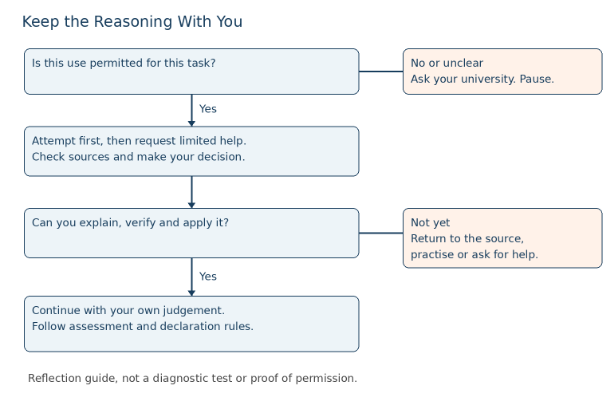
A gap gives you a specific learning task. If you cannot explain a concept, revisit its definition and examples. If you cannot verify a claim, locate the source. If you cannot choose between interpretations, identify the evidence and criteria that would distinguish them.
For persistent difficulty, ask your tutor, supervisor or university academic support team. Explain what you tried and where the reasoning stopped. You do not need to abandon every tool. Adjust the help so it addresses the gap while leaving you responsible for the judgement.
Check that you can defend the central claims and that the references support them. Follow the rules for your specific assessment, including any required declaration. Permission for an earlier task does not establish permission for the next one.
Keep relevant drafts and records where your institution requires them. Do not upload confidential or restricted research material to a tool without permission. A self-check can reveal what you still need to learn, but it cannot certify compliance with academic rules.
For organising your own argument, see our university assignment structure guide alongside your department’s instructions.
Oxford Editors also describes academic writing courses for developing writing skills. Check the course scope against the support you need. To discuss academic writing skills support, contact Oxford Editors with your learning goals and university guidance.
Frequency alone cannot establish dependence. Consider what you ask the tool to do and what you can explain afterwards. Repeated use for permitted access support differs from repeatedly delegating your argument. Use the checks to identify specific gaps, without treating them as a diagnosis or a score.
Rewording shows that you can change the wording. It does not by itself show that you checked the evidence, evaluated alternatives or made the original decisions. Explain the argument without the output and verify its claims. Separately, check whether your assessment permits that use and how it must be declared.
A summary may help you orient yourself, where permitted, but it can omit qualifications or misrepresent the argument. Read the relevant original material before relying on it as evidence. If critical reading is the skill being assessed, replacing that reading also removes an important part of the task.
Access support and outsourcing academic judgement are different considerations. Use approved support and choose an accessible way to demonstrate understanding, such as speaking or drawing. Confirm the arrangements with your institution. Focus on whether you understand and evaluate the content, rather than whether you can perform every mechanical task without assistance.
No. These questions help you reflect on learning, not determine permission. Read the instructions for your specific assessment and ask your tutor or academic support team when uncertain. An activity can help you understand a topic and still be restricted in submitted work. Follow any required declaration process.