
For 2026/27, several UK universities have introduced new AI assessment frameworks or updated how students must record their use. Others are continuing existing approaches or reviewing them. Your next step is to identify the current instructions for your own assessment, including its academic year, permitted activities and disclosure requirements. A university tool licence, a friend’s permission or an old form cannot settle those questions.
This dated selection covers seven universities, not the whole UK. Use the official sources alongside your own module and assessment instructions.

What Has Actually Changed for 2026/27?
Three dates can appear on the same subject: when a notice was published, when a policy took effect and when a future review will happen. Keep them separate. An October reminder may describe arrangements introduced at the start of the academic year. A planned review does not itself replace existing instructions.
Read each development alongside its scope. Departmental examples are not university-wide permission. Current guidance is only labelled a change where the source establishes that change.

Seven Universities: Verified Updates and Student Actions
Manchester—A New Policy From September 2026
Manchester’s AI in Teaching and Learning Policy took effect on 1 September 2026. It requires assessment categories to be communicated through assessment briefs and course-unit Canvas information. The framework distinguishes Prohibited, Minimal, Permitted and AI-Integrated use, with acceptable activities explained for the particular task.
Integrated use is necessary for the learning outcomes; it is not unlimited permission. The policy also requires course leads to explain how groups should approach and record AI use. Students should therefore look beyond an individual tool choice when preparing a group submission.
Official source: Manchester AI in Teaching and Learning Policy
Your next action: open the current brief and Canvas information together. Note the category and permitted activities. For group work, ask how the team’s use and individual contributions should be recorded before work begins.

Bath—Two Lanes Replace ABC Categories
Bath’s official guidance confirms that its open- and closed-lane framework replaced ABC categories from September 2026. Closed-lane conditions prevent GenAI access; open-lane assessments authorise its use within academic integrity requirements. Written or otherwise recorded coursework is classed as open lane.
This is more than a new name for the old letters. The framework links the lane to assessment design and conditions. Bath also explains that open-lane tasks may permit AI or require engagement with it; the task’s learning outcomes still matter.
Official source: Bath two-lane framework and FAQs
Your next action: replace an old ABC-only reference with the current lane information for your task. Read the assessment conditions and acknowledgement instructions. If a saved brief still uses the older language, ask which current instructions apply.
| Institution | Verified Status / Date | Immediate Action |
|---|---|---|
| Manchester | New policy effective 1 September 2026. | Read the category and task-specific instructions in the brief and Canvas. |
| Bath | ABC replaced by two lanes from September 2026. | Check the lane and conditions; identify outdated documents. |
Table 1A. Change register: new or replaced frameworks. Source links appear above.
Glasgow—Supervised and Unsupervised Scenarios
Glasgow implemented updated two-scenario guidance for 2026/27. Supervised assessments generally prohibit GenAI unless expressly permitted. Unsupervised assessments generally permit it with acknowledgement, but course coordinators can impose assessment-specific limitations, including prohibition. Its guidance states an acknowledged-use default where an unsupervised brief is silent.
The implementation notice also says earlier guidance remains applicable until assessments set in 2025/26 are marked. That is a named transition arrangement, not a UK-wide rule for resits.
Official source: Glasgow assessment scenarios
Official source: Glasgow implementation notice
Your next action: identify both the assessment conditions and the year under which it was set. Check local restrictions before relying on a default. If the year or scope is unclear, request written clarification rather than importing another university’s position.
Greenwich—Updated Tiers and AI Reflections
Greenwich’s notice dated 15 October 2026 confirms updated guidance for 2026/27. Assessments use three tiers: Independent of AI, Supported by AI and Augmented with AI. Briefs must explain the permitted role. Where AI contributed, students are expected to explain its use, evaluation and their own contribution through an AI Reflection.
The notice expressly replaces the former AI Declaration form with the reflective statement element of the assignment. It also says the Assessment Misconduct Policy is unaffected: an updated support framework does not remove academic integrity obligations.
Official source: Greenwich 2026/27 guidance update
Your next action: check the brief’s tier and current reflection instructions. Replace an old saved form where the new requirements apply. Keep notes about the decisions you made so the reflection can describe actual work rather than a generic claim of responsible use.
| Institution | Verified Status / Date | Immediate Action |
|---|---|---|
| Glasgow | Updated two-scenario guidance for 2026/27; earlier assessment transition stated. | Confirm conditions, task-specific restrictions and applicable year. |
| Greenwich | 2026/27 update; reminder published 15 October 2026. | Use current AI Reflection instructions instead of the former declaration form. |
Table 1B. Change register: updated assessment and disclosure arrangements.
Liverpool—2026/27 Implementation and Defaults
Liverpool’s official implementation page says assessment tiers must be stated in Canvas and aligned with briefs for 2026/27, with an exception where the default is Tier 2 for non-invigilated assessments or Tier 1 for invigilated assessments. It also points to guidance updated in August 2026 and explains that Appendix L of its assessment code takes precedence in regulatory terms.
Official source: Liverpool policy and implementation guidance
Your next action: locate the tier and its full official meaning before starting the proposed activity. If no tier appears, check the institutional default and whether it applies to your task. This guide does not reconstruct Liverpool’s tier definitions from news reports. A tier number without its definition is not enough to establish a particular use.
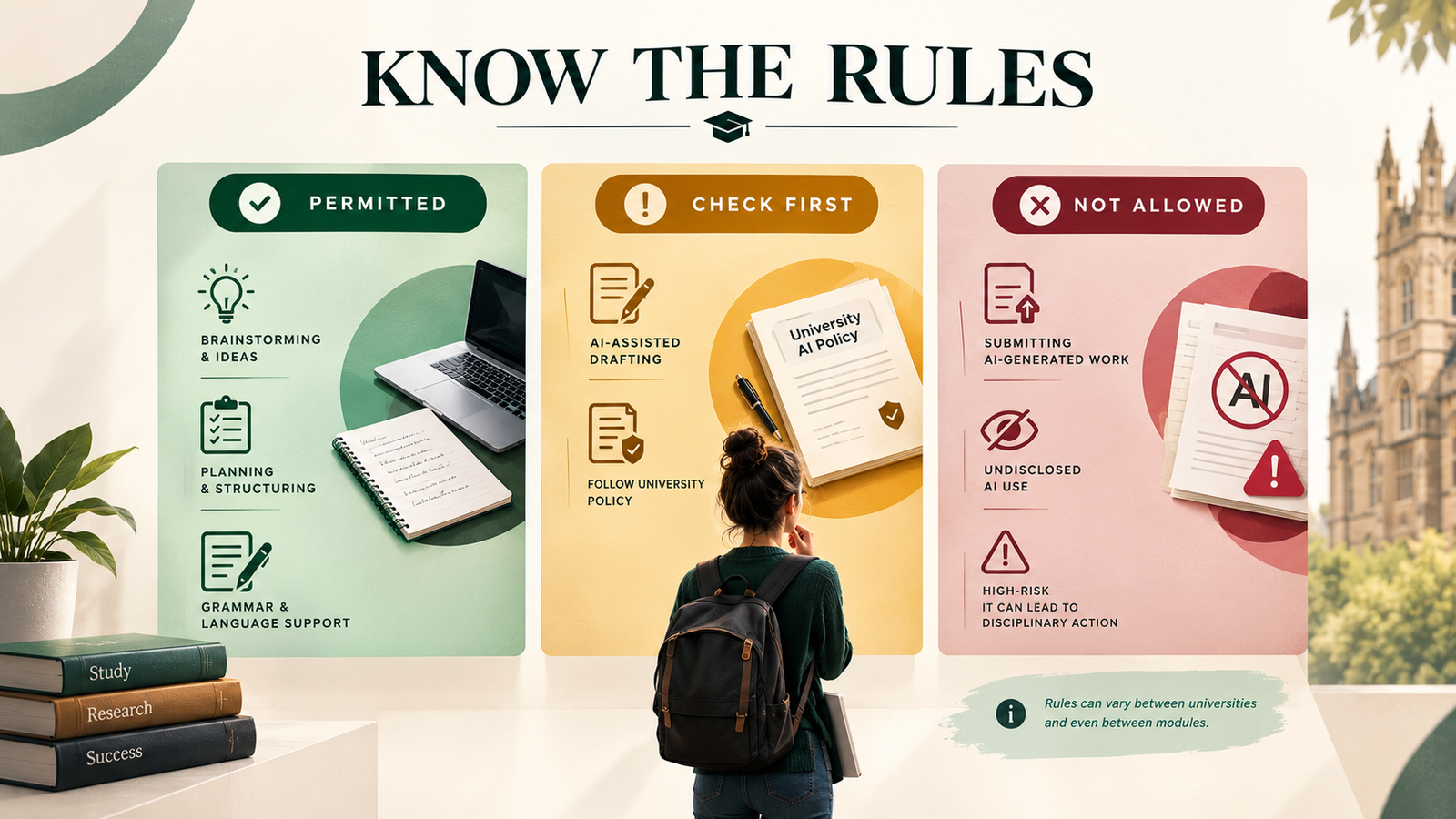
LSE—Continuing Positions and Updated Assessment Safeguards
LSE’s 2026/27 guidance continues three authorisation positions: no, limited or full authorised GenAI use. The framework predates this academic year. September 2026 guidance also requires departments to incorporate observed assessment methods to verify programme learning outcomes; it allows different approaches rather than making every assignment an exam.
Departments or course convenors must clarify whether a full prohibition includes grammar and spell-checking tools. The local position and acknowledgement requirements should be communicated to students, including through Moodle.
Official source: LSE 2026/27 guidelines
Your next action: check the course position and the actual assessment format. Prepare to demonstrate the knowledge and decisions being assessed in any observed component. Do not assume that an example of a possible safeguard, such as an oral element, has been adopted on your own course.
UCL—Current Categories Under Review
UCL says its GenAI assessment categories will be reviewed during 2026/27. The current resource still describes three categories and explains that assessment instructions take precedence over its general guidance. A review announcement is not evidence of replacement categories already being implemented.
Official source: UCL current categories and review notice
Your next action: follow your current task instructions and check for an implemented update. For example, CLIE’s published 2026/27 policy sets specific assessment and language-review boundaries, including restrictions for Modern Foreign Language modules. That is a CLIE example, not a rule for every UCL module.
Departmental example: UCL CLIE 2026/27 policy
| Institution | Status | Student Action |
|---|---|---|
| Liverpool | Published 2026/27 implementation requirements and defined defaults. | Read the official tier meaning, Canvas information and assessment brief together. |
| LSE | Existing authorisation positions; September 2026 safeguards update. | Check local authorisation and the assessment format actually set. |
| UCL | Current framework with a planned 2026/27 review. | Do not treat a planned review as permission to use a different framework. |
Table 1C. Current implementation, continuing requirements and planned review.
Find the Rules That Apply to Your Assessment
Start with a small set of identifying details: institution, programme, module, assessment title and applicable year. Then find the relevant official guidance and your task instructions. A page headed “2026/27” may be current, but you still need to know whether your assessment falls within its scope.
Do not assume a universal document hierarchy. Liverpool identifies a particular assessment-code appendix as taking precedence over its guidance; UCL says task instructions take precedence over its category resource. Use the precedence rules your own institution states. If a brief seems inconsistent with central policy, ask the teaching team to reconcile them rather than deciding that one always overrides the other.
A useful clarification request identifies the proposed function, affected component and uncertainty: “For [assessment], may I use [feature] to [action]? The brief says [wording], while [official source] says [wording]. Which instructions apply, and what record is required?” Keep the answer with the documents it clarifies.

Four Situations Where Students Can Misread the Rules
| Situation | Verified Example / Limit | What to Do |
|---|---|---|
| A brief is silent | Glasgow states a default for unsupervised work. This is not a rule for other institutions. | Check your own institution’s stated default and ask if scope is unclear. |
| Work crosses academic years | Glasgow’s notice distinguishes assessments set in 2025/26 from the new framework. | Confirm the applicable version for a resit, deferral or continuing task. |
| A group member uses AI | Manchester requires leads to explain group approaches and records. | Agree a process using the course instructions; keep contributions identifiable. |
| An embedded feature changes | Greenwich distinguishes assistive functions, editing and agentic tools. | Check the actual function and support arrangements, not the product name alone. |
Table 2. Institutional examples identify questions; they do not create transferable permission.
Consider a student completing a deferred task in October. The calendar date alone does not establish the applicable policy. They should identify when the assessment was set and ask the course team whether the current framework or an earlier version governs it. This is an illustrative decision process, not a conclusion about every deferred assessment.
For a group project, do not wait until submission to discover that one person generated a section or uploaded shared material. Ask what the assessment permits, how the group must disclose use and whether records are collective or individual. Manchester’s policy also requires prior agreement from group members before recording or transcribing their conversations.
For tools embedded in ordinary software, describe the feature: dictation, grammar suggestions, rewriting, generated slides or a multistep agent. Greenwich’s guidance normally permits assistive functions subject to instructions and support arrangements, distinguishes AI-enabled editing, and requires explicit permission for agentic AI. If a restriction appears to conflict with agreed accessibility support, ask the module team and support service to clarify its application.
Official source: Greenwich tool functions and permitted uses
An approved account does not settle assessment permission or what material may be shared. Describe both the action and the input when asking for clarification.
What Students Should Do Now
Use this record for each assessment rather than creating one rule for your entire degree. Some entries organise your work; retain or submit records only as your institution requires.
| Action | Information to Note | When |
|---|---|---|
| Find the applicable instructions | Task, module, year, source location and policy version. | Before using the disputed feature. |
| Define the proposed use | Tool function, activity, input material and affected component. | Before deciding that a general label covers it. |
| Confirm the boundaries | Permitted activity, restrictions and any required AI engagement. | At the start; again after an official clarification. |
| Check agreed support | How access arrangements apply to the task and feature. | Early enough to resolve uncertainty. |
| Keep the required evidence | Declaration/reflection fields and any specified prompts or drafts. | During the work, following local instructions. |
| Review the final submission | Accurate account of use, requested records and correct placement. | Before uploading. |
Table 3. Suggested organisation; institutional requirements determine what is mandatory.
Make the record specific enough to act on. “AI allowed” leaves too much unresolved. “Feedback on my own draft allowed; generated analysis excluded; reflection required” gives you practical boundaries, provided those are the actual instructions for your task. The example is illustrative, not a permission statement.
Keep the learning question separate from the policy question. After establishing permission, consider how you will evaluate suggestions and explain your own decisions. Our student critical-thinking guide explores that part of the process without replacing institutional rules.
Further reading: AI and critical thinking— a student’s self-check
Final Word—Follow the Evidence, Keep Your Responsibility
The most useful response to changing AI policies is a clear account of your own task: which instructions apply, what assistance you intend to use and how you remain responsible for the result. A new label or tool does not remove the need for that judgement. Keep asking precise questions, retain the records your assessment requires and revisit the official guidance when circumstances change. Clarity comes from connecting the current rule to the work you are actually doing.
Frequently Asked Questions
Does Access to a University AI Tool Mean I Can Use It in Every Assessment?
Do not infer task permission from access alone. Read the assessment instructions and identify the actual function you plan to use. The same account may support revision, feedback or generation, but those activities can have different boundaries. Ask your teaching team about an unclear activity and any restrictions on the material you would upload.
Does a New Policy Apply to My Resit or Deferred Assessment?
Check the transition arrangements and the year under which the task was set. Glasgow’s implementation notice explicitly retains earlier guidance for assessments set in 2025/26 until marked. Other institutions may use different arrangements. Give your course team the assessment title and original year, then ask which version governs the resit or deferral.
Can Different Modules at the Same University Have Different Rules?
Yes, local variation can be explicit. LSE’s guidance allows different course positions within its framework, while UCL’s category resource recognises assessment-specific conditions. Check each task rather than reusing a permission from another module. If a general page and a module instruction appear inconsistent, request clarification using both passages.
Does an AI Declaration Make Otherwise Prohibited Use Acceptable?
No. Permission and disclosure are separate requirements. An account of how a tool was used does not change a restriction on the activity. Confirm permission first, then follow the required acknowledgement or reflection process. If you discover a possible breach, seek advice from your institution rather than writing a statement that conceals what happened.
What if My University Is Not Included in This Guide?
Use its official student guidance, academic regulations and module assessment information. Check applicability and dates, then ask the module team about unresolved points. These seven examples show the kinds of differences to look for; they do not supply permission elsewhere. A policy summary is most useful as a route back to the relevant official instructions.