
Writing a university assignment in UK can feel confusing at first. Many students lose marks simply because their structure feels unclear. British universities expect a certain format. This includes a strong introduction, clear body paragraphs, a solid conclusion, plus proper referencing. Our guide breaks everything down into small, easy steps. You will learn how to organise ideas smoothly. We also explain how markers judge your work. Formatting mistakes are common, but avoidable. This resource helps you write with confidence. It will provide you complete guidance on how to structure a university assignment. Soon, your assignments will look neat, professional, and well planned. Let’s start building better academic writing together.
When you start a university assignment, the first thing you need is a clear structure. This means organising your ideas in a logical order so your reader can follow your thinking from start to finish. Most UK university assignments follow three main parts.
Having a proper structure matters for many reasons. It helps your tutor understand your work easily. It also helps you stay within the word limit and cover all the important points without repeating yourself. A well organised assignment shows that you can think critically, which is something UK universities value highly when giving marks. In simple words, a good structure is not just about formatting your paper. It is about presenting your ideas clearly so your reader understands your thinking and you get better grades.
Table of Contents
Toggle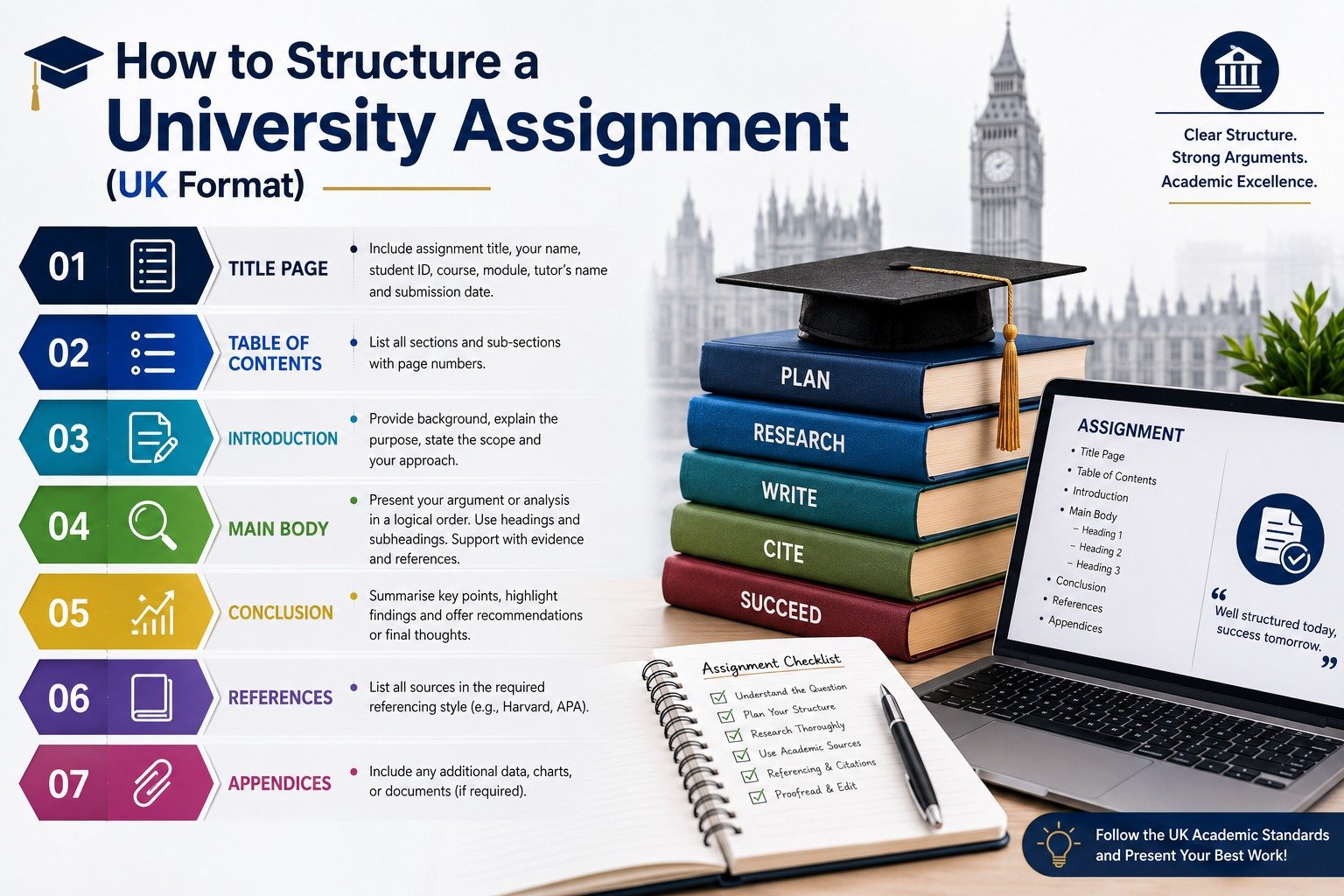
A UK university assignment writing follows a formal academic format that is different from general essay writing. It usually includes specific sections, a set referencing style, and clear formatting rules set by your department. Following this format correctly is important because markers check both content and presentation when giving grades. The academic assignment layout covers formatting details like font size, line spacing, headings, and page numbers required for university submissions.
Key elements usually include:
Not every university in the United Kingdom expects the same thing from a dissertation. Requirements can vary based on word count, formatting rules, referencing style, and even chapter structure. A dissertation for an undergraduate degree in psychology may look very different from one written for a master’s degree in business or engineering.
Some universities expect a strong theoretical focus, while others place more importance on practical research or case studies. Because expectations vary so widely, students are strongly encouraged to check their own university handbook and speak with their supervisor before starting, rather than relying on general assumptions.
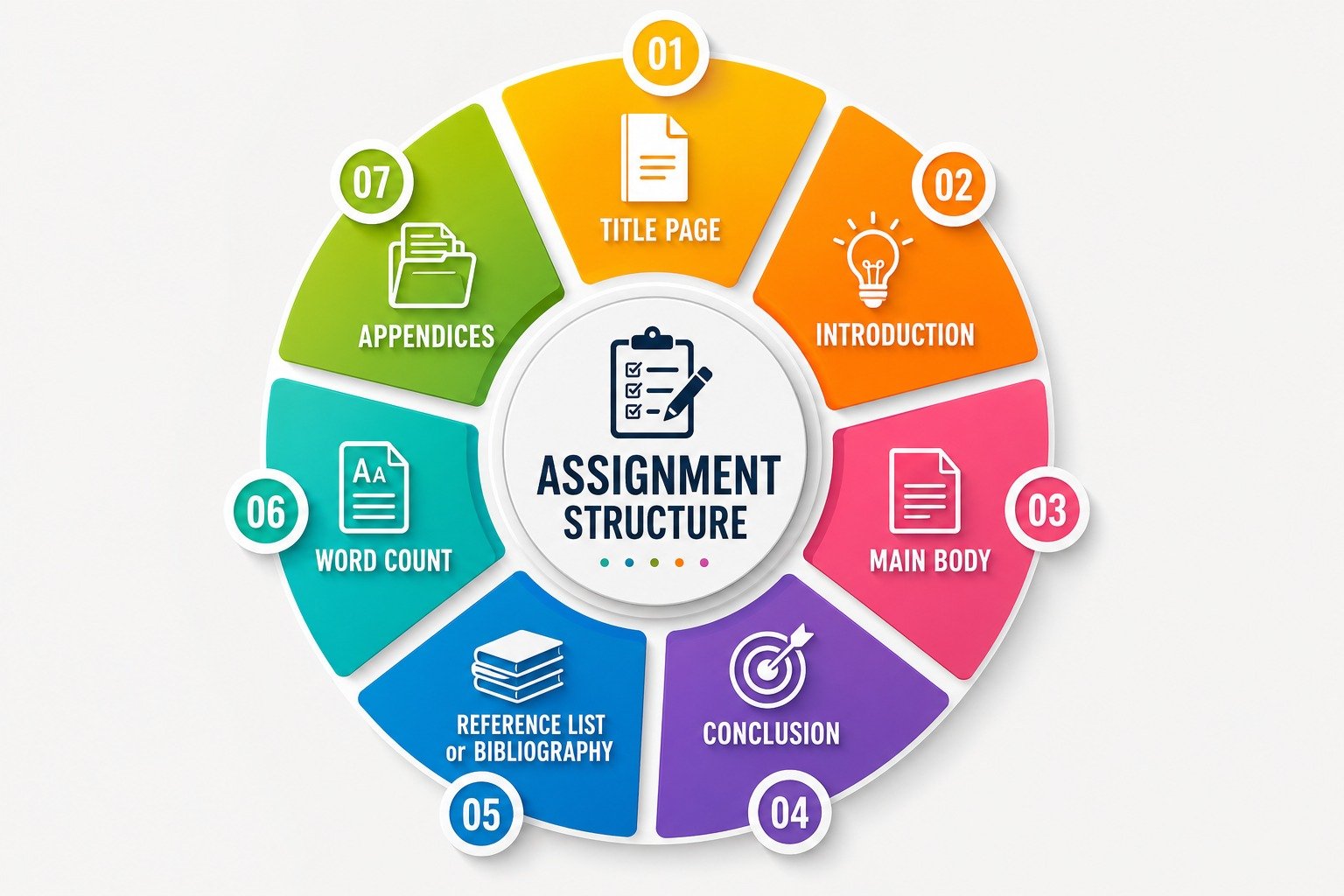
The title page is the first thing your marker sees, so it must be accurate and complete. It usually includes your module code, module name, the exact assignment title given by your tutor, and your student ID number. UK universities use ID numbers instead of names to keep marking anonymous and fair. You should also add the word count and the submission date. Some departments ask for the course name or programme too. Always check your written brief, since formatting expectations can differ between departments. A missing or incorrect title page can create confusion during submission and grading.
The introduction sets the tone for your entire assignment. It should briefly explain the topic, state the purpose of your writing, and outline how you plan to answer the question. A good introduction does not go into deep detail yet. Instead, it gives your reader a roadmap of what to expect in the main body. Many students make the mistake of writing a long introduction, but markers usually prefer it short and focused, often around ten percent of your total word count. Ending your introduction with a clear thesis statement helps guide the rest of your writing smoothly.
The main body carries most of your word count and academic weight. It should be divided into paragraphs, each focusing on one central idea supported by evidence, examples, or research findings. Strong paragraphs usually follow a clear pattern, starting with a point, followed by explanation, then evidence, and finally a short link back to the question. In text citations must appear wherever you use someone else’s ideas or data. Logical paragraph order matters greatly, since jumping between unrelated points can confuse your reader and lower your marks for coherence and structure.
The conclusion brings your assignment writing to a close by summarising the key points discussed in the main body. It should directly answer the original question without introducing new arguments or evidence. A strong conclusion reflects back on your introduction and shows how your discussion supported your original aim. Many UK markers specifically check whether your conclusion matches your introduction in tone and focus. Avoid vague statements here. Instead, be precise about what your assignment achieved and, where relevant, briefly mention any limitations or areas that could be explored further in future study.
Every source you use must be listed accurately at the end of your assignment. Reference styles differ across UK universities, with Harvard, APA, and OSCOLA being common choices depending on your subject. Each entry should include the author, year, title, and publication details, formatted consistently throughout. Accuracy matters because incorrect referencing can lead to accusations of poor academic practice or even plagiarism. Many students use referencing tools to stay organised, but checking each entry manually is still important. A properly formatted reference list also shows examiners that you engaged seriously with credible academic sources.
Word count rules affect how you plan and write your assignment. Most UK universities exclude references, appendices, and sometimes the title page from the total count, but this varies by department. Going significantly over or under the word limit can result in penalties, so checking your specific guidelines early is essential. Word count discipline also encourages clearer writing, since you must express ideas concisely rather than repeating points. Many students track their word count throughout the writing process rather than only checking it at the end, which helps maintain better balance across sections.
Formatting might seem like a small detail, but it directly affects readability and professionalism. The assignment format for university students sets clear expectations for structure, referencing, and presentation. Common requirements include using a 12 point font such as Times New Roman or Arial, along with double or one-and-a-half line spacing. Page numbers are usually required, often placed in the footer. Margins should be consistent, and headings should follow a clear hierarchy if used. These rules make your assignment easier to read and mark. Ignoring formatting guidelines can create a negative impression, even if your content is strong, so always confirm requirements in your assignment brief.
Appendices hold extra material that supports your assignment but would disrupt the flow if placed in the main body. This can include raw data, survey questionnaires, detailed charts, or transcripts. Each appendix should be labelled clearly, such as Appendix A or Appendix B, and referred to at the relevant point in your main text. Appendices are not usually included in your word count, but they should never contain essential arguments or conclusions. Their purpose is to provide supporting evidence for readers who want deeper detail, not to replace clear explanation within your main assignment.
A strong introduction clearly explains your topic and why it matters. The assignment introduction structure typically includes the topic, the aim of the assignment, and a brief outline of what will be discussed. State the purpose of your assignment so your reader knows what you plan to explore or argue. Briefly outline how you will approach the topic, mentioning key themes without going into detail. End with a clear thesis statement that reflects your main position. Keep it short, usually around ten percent of your word count, and avoid adding background details that belong in the main body instead.
The main body is where you build your argument in detail, and each paragraph should focus on just one main idea. A clear way to organise this is to start with a topic sentence that states your point, followed by an explanation, then supporting evidence such as research, data, or examples from credible sources. Always include in-text citations when using someone else’s work, since this shows your argument is backed by proper academic support rather than personal opinion alone.
Beyond individual paragraphs, the overall flow of your main body matters just as much. Ideas should move in a logical order, with each paragraph connecting smoothly to the next using clear linking sentences. This helps your reader follow your reasoning without confusion. It is also important to briefly link each point back to the assignment question, showing relevance throughout. Avoid cramming multiple ideas into one paragraph, as this weakens clarity. A well-structured main body demonstrates strong analytical thinking, which markers value highly when assessing coherence and depth.
A clear conclusion brings your assignment to a proper close by summarising the main points you discussed in the body. It should directly answer the original assignment question without introducing any new ideas or evidence at this stage. Reflect briefly on how your discussion supported your original aim, keeping the tone consistent with your introduction. Avoid vague or general statements, and instead be precise about what your assignment achieved. Where relevant, you can briefly mention limitations or areas for further research, but the main focus should remain on giving your reader a confident, final answer to the question.
Referencing is an essential part of academic writing in British universities, as it shows where your information and ideas come from while avoiding plagiarism. Different universities and subjects often require different citation styles. Harvard referencing is one of the most common styles, using author name and year within the text and a full reference list at the end.
APA style is often used in psychology and social sciences, while OSCOLA is specifically used for law assignments, focusing on footnotes rather than in text citations. Some subjects may also use Vancouver or Chicago style, especially in medical or historical studies. Whichever style your department requires, consistency is key. Every source mentioned in your text must appear in your reference list, and all details such as author, year, and title must be accurate and properly formatted.

Many students find it difficult to balance assignment structure, referencing, and academic tone while managing deadlines and other coursework. In such cases, seeking professional guidance can make a noticeable difference in quality and confidence. Academic support & proofreading service from expert academic writers is the best solution to get good grades.
Oxford Editors offers expert assignment writing support for UK students who want detailed feedback on structure, clarity, and referencing accuracy. Getting a second, experienced opinion before submission can help students identify weak areas early and submit work that better reflects their true understanding and effort.
A well structured assignment is more than just following rules. It is about presenting your ideas in a way that is clear, logical, and easy for your reader to follow. From a properly formatted title page to a focused introduction, a well organised main body, and a precise conclusion, every section plays an important role in how your work is understood and graded.
Paying attention to referencing, formatting, and word count shows academic discipline, while avoiding common structural mistakes helps your arguments stand out clearly. Whether you choose to refine your work independently or seek support from experienced editors, taking structure seriously is one of the simplest ways to improve your grades. In the end, a strong structure does not just organise your assignment; it strengthens your entire academic voice.
Struggling to structure your assignment perfectly? Oxford Editors offers expert academic support to help you improve clarity, referencing, and overall structure. Get personalised feedback from experienced editors and submit your work with confidence. Contact Oxford Editors today and take the stress out of academic writing.
Most UK assignments follow an introduction, main body, and conclusion, along with a title page and reference list formatted to academic writing standards.
An assignment introduction is usually around ten percent of the total word count, focusing on the topic, aim, and brief outline of the discussion.
UK universities commonly use Harvard referencing, though APA, OSCOLA, and Vancouver styles are used depending on the subject and department guidelines.
Most universities exclude references and appendices from the total word count, but this can vary, so checking your specific assignment brief is recommended.
A strong conclusion should never introduce new arguments or evidence, and should only summarise points already discussed in the main body.
Proper formatting, including font size, spacing, and page numbers, improves readability and reflects academic professionalism, which markers consider during assessment.
Yes, professional editing & proofreading services in UK by Oxford Editors can help students strengthen structure, clarity, and referencing accuracy before final submission.