
An academic editor can identify language and presentation problems in your assignment, but the support you may use depends on your university’s rules. Some assessments allow limited proofreading suggestions. Others restrict paid services or direct changes to the text. Your ideas, evidence and conclusions must remain your own.
Before booking academic editing for assignments, check what your institution permits. Then agree on a clear scope. The examples below explain what a correction does, when a comment is more appropriate, and where a change would affect your academic meaning.
A service called “editing” can cover anything from spotting a typo to reorganising a chapter. Your university may permit only a small part of that work. The service name alone does not establish permission.
Table of Contents
ToggleFor example, the University of Dundee’s proofreading guidance allows proofreaders to identify certain errors and suggest technical corrections. It generally requires comments rather than direct edits. Rewriting, changing ideas and rearranging paragraphs fall outside that scope.
By comparison, Swansea University’s proofreading policy restricts professional proofreading services for taught undergraduate and postgraduate students, with specified exceptions. It provides separate guidance for postgraduate research students.
These are examples of different institutional rules, not a checklist of permission for every UK student. Read your course handbook and assessment instructions. If the position is unclear, ask your tutor or academic support team before sharing your draft. Check any approved disability-related support arrangements separately.
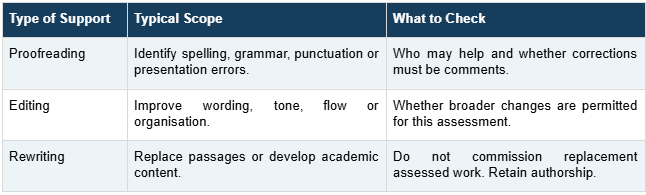
Proofreading usually focuses on surface errors. Editing can involve broader changes to language, organisation or style. Rewriting can replace the author’s wording or intellectual contribution. These terms overlap in commercial services, so ask what the provider will actually do.
For assessed work, the permitted actions matter more than the label. Even a change that preserves meaning may be outside your assessment rules if a third party makes it directly. Oxford Editors describes its proofreading and editing support as covering language, clarity and presentation. Share your university’s policy so the requested scope can be considered against it.
Table 1. Compare the scope before choosing support.
The following examples are invented for explanation. They are not client assignments, testimonials or evidence of grade improvements. The “after” wording shows a possible student revision after feedback, where that feedback is permitted. It does not imply that an editor may make the change directly.
Before: “The participants was asked to complete a questionnaire.”
Possible Student Revision: “The participants were asked to complete a questionnaire.”
Why It Changes: The plural subject “participants” needs the plural verb “were”. The activity and its meaning stay the same. An editor can identify the agreement error where policy permits. The student should understand and review the correction.
Before: “The report examines employement patterns however the sample is small.”
Possible Student Revision: “The report examines employment patterns. However, the sample is small.”
Why It Changes: The revision corrects “employment” and separates two complete statements. It keeps the original limitation. Removing the small-sample warning would change the claim, rather than simply correct its presentation.
Before: “The students discussed the findings with their supervisors after they changed their approach.”
Appropriate Comment: “Who changed their approach: the students or the supervisors?”
Why a Comment Helps: The editor cannot know what “they” refers to. Choosing an answer would introduce an assumption. The student must clarify the sentence using their own intended meaning. Sometimes a useful review ends with a question instead of a rewritten sentence.
Before: Two headings at the same level use different font sizes and spacing.
Appropriate Comment: “These headings appear to have different formatting. Check the required heading style in your assignment brief.”
Possible Student Revision: Apply the required style consistently, if the headings belong at the same level.
Why It Changes: Consistency helps readers recognise the document’s structure. However, identifying a formatting problem and reformatting the document are different actions. Check which is permitted. For help with the overall layout, consult our assignment structure guide.
Before: “The findings suggest a relationship between attendance and performance.”
Change to Avoid: “The findings prove that attendance improves performance.”
Why It Crosses the Boundary: “Prove” is stronger than “suggest”. The revised sentence also asserts an effect that the original does not establish. Better-sounding language cannot justify a different interpretation. Keep the claim’s uncertainty, or revisit the evidence yourself with appropriate academic guidance.
You remain responsible for answering the assignment question and deciding what your evidence supports. An editor should not supply a missing argument, invent a reference, correct your results or write a stronger conclusion on your behalf.
A polished sentence can still be academically wrong. If a passage needs new research or a different interpretation, return to your sources and seek the support your university provides. Keep that work separate from a language review.
The same principle applies to unclear reasoning. A comment may be useful if your policy allows it, but detailed advice about content or structure can itself exceed permitted proofreading. Student approval of a change does not automatically make the assistance acceptable.

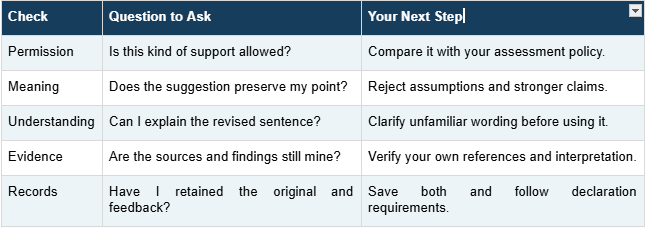
Keep the original draft and the reviewed version. Read each suggestion in context before applying it. A correction should leave you able to explain both the sentence and the academic point it makes.
If you disagree with a suggestion, leave it out or ask for an explanation. You do not need to accept every comment. Before submission, read the complete assignment again so your final wording remains consistent.
Table 2. A checklist for reviewing feedback.
Share the assignment brief, your university’s policy and your deadline. Ask whether the proposed review will use comments, tracked suggestions or direct corrections. Agree on the scope and price before work begins. Request an explanation of any change that could affect your meaning.
Your university’s assessment rules still apply. Being an international student does not automatically permit third-party editing. Ask your academic support team what language help is available and whether external proofreading is allowed. If permission is granted, share the policy with the proofreader before any review begins.
No. Track Changes records edits, but it does not establish permission. A university may require comments only, restrict the type of feedback, or prohibit professional services. Check both the actions allowed and the required delivery format. Keep records of permitted feedback and the revisions you make yourself.
Do not assume this is permitted. Removing content or rewriting passages to reduce the word count can affect your academic work. Dundee’s guidance, for example, excludes changing content to meet a word limit. Check your own policy and make decisions about what to remove yourself, using approved academic support where needed.
Follow your university’s declaration and acknowledgement instructions. Requirements may differ by course and document type. Dundee’s guidance recommends acknowledging third-party proofreading and retaining the suggested changes. If your handbook is unclear, ask where to record the assistance and what details are needed before submitting the assignment.
No editor can guarantee how your assignment will be marked. Correct language does not establish that your research, analysis or answer meets the assessment criteria. Review those requirements yourself and use the academic support available through your university. Treat permitted proofreading as help with identified errors, not a promise of marks.