
To check whether an essay paragraph answers the question, state what it contributes to your answer, then test whether its evidence and reasoning establish that contribution. Try completing: “This paragraph helps answer the question by showing that…” If you can name only a general topic, the paragraph may need a clearer point or a more precise explanation.
Every paragraph should have a defensible purpose within the essay. Some develop a claim directly; others establish a definition, examine an objection or provide context needed for the argument. The aim is to make that purpose clear. Repeating the essay title at the end of a paragraph does not establish relevance.
This practical guide is for UK undergraduate and master’s students. The worked examples use fictional evidence, clearly identified below. Apply the method alongside your assignment brief, marking criteria and subject conventions.
Turn Your Essay Question Into Clear Requirements
Identify The Task Before Checking The Paragraphs
Copy the full question above your draft. Separate what you are writing about from what you must do with it. Identify the instruction, key concepts, scope and any required comparison or judgement. Check accompanying guidance for prescribed sources, cases or learning outcomes.
Consider this teaching question: “To what extent do urban green spaces improve community wellbeing?” A paragraph about attractive parks shares the topic, but the task asks for a judgement about improvement. You need to explain what counts as wellbeing, assess relevant evidence and consider the conditions or limits of any improvement.
| Question Element | What It Requires In This Example |
|---|---|
| Instruction: to what extent | Judge the degree of support and qualify the answer where necessary. |
| Subject: urban green spaces | Keep the analysis focused on green spaces in urban settings. |
| Outcome: community wellbeing | Specify the dimension of wellbeing being examined. |
| Relationship: improve | Assess evidence for improvement; distinguish it from use or popularity. |
| Scope | Avoid generalising beyond the settings and populations supported by the evidence. |
Table 1. A question breakdown. This is an original planning aid, not a universal marking rubric.
Write A Provisional Answer
Write one sentence stating the answer your current reading supports. It can remain provisional: for example, improvement may depend on accessibility and how wellbeing is measured. Use it to locate each paragraph’s role. Revise the answer if the evidence requires it rather than forcing every source to support your initial view.
See University of Sheffield’s essay planning guidance for support with analysing a question and organising an argument around its requirements.
State What Each Paragraph Contributes
Use The Contribution Sentence
Number your body paragraphs. For each one, complete the test sentence in a margin comment: “This paragraph helps answer the question by showing that…” Finish with a specific point. “It discusses green spaces” identifies the subject matter. “It shows why higher park use alone cannot establish improved wellbeing” identifies a contribution to the judgement.
Read the paragraph again to check whether it actually establishes that point. A persuasive margin note cannot compensate for missing reasoning in the text. If the note expresses an argument you intended to make but never wrote, revise the paragraph so readers can follow it.
Check The Topic Sentence Against The Actual Content
A topic sentence should give readers an accurate sense of the paragraph’s focus. “Green spaces have many benefits” promises a broad discussion. “Evidence of increased park use must be distinguished from evidence of improved wellbeing” establishes a precise analytical task. The rest of the paragraph must then perform that task.
If the opening promises a comparison but the paragraph describes only one side, you have found a mismatch. Rewrite the opening when the content is valid but the promise is wrong. Develop the content when the promised comparison is necessary to answer the question.
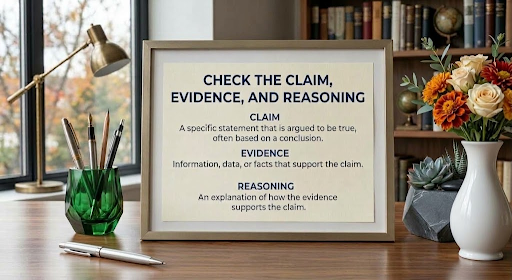
Check The Claim Evidence And Reasoning
Test What The Evidence Actually Supports
Identify the material supporting the point: a study, text, theory, case, dataset or other evidence appropriate to your discipline. Ask whether it addresses the same outcome, setting and comparison as the claim. A source about visitor numbers cannot by itself support a claim about improved mental wellbeing.
Separate the source’s finding from your interpretation. Keep attribution clear and preserve relevant limitations. If evidence supports a narrower claim, narrow your point or find suitable additional evidence. Do not expand a source’s meaning to fit a topic sentence.
Explain The Connection
Find the sentence that explains why the evidence matters for this question. It may establish a mechanism, expose a limitation, distinguish interpretations or weigh competing accounts. If the paragraph ends after reporting a source, ask what the reader must infer and write the necessary explanation.
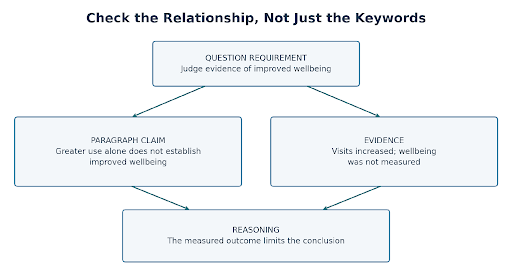
A useful draft prompt is: “This matters for the question because…” Replace it with natural prose in the finished essay. For example: “The absence of a wellbeing measure limits what the increased attendance can establish about improvement.” This explains a specific evidential boundary.
Check The Strength Of Your Judgement
Look for a conclusion stronger than the paragraph’s evidence. “Proves”, “always” and “causes” need appropriate support. Equally, vague language can hide the contribution: “This is important” gives readers no reason. State what the evidence allows you to conclude and what remains uncertain.
The University of Portsmouth’s paragraph guidance explains the relationship between a paragraph’s point, supporting material and analysis. Paragraph models can be adapted to the task.
Undergraduate Example From Description To A Relevant Argument
Question: “To what extent do urban green spaces improve community wellbeing?” Fictional evidence for this exercise: an evaluation reports increased visits after a park refurbishment but does not measure wellbeing. A separate interview exercise reports that some residents avoid the park because they feel unsafe. These are invented teaching details, not research findings or sources to cite.
A Paragraph That Stays On Topic But Misses The Task
“Urban parks contain paths, seating and open areas. Refurbishment can introduce new facilities. In the evaluation, visits increased after the refurbishment. Some residents also discussed the park in interviews. Green spaces are therefore important for community wellbeing.”
The paragraph describes the setting and reports attendance, then jumps to a wellbeing conclusion. The final sentence contains words from the question but does not explain the relationship. The interview reference contributes little because it omits what the accounts reveal.
A Revised Paragraph
“Increased use of a refurbished park is insufficient on its own to establish improved community wellbeing. The evaluation recorded more visits but did not measure wellbeing, so its findings demonstrate greater use rather than the outcome the question asks about. Interview accounts of feeling unsafe also suggest that opportunities to benefit may be uneven. Together, these findings limit the case for assuming that refurbishment improves wellbeing across the community; direct outcome measures and attention to access are needed to assess that claim.”
| Part Of The Revision | What It Contributes |
|---|---|
| Opening sentence | States a point about the evidence needed to answer the question. |
| Evaluation and explanation | Separates the measured outcome from the claimed outcome. |
| Interview accounts | Introduces a relevant qualification about access. |
| Closing judgement | Explains how the evidence changes the extent of the claim. |
Table 2. Functions within the revised undergraduate paragraph. A real essay would cite the actual evaluation and interview evidence.
The revision does not establish that parks provide no benefit. It establishes that these particular findings cannot justify a broad improvement claim. This distinction keeps the judgement proportionate and gives the paragraph a clear role in the essay.
Master’s Example Making The Required Comparison
Question: “Critically compare centralised and decentralised decision-making in multinational organisations.” For this fictional exercise, one case describes local managers approving a supplier change quickly. Another describes headquarters reviewing supplier changes to maintain common standards. No measured response times, quality outcomes or wider organisational effects are supplied.
A Paragraph That Covers Only One Side
“Decentralised decision-making gives local managers authority. In the first case, a local manager approved a supplier change quickly. Local knowledge is useful in multinational organisations. Decentralisation is therefore the better approach.”
The question asks for a critical comparison, but the paragraph discusses only decentralisation. It does not define “better”, compare the approaches against a shared criterion or assess the limits of the case evidence. An example of one quick decision cannot establish general superiority.
A Revised Comparative Paragraph
“The two arrangements allocate the balance between local response and common oversight differently. The decentralised case illustrates a local manager approving a supplier change without the headquarters review described in the centralised case. This gives a reason to examine whether local authority reduces approval delays, while central review may support consistent standards. However, the accounts provide no comparable timings or quality outcomes, so they cannot establish which arrangement performs better. The comparison therefore identifies a potential trade-off whose significance depends on the organisation’s priorities and stronger evidence of outcomes.”
The first sentence establishes the shared comparison. The case details identify a difference, and the interpretation explains why it might matter. The limitation specifies missing evidence. The final sentence gives a qualified judgement about what the comparison establishes.
At master’s level, a paragraph may need to examine assumptions, theoretical explanations or differences in evidence quality more deeply. Add those where the assessment calls for them and sources support them. Complexity of wording alone does not demonstrate critical analysis.
Diagnose Why A Paragraph Misses The Question
Choose the revision that addresses the actual problem. Adding a sentence containing “therefore” will not repair evidence that supports a different claim. Use this table after identifying the paragraph’s intended contribution.
| Problem | Diagnostic Sign | Appropriate Revision |
|---|---|---|
| Topic drift | The paragraph concerns the broad subject but no question requirement. | Refocus it around a necessary point or remove it. |
| Description without analysis | Sources are reported, but their relevance is unexplained. | Explain what the evidence establishes for the answer. |
| Unsupported claim | The main point goes beyond the cited material. | Narrow the claim or obtain suitable support. |
| Missing comparison | A comparative question receives a one-sided account. | Compare using a shared criterion and relevant evidence. |
| Mixed purposes | Two unrelated arguments compete for attention. | Split and develop each necessary contribution. |
| Repeated contribution | A later paragraph adds no evidence or qualification. | Merge or remove the duplication. |
| Weak placement | The point is useful but depends on unexplained material. | Move it and repair the surrounding transitions. |
Table 3. Paragraph problems and targeted revisions.
Read the opening and final sentences together. Does the ending follow from the point and evidence, or has it introduced a different claim? Then read the middle: it must supply the reasoning that connects them. This is a diagnostic check, not a rule requiring identical paragraph shapes.
Check The Whole Essay With A Paragraph Audit
Record The Contribution Of Each Paragraph
A reverse outline records the draft you actually wrote. Summarise each paragraph in one sentence, then record which requirement it serves and what action it needs. The example below audits selected paragraphs from the fictional green-space essay. It is not a full essay plan.
| Paragraph | Actual Contribution | Requirement And Action |
|---|---|---|
| P1 | Defines the wellbeing outcome used in the essay. | Outcome definition: retain if used consistently. |
| P2 | Describes park landscaping history. | No clear role: remove or condense necessary context. |
| P3 | Distinguishes attendance from wellbeing evidence. | Judgement about improvement: retain and cite. |
| P4 | Examines uneven access in resident accounts. | Community scope: develop its significance. |
| P5 | Repeats the attendance limitation from P3. | Duplicate: merge any new detail into P3. |
Table 4. A completed audit identifying useful contributions, drift and duplication.
Look For Missing Requirements
Read the contribution column from top to bottom. Does it form a connected answer? Relevant paragraphs can still leave a requirement uncovered. An essay comparing two approaches might contain several useful paragraphs on one approach and none assessing the other.
For the green-space question, a draft consisting entirely of evidence limitations may need further reading to assess evidence of actual benefits. You cannot complete “to what extent” merely by showing that one evaluation is inconclusive. Identify the gap and research it before writing a conclusion.
The University of Leeds’ revision guidance recommends reverse outlining to check relevance, repetition and the order of ideas.
| Paragraph Number | Specific Contribution | Question Requirement | Evidence Or Gap | Revision |
|---|---|---|---|---|
| P___ | This paragraph shows that… | Instruction, concept, scope or comparison | Identify support or missing material. | Retain, refocus, split, move, merge or remove. |
| P___ | ________________ | ________________ | ________________ | ________________ |
Table 5. Reusable paragraph audit. Copy rows as needed and remove working notes from your submitted essay.
Keep Useful Context And Counterarguments
A definition contributes when later analysis depends on the distinction it establishes. Background contributes when readers need it to understand the argument. Test its necessity by asking which later point becomes unclear without it. Keep sufficient explanation and avoid extending context into an unrelated survey.
A counterargument can directly improve the answer by testing its limits. Keep relevant evidence that challenges your position, then explain whether it changes, narrows or fails to overturn that position. Removing disagreement solely to make the essay appear consistent can weaken the evaluation.
Paragraphs may work together: one establishes a concept, the next applies it. Their contribution can be clear through this local relationship. Check that the section itself serves the question and that readers can follow the connection without guessing.
Run A Final Relevance Check
After revising, reread each paragraph in context. Check that the topic sentence matches its content, the evidence supports the claim and the explanation establishes its significance. Repair transitions after moving material. Verify citations and remove margin comments and audit notes.
For broader organisation, consult Oxford Editors’ assignment structure guide alongside your module requirements.
For attribution checks after revising, Oxford Editors describes its reference and citation support.
For developing your own writing skills, explore its academic writing courses.
For feedback on clarity and paragraph connections in your own draft, explore Oxford Editors’ proofreading and editing support. Check what assistance your assessment permits and make your own analytical decisions.
Frequently Asked Questions
Must Every Paragraph Repeat Words From The Essay Question?
No. Repeated wording can help maintain focus, but relevance depends on the paragraph’s contribution to the answer. A paragraph can repeat key terms while making no useful point. Explain the connection through a specific claim and supported reasoning. Use terminology consistently without mechanically inserting the full question into every paragraph.
Does Every Paragraph Need A Separate Linking Sentence?
Not necessarily. The relationship may already be clear from the topic sentence, analysis or connection to the surrounding paragraphs. Add a linking sentence when it clarifies the contribution, rather than repeating a formula. Follow any paragraph guidance required by your module, while checking that the finished prose remains coherent and purposeful.
Can A Background Paragraph Still Be Relevant?
Yes, when the background is needed to understand the argument that follows. Identify the later claim or distinction it prepares readers to assess. Keep its length proportionate to that purpose. General history or context that the essay never uses may need to be condensed, refocused or removed even when it concerns the same topic.
How Do I Recognise Analysis Rather Than Description?
Description tells readers what a source, case or text says. Analysis explains what that material establishes, how it supports a point or why its limits matter. Both can be useful, but an analytical essay needs their relationship made clear. Ask what conclusion the reader should draw from the material and explain the basis for it.
What If One Paragraph Addresses Two Requirements?
Keep it together if the requirements are closely related and the paragraph develops one coherent point. Split it when it contains separate arguments that need their own evidence or explanation. The aim is clarity, rather than a fixed rule of one question term per paragraph. Check that neither requirement receives only a passing mention.
Should I Remove Evidence That Challenges My Argument?
Retain challenging evidence when it is relevant and credible. Explain how it affects your judgement: it may qualify a claim, reveal a boundary or support a stronger alternative. An essay answers the question through evaluation, so a defensible conclusion may differ from your original view. Do not hide disagreement merely to make the argument look simpler.
Can Relevant Paragraphs Still Leave The Question Unanswered?
Yes. Individual paragraphs may contribute useful points while the essay omits a required comparison, concept or part of a multi-part question. Map the paragraph contributions against all requirements and look for gaps. Also check whether the conclusion gives the judgement requested, rather than summarising material without stating what it establishes.
How Long Should An Academic Essay Paragraph Be?
There is no universal length that guarantees a relevant paragraph. Give a coherent point enough space for the explanation and evidence it needs. Review a very long paragraph for competing arguments, and a very short one for missing development. Use your subject conventions and assignment guidance rather than aiming for an arbitrary sentence count.