
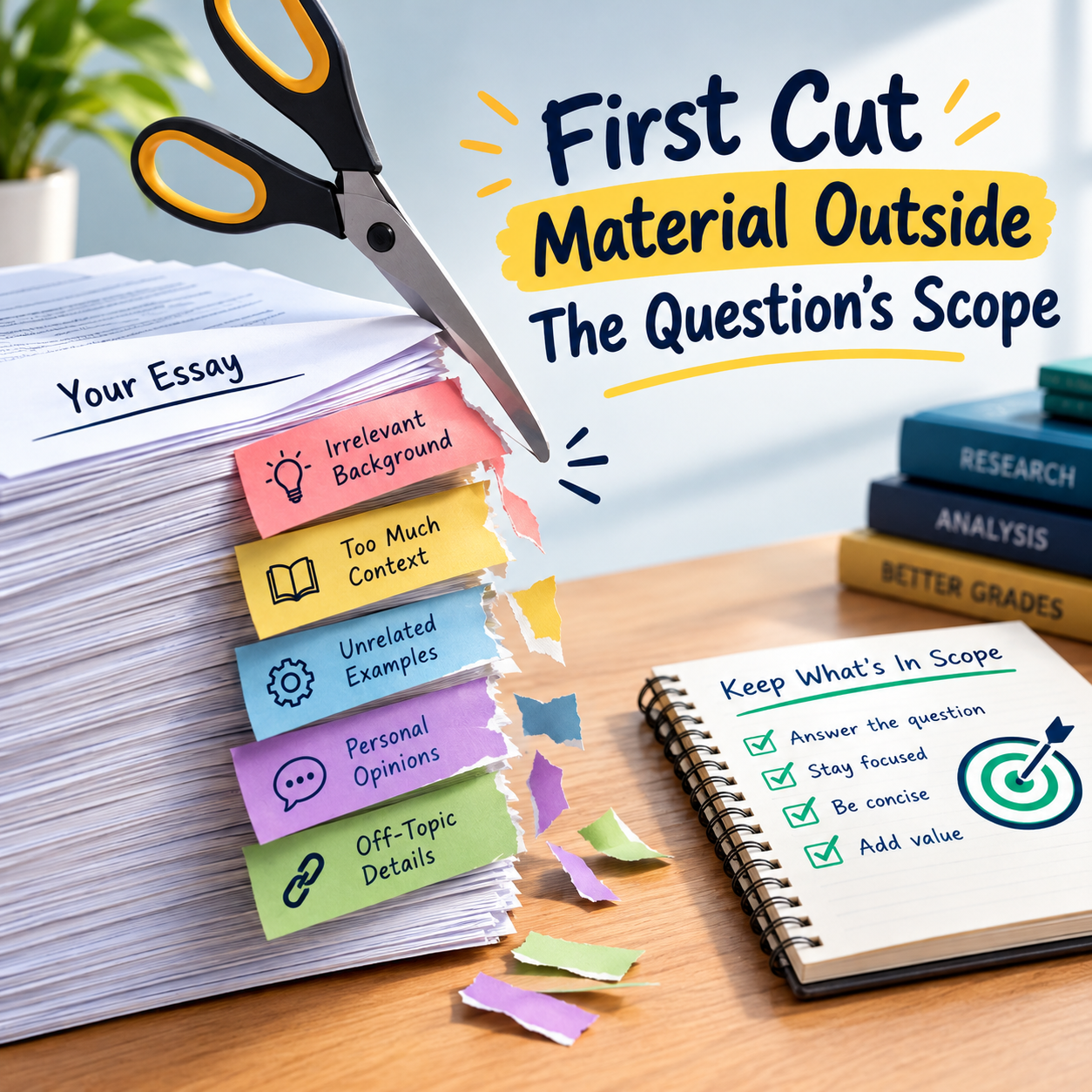
If your essay is over the word limit, first look for material that does not help answer the question and passages that repeat a point already established. Next, condense excessive background and redundant examples. Tighten the introduction, conclusion and transitions before making sentence-level cuts. Protect the evidence and reasoning needed to justify your answer.
To fix an essay over the word limit, remove irrelevant details, repetitive points, unnecessary examples, and lengthy explanations. Keep essential analysis, strong evidence, and arguments directly answering the question. This order is a practical editing method, not a university regulation. Use it alongside your current assessment brief and marking criteria.
The guide is for UK undergraduate and master’s students and uses fresh, fictional examples. Its aim is to help you choose cuts deliberately rather than delete whichever paragraph happens to be longest.
Table of Contents
ToggleCheck whether your essay over the word limit & assignment specifies a maximum, target or range, and which parts count. Read the rules for citations, quotations, headings, footnotes, tables and the reference list. Do not assume there is a 10 per cent allowance because a different module permitted one.
For a hypothetical strict limit of 2,000 words, a counted draft of 2,350 needs at least 350 words removed. Save the original, then count the same included material after each edit. A lower total caused by excluding a different section is not a saving from revision.
If the rules are ambiguous, ask your tutor or programme team. Avoid starting with drastic cuts before you know the actual excess. Where you have time, leave enough opportunity to read the revised essay as a whole before submission.
Table 1. Suggested order of review. If a draft has no tangents, move to the next stage; do not force a deletion in every category.
| Review Order | Look For | Check Before Cutting |
|---|---|---|
| 1. Relevance | Tangents outside the required question or scope | Does a later argument depend on this material? |
| 2. Duplication | A point explained again without development | Does the later passage add a qualification or new evidence? |
| 3. Description | Background or source detail beyond its purpose | Can readers still understand and assess the argument? |
| 4. Examples | Illustrations performing the same function | Does each add a necessary contrast or boundary? |
| 5. Framing | Long introductions, recaps and transitions | Are the position, scope and final judgement retained? |
| 6. Wording | Inflated phrases and redundant sentence parts | Does the revised wording preserve the exact meaning? |

A passage can be accurate and well researched yet unnecessary for this essay. Ask what part of the required answer would become weaker if you removed it. If you cannot identify a contribution, consider deletion. If it supplies one necessary detail, retain that detail in the paragraph that uses it.
Undergraduate teaching question: “Evaluate whether free admission improves access to public museums.” Imagine a draft containing a lengthy account of early private collections, followed by analysis of admission charges and barriers to visits. Unless the historical account explains a barrier assessed later, it may take space from the requested evaluation.
Cut candidate: “Early collectors displayed objects in private rooms. Collections grew through travel and exchange, and some eventually became public institutions. The architecture of museums also changed as collections expanded.” These fictional sentences introduce a history that the proposed argument does not use.
A useful retained point might be: “Here, access means the opportunity to visit, rather than admission price alone.” This establishes the distinction the evaluation needs. In a real essay, cite a definition or conceptual account where it relies on scholarly work. It does not require a broad history of museums.
Do not solve an excess by quietly omitting a country, text or comparison the question requires. You can remove optional detours, but compulsory coverage remains. If you narrow an open question, explain and justify the scope within the assignment’s expectations.
Consult The Open University’s guidance on understanding the question when checking the task and accompanying assignment instructions.
Look for two passages that arrive at the same conclusion using the same explanation. Retain the clearer account and any genuinely new material. A repeated claim does not become more persuasive merely because it appears in another paragraph.
For example, a museum essay might state three times that free admission does not remove transport costs. Keep the developed analysis of that barrier. In the conclusion, retain only the brief implication for your overall judgement. You need not repeat the example and explanation in full.
Distinguish a reminder from duplication. A short reference to an earlier point can help a comparison progress. A full re-explanation often delays the new contribution. Replace it with a precise connection such as “Unlike admission charges, the transport barrier remains in both arrangements,” if the preceding analysis supports this.
Also distinguish repetition from development. A later paragraph showing that a barrier affects groups differently adds a qualification. Preserve that contribution even when it shares vocabulary with an earlier paragraph. If you merge passages, check that each source still supports the claim beside its citation.
See Swansea University’s advice on what to cut for guidance on paragraph purpose, excessive description and repetition.
An evaluative essay needs readers to understand the ideas it examines, but it rarely needs every detail of every source. Identify the finding, concept or assumption your analysis uses. Preserve that material and the information needed to judge its applicability. Condense unrelated details about a source’s wider argument.
For example, if you assess whether a study supports a claim about museum access, its population and outcome measure may matter. A detailed account of the report’s chapter order probably does not. Shortening the summary should leave enough information for your criticism to make sense.
A definition can prevent an essay from treating different outcomes as equivalent. In the museum example, affordability and actual visiting opportunity are connected but distinct. Keep the distinction if your conclusion depends on it. Remove repeated definitions once the term has been established.
If the assessment is primarily descriptive, its required explanation deserves space. The question and criteria determine what matters. This guide’s priority order does not mean that description is always expendable; it means checking whether its detail serves the task.
An extra example is removable when it adds no new reason, contrast or boundary. Judge function before quantity. Three examples can be justified when each tests a different aspect of the argument; one can be excessive when it is only loosely related.
Teaching question: “Discuss how seminar design affects student participation.” Suppose a draft offers three fictional illustrations of the same mechanism: written prompts in a literature seminar, question cards in a history seminar and advanced questions in a philosophy seminar. If the paragraph uses all three simply to illustrate preparation before speaking, one concise illustration may be sufficient.
Do not treat several independent studies as interchangeable merely because they reach similar findings. Their methods, settings or combined evidential weight may matter. You can present them together with clear attribution, but check that compression does not hide differences necessary to your judgement.
| Example Function | What It Adds | Likely Editing Decision |
|---|---|---|
| A second illustration of the same mechanism | Another instance, with no new analytical consequence | Condense or remove if the first is sufficient. |
| A contrasting setting | Tests whether the explanation applies differently | Retain the contrast and explain its significance. |
| A case that challenges the claim | Reveals a limit or competing explanation | Keep enough detail to assess the challenge. |
| A compulsory case or text | Fulfils a specified assessment requirement | Retain relevant coverage; shorten presentation. |
| A loosely related anecdote | Adds interest without supporting the answer | Remove unless its relevance can be established. |
Remove broad statements about the importance of the topic when they do not establish the specific problem. Keep the question, position, scope and necessary definitions. An introduction should prepare readers for the essay you actually wrote, so revise any roadmap that promises material you removed.
Fictional example question: “Is fidelity to the source novel a sufficient criterion for evaluating a film adaptation?”
Original (66 words): Film adaptations of novels have been discussed by many people for a long time. There are many different opinions about whether films should remain close to the novels on which they are based. This essay will consider this debate. It will argue that fidelity alone is an insufficient measure of an adaptation because changes in narrative perspective can serve a coherent interpretation of the source novel.
Revised (28 words): This essay argues that fidelity alone is an insufficient measure of a film adaptation because changes in narrative perspective can serve a coherent interpretation of the source novel.
The edit removes 38 words of general scene-setting while retaining the position and reason. This is a compact teaching extract. A real introduction may also need to identify the texts and define the evaluation criterion; add those if the essay requires them.
In the conclusion, prioritise the answer established by the essay. Condense repeated examples and a paragraph-by-paragraph itinerary. Keep the qualification that materially affects the judgement. In transitions, state the actual connection instead of announcing at length that you will now proceed to another topic.
The Open University’s essay guidance explains the purposes of introductions and conclusions. Treat its general suggestions alongside your module’s requirements.
Once the essay contains the right material, shorten wording that adds no meaning. Work in context: a phrase can be redundant in one sentence and necessary in another. Read the complete revision rather than accepting a lower word count as proof of an improvement.
For the final three complete-sentence examples, the space-separated counts change from 8 to 5, 7 to 5 and 7 to 3 words respectively. Your required software may count differently.
Do not replace “associated with” by “caused”, delete a necessary condition or shorten a technical term into a different concept. The University of Reading’s academic style guidance recommends concise wording while checking that essential information and meaning remain.
| Original | Shorter Wording | Meaning Check |
|---|---|---|
| The purpose of this paragraph is to explain why the distinction matters. | This distinction matters because… | Replace a procedural announcement with the actual explanation; complete the sentence. |
| The essay provides an evaluation of two interpretations. | The essay evaluates two interpretations. | A direct verb replaces a longer noun phrase. |
| This may potentially suggest a possible limitation. | This may suggest a limitation. | Remove stacked uncertainty while retaining “may”. |
| Both interpretations are different from one another. | The interpretations differ. | Remove wording that repeats the comparison. |
A counterargument may be the shortest route to a more accurate answer. Deleting it can make the essay simpler while making the conclusion less defensible. Compress its presentation if possible, but preserve the point that tests or qualifies your position.
Master’s teaching question: “Critically evaluate performance-related pay as a way to improve organisational performance.” Fictional evidence for this exercise: one account reports increased output after a pay change but does not establish whether quality improved or whether other organisational changes contributed. These invented details are not research findings to cite.
Original counterargument (69 words): Although the account describes an increase in output after the introduction of performance related pay, this should not automatically be taken as evidence of improved organisational performance. The account does not establish whether quality also improved. It also does not separate the pay change from other organisational changes. These limitations mean that the apparent increase in output cannot, by itself, demonstrate that the pay arrangement caused better overall performance.
Condensed counterargument (38 words): The reported increase in output does not establish better organisational performance: quality improvement was unconfirmed, and other organisational changes were not separated from the pay change. The account therefore cannot show that the pay arrangement caused the improvement.
The revision saves 31 words while retaining the outcome distinction and causal limitation. Deleting the entire passage would leave the output claim insufficiently qualified. In a real essay, cite the account and represent its actual methods and findings accurately.
| Protect | Why It Matters |
|---|---|
| Required comparison or case | Removing it can leave part of the question unanswered. |
| Evidence for a central claim | Readers must be able to assess the basis of the answer. |
| Reasoning connecting evidence and judgement | Facts alone may not establish your conclusion. |
| A relevant counterargument or limitation | It controls the strength and scope of the claim. |
| Necessary definitions and attribution | They preserve meaning and identify borrowed material. |
After deleting or merging a passage, read the paragraphs around the change. Check whether a later reference to “this distinction” still has a clear meaning and whether a comparison has become one-sided. Repair necessary connections with precise wording.
Compare the revised draft with the full question and criteria. Check that its required parts are covered and that the conclusion follows from evidence still present. Verify citations and review reference-list entries after deleting source-dependent passages. Use your required referencing conventions.
Recount the included material and stop making cuts when further deletion would remove required support. If you remain substantially over the limit, revisit optional scope or seek tutor guidance. Avoid submitting without checking that your final count and declared count agree.
For broader organisation, see Oxford Editors’ assignment structure guide alongside the assessment brief. For attribution checks after cuts, Oxford Editors describes its reference and citation support.
For developing your own editing skills, explore its academic writing courses. For feedback on clarity and repetition in your own draft, explore Oxford Editors’ proofreading and editing support. Confirm what assistance your assessment permits and retain responsibility for the argument.
Only when the current assessment rules explicitly permit it. There is no universal UK allowance for every essay. Check the brief for a maximum range, permitted variation and any penalty. Where the wording is unclear, ask your tutor or programme team rather than applying a rule from another module.
Confirm the counted total, then inspect repetition and inflated wording in the remaining draft. A few precise sentence edits may be sufficient if the structure already works. Do not remove a required citation, condition or analytical explanation to meet a small target. Read the edited passages again to check their meaning.
Begin with whole passages that do not serve the question, repeated arguments and excessive descriptive detail. Then review examples and framing before polishing sentences. The appropriate savings depend on the draft, so do not assign identical cuts to every section. Check that the revised essay still covers all compulsory requirements.
Judge the function of each rather than applying a fixed rule. A lengthy quotation may be paraphrased with attribution when only its idea matters. Exact wording may be essential in textual analysis. An example may supply a necessary contrast or merely repeat an illustration. Preserve what the reasoning actually depends on.
Keep the attribution required for borrowed ideas, findings and quotations. If you delete an entire claim, its citation may no longer be needed there; check the remaining text and reference list. Do not leave a source-dependent statement uncited merely because the count is high. Follow the prescribed style rather than inventing shorter citation forms.