
“Discuss” usually asks you to examine important perspectives, weigh relevant arguments and develop a reasoned answer. “Critically evaluate” asks you to make the judgement especially explicit: assess the strengths, limitations and value of something using suitable criteria and evidence. Both instructions can require critical thinking. Neither is an invitation to list facts or give an unsupported opinion.
The practical difference is what drives your essay writing plan. For a discussion, start with the main issues or debates. For a critical evaluation, start with what you are judging and the criteria you will use. You may still cover similar material, but the questions guiding each paragraph will change.
This guide uses simple examples to understand better essay writing for UK undergraduate and master’s students. The essay questions, plans and sample passages are original teaching illustrations, not published research findings. Use them to understand the approach, then build your own argument from your reading and assessment brief.
Table of Contents
ToggleIn Queen Margaret University’s guide to academic instruction words, discussion includes important aspects, arguments and implications. Critical evaluation explicitly includes assessing evidence and using criteria to guide judgement.
Planning Question | Discuss | Critically Evaluate |
|---|---|---|
What am I doing? | Examining significant perspectives and their implications. | Judging strengths, limitations or value against criteria. |
How do I organise the body? | Often by issues, themes or competing explanations. | Often by criteria, claims or aspects of the object being judged. |
What do I do with evidence? | Compare what supports different views and why it matters. | Assess how convincingly evidence supports each judgement. |
What does the conclusion do? | Answers the question through the discussion. | States the overall judgement, its reasons and limits. |
Table 1. Typical planning emphases. These approaches overlap and are not fixed university templates.
For example, “Discuss the role of group work in university learning” invites you to examine its purposes, possible benefits, concerns and conditions. “Critically evaluate the role of group work in university learning” asks you to judge that role more explicitly: effective for which outcomes, fair to whom, and under what conditions?
The University of Bath guidance on essay instruction words also highlights the overlap. Its discussion guidance points students towards evidence-backed judgement rather than simple description.
The command word is only one part of the task. A good plan also respects the topic, focus and limits. “Discuss remote working” leaves considerable room for interpretation. “Discuss the effects of hybrid working on collaboration in UK software teams” gives you a narrower setting and outcome.
The University of Kent guidance on understanding essay questions recommends identifying the subject, particular aspect, limits, instruction and required module knowledge.
Break your question into four notes: instruction—what thinking is required; topic—what you are examining; focus—which aspect matters; limits—which population, period, setting or sources belong in the answer. Then check the marking rubric for expectations such as use of theory, comparison of evidence or evaluation of methods.
If the question contains two instructions, such as “Describe and critically evaluate”, cover both. Provide enough explanation for the reader to understand the object, then evaluate it. Do not assume the word count must be split equally; use the task and assessment criteria to decide the balance.

Start by identifying the important questions within the topic. Group your reading around those issues rather than creating a separate section for every author. Ask which perspectives deserve attention, what evidence supports them and how they relate to the question.
A useful discussion plan contains an introduction defining the scope and giving a provisional answer; body sections exploring the main issues with evidence and relevant counterarguments; and a conclusion explaining what the discussion establishes. This is a flexible planning aid, not a compulsory three-part formula for every assessment.
For a group-work essay, themes might include learning through explanation, difficulties in participation and the effect of task design. Within each theme, explain the argument, examine evidence and show what follows. A discussion can favour one interpretation when the evidence warrants it. Balanced treatment means fair consideration, not identical space for every position.

First, define what is being judged. It might be a theory, intervention, policy, research method or claim. Next, choose criteria that fit the question. A theory might be judged on explanatory power and supporting evidence; a teaching method on learning outcomes and suitability for its intended context.
Make each criterion specific. “Is it good?” is too vague. “Does it improve the outcome named in the question?” is clearer. Explain why your criteria are appropriate and apply them consistently. Avoid selecting a criterion merely because it makes your preferred conclusion easier to defend.
For each body section, make a judgement, show the evidence behind it, examine relevant limitations or alternatives, and explain the consequence for your overall answer. Your final position might be strongly positive, negative or conditional. Critical evaluation does not require a negative verdict, and uncertainty does not excuse avoiding a judgement.
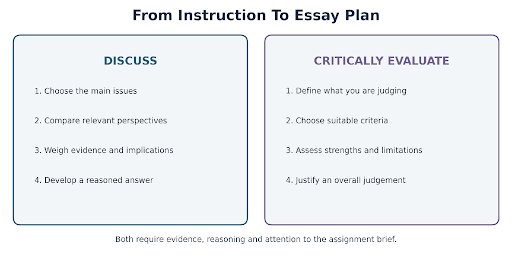
Discuss: “Discuss the role of assessed group work in undergraduate learning.”
Critically evaluate: “Critically evaluate the role of assessed group work in undergraduate learning.”
Keeping the topic the same makes the change easier to see. For both essays, you would read relevant research and your module’s material. The table below shows possible section purposes, not predetermined findings.
Section | Discuss Plan | Critically Evaluate Plan |
|---|---|---|
Introduction | Define assessed group work and identify the main debate. | Define the task and explain the criteria: learning, participation and assessment fairness. |
Body Section 1 | Explore how collaboration might support learning; compare relevant evidence. | Judge the evidence that group work supports the specified learning outcomes. |
Body Section 2 | Examine participation problems and different explanations for them. | Assess participation and fairness using evidence about contribution and marking. |
Body Section 3 | Discuss how task design and support may influence the experience. | Evaluate which design conditions strengthen or limit its educational value. |
Conclusion | Answer what role group work can play and explain the conditions. | Give a reasoned verdict against the criteria, including limits. |
Table 2. Paired undergraduate plans. The evidence you find should determine the final argument.
Discuss: “Assessed group work combines collaborative activity with a shared or individual assessment outcome. This essay examines its possible contribution to learning, concerns about participation and the role of task design. It considers whether these issues support a conditional rather than universal case for its use.”
Critically evaluate: “This essay evaluates assessed group work using three criteria: its contribution to learning, the fairness of participation and the defensibility of assessment decisions. It examines supporting evidence and limitations to judge when group work is an appropriate assessment approach.”
What changed? The discussion introduction maps the debate. The evaluation introduction names the basis of judgement. Neither needs to promise a result before you have examined the evidence. Once your reading supports a position, state that position clearly rather than leaving the introduction as a list of intentions.
Discuss: “Discuss the effects of remote working on collaboration in knowledge-work teams.”
Critically evaluate: “Critically evaluate the effects of remote working on collaboration in knowledge-work teams.”
At master’s level, a useful additional step is checking how the studies define their terms. Fully remote work and hybrid work are different arrangements. Collaboration might mean meeting frequency, knowledge sharing or joint problem-solving. Comparing studies without noticing these differences can produce a misleading argument.
These checks also matter at undergraduate level. The master’s example adds complexity rather than creating a separate set of rules. Your marking criteria determine the expected depth.
Organise the essay around communication, knowledge sharing and coordination. Within each theme, compare explanations for how remote working may affect collaboration. Examine conditions such as task type, team experience and technology. Finish by explaining how these conditions shape the answer to the question.
Organise the assessment around the meaning of collaboration, the strength of evidence for reported effects and the applicability of findings across contexts. Check how outcomes are measured and whether the design supports the authors’ interpretation. Then judge how confidently the evidence can support a conclusion about remote working.
Do not turn this into an unrelated review of research methods. A limitation matters because it changes what you can conclude about the effects on collaboration. Keep returning to that relationship.
Discuss: “The relationship between remote working and collaboration can be examined through communication practices, knowledge sharing and coordination. This essay compares these perspectives while considering how working arrangements and task characteristics shape the debate.”
Critically evaluate: “This essay judges claims about remote working and collaboration by examining how collaboration is measured, how convincingly reported effects are supported, and which settings the findings can reasonably inform.”
For a longer piece of research, Oxford Editors’ guide to dissertation planning provides related guidance on organising a research question and literature review. Follow the structure required by your own programme.
Hypothetical example: “One argument for group work is that explaining an idea to peers can support learning. A different concern is that uneven participation may restrict who benefits. These perspectives suggest that the discussion should examine both the collaborative activity and how contribution is supported, rather than treating all group tasks as equivalent.”
Why it works as a planning model: it connects perspectives and identifies their implications. In the actual essay, supply evidence for the arguments and explain its relevance. This example is not enough by itself to establish that group work improves learning.
Hypothetical example: “Against the criterion of assessment fairness, a shared group mark needs careful justification. If the available evidence records only the final product, it may not establish how contributions differed. The judgement should therefore consider whether the assessment design captures individual participation, while recognising that contribution measures also require scrutiny.”
Why it works as a planning model: it identifies a criterion, explains an evidential limitation and states the consequence for judgement. The conditional wording reflects the hypothetical evidence. Do not copy it into an assignment unless it accurately fits your sources.
Discuss, if supported by the essay: “The discussion suggests that group work has a useful but conditional role in undergraduate learning. Its contribution depends on participation, task design and assessment arrangements, so its value cannot be judged from the label ‘group work’ alone.”
Critically evaluate, if supported by the essay: “Against the criteria of learning, participation and fairness, the case for assessed group work is strongest where the design supports meaningful collaboration and defensible marking. The evaluation therefore supports selective use, while the limitations of the evidence prevent a universal recommendation.”
Both conclusions answer the question. The second makes the criteria and resulting judgement more visible. Neither should introduce a new study or unsupported claim at the end.
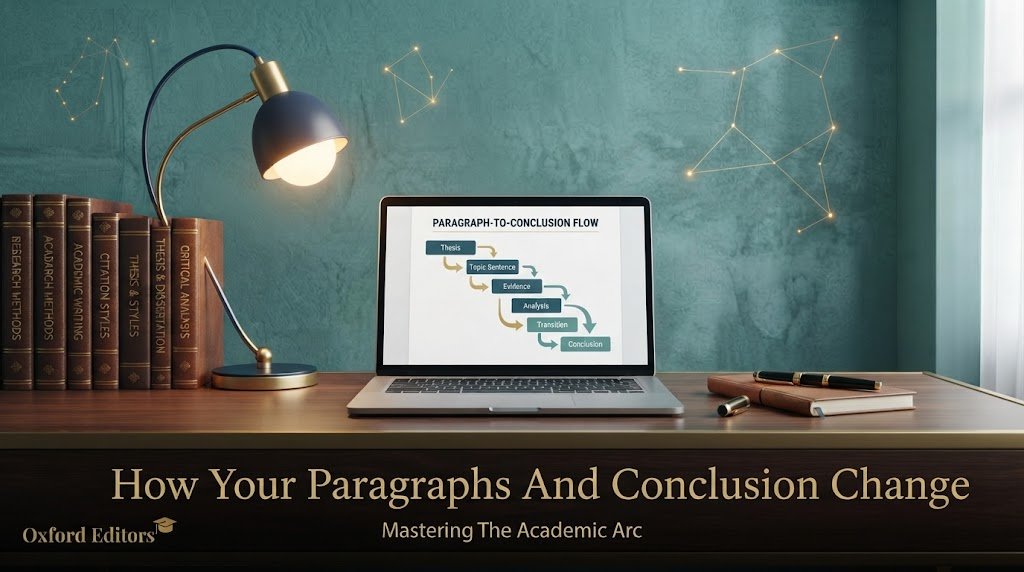
Description without reasoning: a plan headed “Definition, benefits, problems” may encourage a list. Improve it by adding a question to each section: What evidence supports this benefit? What limits that conclusion? Why does the point matter to the task?
Criticism without justification: “The study is weak” is not an evaluation. Explain the limitation and its effect on the claim. A study can be useful for understanding experiences while being unsuitable for estimating how common those experiences are.
Equal space for unequal evidence: do not reserve half the essay for each side automatically. Give relevant objections fair attention, but allocate space according to their importance and support. Explain why stronger evidence deserves greater weight.
One author per paragraph: this can leave relationships between sources unexplained. Group sources around a shared question and compare their findings, assumptions or context. Use separate treatment when a particular theory genuinely needs focused explanation.
An unclear judgement: repeatedly writing “it depends” leaves the reader without an answer. State what it depends on, which conditions matter most and what the evidence allows you to conclude.
Write a one-page plan for essay writing before drafting. Record the instruction and scope; a provisional answer; the main issues or criteria; and the evidence needed for each section. Under every heading, add the judgement or implication that the section should establish. Revise the answer as your reading develops.
Check that the plan addresses the whole question, that description supports analysis, and that the conclusion can follow from the body. There is no universal percentage for description or evaluation. Let the word limit, topic and rubric guide your allocation.
Oxford Editors’ guide to UK university assignment structure offers further organisation guidance. Use it alongside your module’s requirements rather than treating any general template as compulsory.
Try this now: take one essay question and write two headings—“What I must explain” and “What I must judge or resolve”. Add three notes beneath each. Then build body sections that connect those tasks instead of keeping all the evaluation for the conclusion.
If you would like help learning how to plan and assess your own arguments, explore Oxford Editors’ academic writing courses. Confirm the permitted scope of ESSAY Writing support for assessed work and keep the argument and final decisions your own.
No. A discussion normally needs a reasoned answer to the question, not an unresolved list of opinions. Explain which arguments you find more convincing and why, where the task calls for this. Follow the full wording and your department’s guidance because discussion can have different emphases across disciplines.
No. Critical evaluation examines strengths as well as limitations and judges their significance using evidence. A positive judgement can be critical when it is carefully justified. Instead of looking for something negative to say about every source, ask what it establishes, how convincingly it does so and where its usefulness ends.
No fixed number applies. Include relevant perspectives and serious objections, then weigh them according to the evidence and question. Two well-supported arguments may be more important than several weak ones. Fairness means representing positions accurately, not creating an artificial tie or assigning identical word counts to every view.
Yes. Both may use an introduction, themed body sections and a conclusion, and either can organise paragraphs around criteria. What matters is the work each section performs. A critical evaluation should make the basis of judgement clear; a discussion should explore the relevant issues and develop a supported response.
Begin with the object and purpose named in the question. For a method, suitability and evidence quality may matter; for a theory, explanatory power may be relevant. Check course frameworks and justify your choice. Apply criteria consistently, and avoid adding measures unrelated to what the essay asks you to judge.
It usually emphasises examining perspectives through evidence-based reasoning, including their strengths, limitations and implications. It does not create a universal third template. Read it alongside the topic, scope and rubric. If examples or instructions from your module suggest a specific approach, use those to guide your plan.
Include enough to explain the concepts, context or evidence the reader needs to understand your reasoning. Then show their significance for the question. There is no universal description-to-analysis ratio for UK essays. Remove background that does not support the answer and follow any specific allocation required by your assessment.
Break the question into instruction, topic, focus and limits, then compare it with the rubric and module guidance. Ask your lecturer or seminar tutor about the required approach if uncertainty remains. A focused question such as “Should the judgement use this module’s framework?” is more useful than asking for a complete plan.