
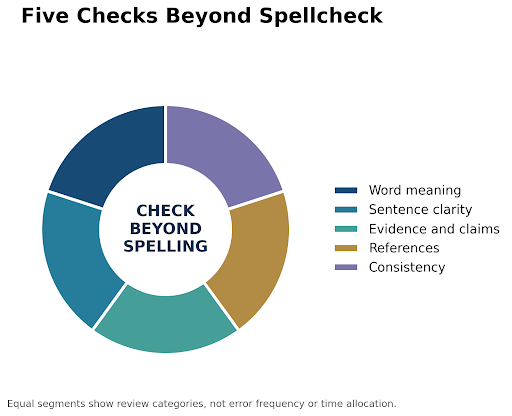
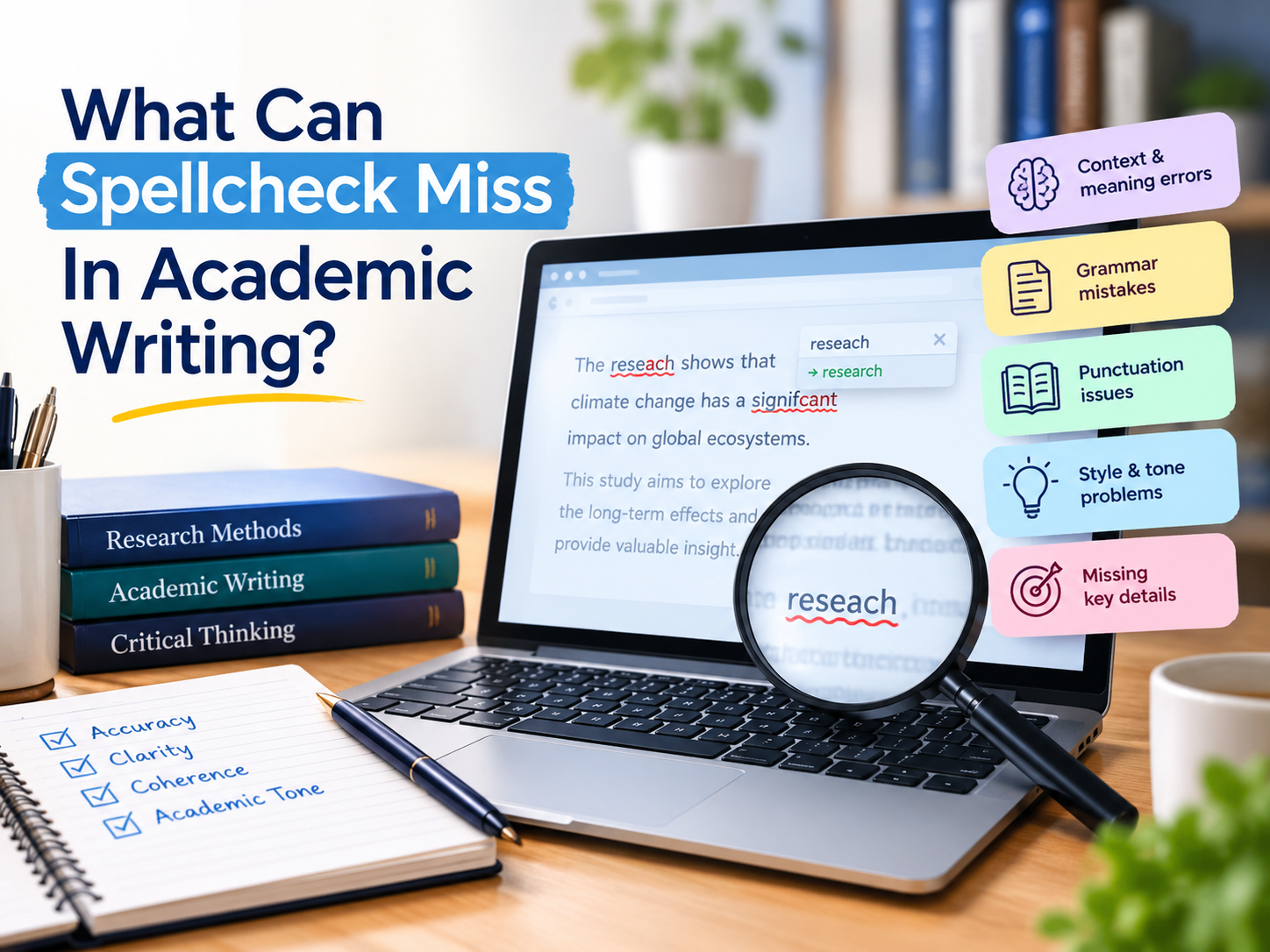
Spellcheck can miss a correctly spelt word used incorrectly, an omitted negative, an unclear sentence, a citation mismatch or a claim that goes beyond the evidence. A draft can contain no spelling warnings and still leave a reader unsure what you mean or why your conclusion follows.
For UK undergraduate and master’s students, the useful question is therefore broader than “Are all my words spelt correctly?” Ask whether each sentence communicates the intended meaning, accurately represents its sources and contributes to the assignment. This guide explains common academic writing errors through original examples and corrections, then gives you a practical review method.
All examples below are hypothetical teaching examples, not findings from published studies. Undergraduate and master’s labels indicate the complexity of the example; both groups need to check all categories. Your assignment brief and marking criteria remain the best guide to the required standard.
Table of Contents
Toggle
Basic spellcheck compares words with a dictionary. A real word can pass that check even when it is inappropriate in its sentence. Grammar and contextual checking tools may identify some word-choice, agreement and punctuation problems, but their suggestions are not a complete academic review. What a tool catches depends on its features, settings and the text.
The Open University guidance on editing and checking recommends combining automated checks with manual review and module guidance. Names, specialist terms, meaning and accurate quotations need particular attention.
Separate language errors from problems in reasoning. A comma splice needs sentence correction; an unsupported conclusion needs you to revisit the evidence. The second task cannot be solved simply by making the sentence sound more fluent.
Some common academic writing mistakes involve choosing between words with similar sounds or spellings. Check the meaning and grammatical role, rather than accepting the word because the software recognises it.
Undergraduate — Original: The timetable change had a positive affect on attendance.
Correction: The timetable change had a positive effect on attendance.
Here, effect is a noun meaning a result. Affect usually functions as a verb meaning to influence. These are useful everyday distinctions, not exhaustive definitions: specialist uses exist.
Original Wording | Corrected Wording | Reason |
|---|---|---|
The principal of consent | The principle of consent | Principle means a rule or belief. |
Students should site the source | Students should cite the source | Cite means refer to a source. |
The groups were complimentary | The groups were complementary | Complementary means they work together; complimentary can mean praising or free. |
Table 1. Meaning checks for commonly confused words. Choose the correction only when it matches the intended meaning.
Master’s — Original: The questionnaire is reliable because it measures the intended construct.
Correction: Evidence that the questionnaire measures the intended construct supports its validity; reliability requires separate evidence of consistency.
Reliability and validity address different questions. A spelling tool cannot assess whether your methodological terminology matches your evidence. Check the definitions used in your discipline before applying either label.
Undergraduate — Original: Participants who submitted consent forms were excluded.
Correction: Participants who did not submit consent forms were excluded.
This correction assumes the exclusion rule concerns missing consent. The original is grammatical, so compare it with the actual procedure. Never insert not simply because the revised sentence seems more plausible.
Master’s — Original: The interviews made an insight into students’ experiences.
Correction: The interviews provided insight into students’ experiences.
A word combination can sound unnatural without containing a spelling mistake. Prefer a familiar, precise expression. Then check whether the sentence needs further detail about which experiences were investigated.
Quick check: highlight words that carry the central meaning—especially not, only, all, significant, reliable and valid. Compare each one with your notes or sources.
Undergraduate — Original: The lecturer discussed the draft with the student after she revised it.
Correction: After the student revised the draft, the lecturer discussed it with her.
The correction assumes the student made the revision. Naming the person removes ambiguity. If the lecturer revised it, write that instead.
Master’s — Original: Using thematic analysis, three patterns emerged from the interviews.
Correction: Using thematic analysis, the researcher identified three patterns in the interviews.
The opening phrase should describe the person performing the analysis, rather than the patterns. The correction also makes the analytical action explicit without changing the assumed number of patterns.
Undergraduate — Original: Although the response rate was low. The findings were discussed.
Correction: Although the response rate was low, the findings were discussed.
Although introduces a dependent clause. Attach it to a complete main clause. A grammar tool may flag the fragment, but the writer still needs to decide how the ideas connect.
Master’s — Original: The sample was small, the estimates should be interpreted cautiously.
Correction: The sample was small; the estimates should be interpreted cautiously.
Two independent clauses cannot normally be joined by a comma alone. A full stop also works. Where appropriate, explain the specific limitation rather than treating sample size as a complete evaluation.

Undergraduate — Original: The list of references are incomplete.
Correction: The list of references is incomplete.
The grammatical subject is list, which is singular. A nearby plural noun can distract both the writer and an automated checker.
Master’s — Original: Participants completed the survey and report their study habits.
Correction: Participants completed the survey and reported their study habits.
Both verbs describe the same completed data-collection event. Consistency matters, but do not force an entire dissertation into one tense: past methods and present discussion can legitimately coexist.
Quick check: read difficult sentences aloud. Identify the subject, main verb and object. If you cannot tell who did what, restructure the sentence before adjusting individual words.
Undergraduate — Original: All university students prefer recorded lectures.
Correction: Students in this sample reported preferring recorded lectures.
The correction limits the claim to the hypothetical sample. It is appropriate only if that is what the responses show. If preferences varied, report that variation instead.
Master’s — Original: The interviews prove that the support programme is effective.
Correction: The interviews suggest that participants perceived benefits from the support programme.
Interview accounts can support a claim about reported experiences. They do not automatically establish programme effectiveness against an outcome measure. State what the evidence actually demonstrates.
The Manchester Academic Phrasebank guidance on cautious language provides ways to express qualified claims. Choose wording that reflects the evidence; adding may to an unsupported statement does not make it well supported.
Master’s — Original: The correlation proves that feedback causes higher attainment.
Correction: The correlation indicates an association between feedback and attainment; it does not, by itself, establish causation.
To justify a causal conclusion, examine the study design and alternative explanations. Prior attainment, motivation or other factors may be relevant. Do not invent an explanation that the study did not investigate.
Quick check: search your draft for proves, causes, all, always and never. These words are not universally wrong, but each demands a defensible level of evidence. Keep a strong claim when it is justified; qualify or remove it when it is not.
A spelling tool cannot decide whether a paragraph answers your research question or evaluates the literature. Critical analysis involves explaining the significance, strengths and limitations of evidence. It does not mean criticising every source or replacing ordinary words with more elaborate ones.
Original: “The study used interviews. It examined students’ experiences of feedback. Interviews are useful for research.”
Improved: “The study used interviews to explore students’ experiences of feedback. This approach provides detailed accounts of how participants interpreted the comments they received. However, those accounts cannot establish how common each experience is across the wider student population.”
Why it helps: the improved paragraph connects the method to the research aim and identifies a boundary on interpretation. In a real assignment, cite the study and use your methods literature to justify that evaluation. Do not add the limitation if it misrepresents the design.
Original: “Study A found that students valued feedback. Study B found that students did not use feedback. Both studies are important.”
Improved: “Study A examines students’ reported appreciation of feedback, whereas Study B examines whether they applied it in later work. These findings need not conflict: valuing comments is different from acting on them. Comparing the studies therefore requires attention to how each defines and measures engagement.”
Why it helps: synthesis explains the relationship between studies and the concepts behind their findings. Study A and Study B are placeholders, not real citations. Replace them with verified sources and retain the comparison only if their designs support it.
For the wider structure of a literature review and dissertation, see Oxford Editors’ guide to writing a dissertation.

A correctly spelt author name can still be the wrong author. A plausible publication year can still mismatch the source. Check citations against the actual material, not merely against your reference manager’s output.
Undergraduate — Original: The text cites Taylor (2022), but the reference list records Taylor (2021).
Correction: Check the original source and make the citation and reference entry agree with the correct publication details.
Do not assume the reference list is right. The mismatch could also involve two different works by the same author. Apply the required referencing style after verifying the source.
Master’s — Original: The text refers readers to Table 4, although the reported values appear in Table 5.
Correction: Change the cross-reference to Table 5 after checking that it contains the intended values.
Numbering can change during revision. Check the label, the values, units and surrounding interpretation together. Updating the number alone will not correct a misreported result.
For author–date systems, check that citations and reference entries correspond, subject to the style’s exceptions. Footnote-based systems need their own checks. Verify quotations against the source and include page numbers or other locators where required. Keep a separate record of direct quotations while drafting.
Oxford Editors describes its reference and citation support for students who need assistance checking citation presentation and consistency. Confirm which assistance your assessment permits before using it.
Review Area | Undergraduate Focus | Master’s Focus |
|---|---|---|
Answering the task | Explain relevant concepts and support the response. | Maintain a focused argument through complex evidence. |
Using sources | Represent sources accurately and explain their relevance. | Compare findings, methods and theoretical assumptions. |
Claims | Avoid assertions broader than the evidence. | State uncertainty and limits on transfer or generalisation. |
Consistency | Check citations, terms and presentation. | Check these across chapters, appendices and analytical reporting. |
Table 2. Suggested review priorities. These are overlapping skills, not universal marking rules or exclusive expectations for either level.
Both levels require clear language and critical judgement. A master’s dissertation may create more opportunities for inconsistencies across chapters, but it does not require longer sentences or needless jargon. Use the terminology needed to describe the work accurately.
Oxford Editors’ guide to UK university assignment structure can help you review the overall organisation alongside your own department’s instructions.
Review your own work in separate passes. First check the argument and evidence; then check language and presentation. Otherwise, a polished sentence may distract you from an unsupported conclusion.
The University of Edinburgh editing and proofreading guidance recommends reviewing in separate stages and notes that listening to short passages can help reveal sentence problems.
Use British English consistently where your course requires it, but check the department’s preferred convention. Do not change the spelling inside an accurate quotation or an official title to make it match your own prose.
Start now with one paragraph. Mark its claim, supporting evidence and explanation. Correct one recurring language problem and record it in a personal error log. This turns essay proofreading into a skill you can reuse.
If you want help identifying language or presentation issues in your own draft, explore Oxford Editors’ proofreading and editing support. Check your university and assessment rules first, agree the permitted scope, and retain responsibility for your ideas and final wording.
Basic spellcheck checks words, not whether a citation identifies the correct source or whether a reference is missing. Referencing software may help with presentation, but incorrect imported details can remain. Compare citations with the original sources and follow your required style, including its rules for reference lists, footnotes and exceptions.
Every word may be recognised while the sentence contains an ambiguous pronoun, a misplaced modifier or a missing negative. Contextual grammar tools may flag some of these problems. To check meaning yourself, identify who acts, what happens and which conditions apply. Rewrite only after deciding what you intended to say.
The terms can be used differently, so define the task. Proofreading commonly focuses on final language and presentation errors; editing can involve structure, clarity and argument. When reviewing your own work, both are useful. For external assistance on assessed work, the permitted scope depends on your university, course and assessment rules.
No. Read each suggestion in context and check whether it preserves your meaning. A proposed change may alter a technical term, certainty level or disciplinary convention. Consult a dictionary, your course guidance or an academic skills adviser when unsure. After accepting a change, read the whole sentence again.
Follow the spelling and style instructions for your course rather than assuming one rule covers every UK institution. Where British English is required, set the proofing language accordingly and keep your own prose consistent. Preserve accurate quotations, publication titles and proper names even when their spelling follows a different convention.
Sometimes. First person can be appropriate in reflective writing or when explaining your own research decisions, depending on the discipline and task. It is not a universal academic writing error. Check your assignment guidance and examples from your field. Use wording that makes responsibility clear without turning evidence-based analysis into unsupported opinion.
Whether you may use AI, and how you must acknowledge it, depends on your institution and assessment instructions. Where permitted, examine suggestions critically and retain your own meaning and decisions. Do not assume an AI rewrite is acceptable because you supplied the first draft. Ask your lecturer or supervisor if the permitted scope is unclear.
Keep a short error log containing the problem, one example from your work, a corrected version and a checking question. Before submission, review the patterns that recur most often. If feedback concerns weak analysis, practise explaining why evidence matters; a spelling check will not address that problem. Seek clarification when feedback is ambiguous.