
Few things feel riskier than asking for help with your final piece of work, so it is natural to worry that using a proofreading service at university could get you into trouble. The short answer is that it depends. Some universities allow limited proofreading, some allow it only for certain pieces of work, and some do not allow paid services at all.
It also depends on the kind of help you want, because proofreading, editing and rewriting are treated very differently. This guide explains what to check in your university’s policy, where to find it, who to ask and how to use a proofreading service safely if your university allows it. It is general information, not legal advice, and your own university’s rules always come first.
There is no single UK-wide rule for student proofreading. Each university sets its own policy, and the differences are real.
Table of Contents
ToggleTwo points hold across these policies. The work you submit must stay your own, and you are responsible for it, whoever helps you. That is why checking your own university’s rules matters more than any general claim about what is allowed.

Universities use these words in slightly different ways, so check how yours defines them. The law adds a further line in England. It is a criminal offence to provide, in commercial circumstances, a service that completes all or part of an assignment for a student at a higher education provider. The explanatory notes to the Skills and Post-16 Education Act 2022 say that generally accepted study support, including proofreading, falls outside that offence. Your university’s own rules still apply.
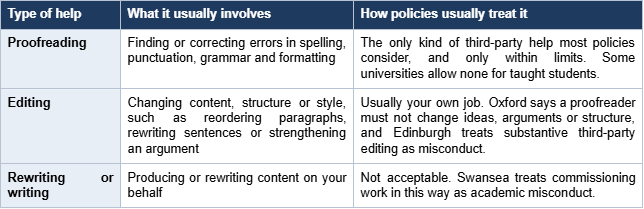
The table shows where the line usually sits in the policies above. Where the line usually sits between proofreading, editing and rewriting
Work through this checklist and note the exact wording your university uses. Terms such as “third party”, “proofreading”, “editing”, “authorship” and “acknowledge” are good ones to search for in your university proofreading policy.

Policies sit in different places, so try several:
If you cannot find a clear answer, ask your academic office or tutor, as in the next section. Do not assume that silence means permission.
Asking in writing gives you a clear record. The QAA’s guidance for universities recommends that students check with their personal tutor if they are unsure whether support is legitimate. Here is sample wording you can adapt.
Subject: Question about proofreading rules for my [dissertation or module]
Dear [name],
I am working on [assignment or dissertation title] and want to check the university’s rules before I submit. Could you tell me:
I have read [name or link of the policy] and want to make sure I follow it. Thank you for your help.
Kind regards,
[Your name, course and student number]
If your university allows it, these habits protect your authorship and your record.
Be cautious if a service:
If anything feels unclear, ask your tutor before you order.
Whether you can use a proofreading service at university depends on your university’s policy, your assessment and the kind of help you want. Check the policy, ask if anything is unclear, keep the work and the responsibility your own, and keep records of any help.
If your university’s rules allow it, you can request a free quote from Oxford Editors for proofreading that corrects grammar, spelling, punctuation and consistency in work that stays your own.
It depends on your university and your course. Oxford’s default policy covers assessed work of 10,000 words or more, while Swansea does not permit professional services for taught students but allows them for postgraduate research students within set rules. Even where proofreading is allowed, it is limited to correcting errors. Check your policy and assessment instructions, and ask your tutor if anything is unclear.
Proofreading that follows your university’s rules is not cheating, but going beyond those rules can be treated as academic misconduct. Edinburgh, for example, treats substantive editing by a third party as misconduct, and Swansea treats professional third-party services as misconduct for taught students. Check your policy, keep the work your own, and ask if you are unsure.
Often you do, but it depends. Nottingham expects students to declare at submission whether their work was proofread, Reading requires a written statement, and Edinburgh says students should declare the use of a proofreader and keep copies from before and after. Check your submission declaration and policy, and ask your tutor if it is unclear.
Check your university’s guidance first. Leeds allows grammar-checking software and generative AI as proofreading tools unless the assessment says otherwise. Edinburgh treats online proofreading tools like proofreaders and expects you to acknowledge generative AI features, and Swansea allows basic spelling and grammar checkers but urges extreme caution with more advanced tools.
Rules usually apply to everyone, with limited exceptions. Translation is restricted: Oxford does not let proofreaders translate work into English, and Edinburgh says not to use a translation tool to produce text for a proofreader. Several universities, including Leeds, Oxford and Swansea, allow assistance for disability or as a reasonable adjustment. Contact your disability or language support team to find out what applies to you.