
To link dissertation findings to research questions, identify the evidence relevant to each question, explain what that evidence means and state the answer it can support. Keep the limitations visible. Repeating a research question next to a result is not enough: the reader needs to see the reasoning connecting them.
For UK undergraduate and master’s students, this connection is the foundation of a coherent discussion and conclusion. A useful finding might answer a question directly, address only one part or reveal that the question cannot be resolved with the study’s design. Your writing should distinguish these situations rather than make every outcome sound conclusive.
This guide offers a practical mapping method, completed examples and paragraph corrections. All study details, numerical findings and locations in the examples are hypothetical teaching material. Use your own verified evidence and programme guidance when applying the method.
Table of Contents
ToggleA research question states what you want to find out. A finding records what your analysis established. An interpretation explains how that finding bears on the question. A supported answer brings the evidence and interpretation together without claiming more than the study allows.
In Sheffield Hallam University’s discussion guidance, students are advised to address research questions through interpretation of relevant results and to acknowledge questions the study cannot answer.
Consider “How do students use written feedback?” A result showing that students liked the comments does not automatically answer how they used them. Appreciation and application are different concepts. The evidence can inform the discussion, but the missing connection needs to be recognised.
The aim is traceability: a reader should be able to move from your final answer back to the interpretation, finding and analysis that support it. The mapping method below is a practical writing aid, not a required university form.

Copy the approved wording into your planning notes. Underline the main concept, the population or material, the context and the type of answer requested. “What barriers do commuter students report when attending campus activities?” asks about reported barriers in a defined group. It does not ask you to prove which barrier causes absence.
Turn those components into an evidence requirement. You need relevant accounts from commuter students, analysis of the barriers described and enough context to explain the setting. If your questionnaire only asks whether students enjoyed events, it does not measure the required concept.
An objective describes what the project aims to accomplish, such as identifying reported barriers. A research question expresses the uncertainty the work addresses. A hypothesis proposes a testable expectation where the design supports that approach. They can align, but completing an activity such as distributing a questionnaire is not itself an answer.
Create a note connecting each objective to its question and evidence. If they do not align, check your approved proposal and discuss the issue with your supervisor. Do not silently change the question to make the available results look more successful.
Build a research question finding matrix in your working notes. Begin with the question, then record the relevant finding and where it appears. Add what the finding permits you to say and the limit on that statement. Use precise locations, such as a section number, labelled theme or table.
Use two linked tables if the full mapping is too wide. The first records the evidence; the second records the answer. Keep the same question identifier in both. The completed example below demonstrates how this works without forcing lengthy reasoning into narrow cells.
Hypothetical undergraduate question RQ1: “What travel barriers do commuter students report when attending evening campus activities?” A survey of 50 commuter students allows multiple barrier selections. Thirty select limited late transport, 18 select travel cost, and 10 select neither of those two options. There is no attendance observation or causal test.
Question | Relevant Evidence | Location In Example |
|---|---|---|
RQ1 — reported travel barriers | 30 of 50 select limited late transport; 18 of 50 select travel cost. | Results section 4.2, hypothetical Table 4.1. |
RQ1 — variation | 10 of 50 select neither of these two barriers. | Same hypothetical response table. |
Table 1. Evidence map. Multiple selections are allowed, so response counts are not mutually exclusive.
Question | Supported Answer | Important Limit |
|---|---|---|
RQ1 | Limited late transport and travel cost are reported barriers in this sample; the former is selected more often. | Responses do not establish causes of absence or represent every commuter student. |
RQ1 — variation | The two barriers are not reported by every respondent. | Selecting neither does not establish that a respondent faces no other barrier. |
Table 2. Answer map for the same question. The hypothetical counts describe selections rather than exclusive groups.
Add further rows for other findings that genuinely inform the question. Keep irrelevant results out of the answer map, even if they are interesting. Record uncertainty rather than fill a missing cell with a plausible assumption.
When interpreting dissertation findings, distinguish what was observed from what you infer. A survey response establishes what respondents selected under the stated question. It may support an account of reported perceptions or experiences. It does not automatically establish behaviour, prevalence in a wider population or causation.
Choose verbs that match the evidence. “Reported”, “described” and “selected” identify the direct result. “Suggests” can introduce an interpretation, but it does not rescue a claim with no evidential basis. “Caused” needs a design and analysis capable of supporting that conclusion.
Also distinguish limitations in coverage from limitations in certainty. A study might address the concept directly but offer an imprecise estimate. Another might provide precise information about a different concept. A larger sample cannot fix asking the wrong question.
The Loughborough University London guidance on discussion writing encourages examining meaning, alternative explanations and methodological or contextual constraints, rather than restating results.
“Thirty students selected limited late transport and 18 selected travel costs. This proves that transport problems cause commuter students to miss evening activities. Therefore, the university should provide free transport for all students.”
The passage repeats the counts, introduces an untested cause and makes a recommendation wider than the evidence. It also changes the question from reported barriers to actual absence.
“In response to RQ1, limited late transport was the most frequently selected of the two reported barriers: 30 of 50 respondents selected it, compared with 18 selecting travel cost. The finding identifies transport availability and affordability as issues reported within this sample, while the multiple-response design allows students to report both. It does not establish that either issue caused non-attendance, and the 10 respondents selecting neither show that these two barriers were not universal. The answer is therefore about reported barriers in this group, rather than the causes of attendance patterns across the university.”
The opening names the question and finding. The next sentence explains the significance and response design. The final sentences limit the answer appropriately. In a real discussion, compare these results with relevant literature and assess similarities in the population, wording and setting before suggesting implications.
The numerical details are consistent: 30/50 is 60% and 18/50 is 36%, but these percentages should not be added as exclusive categories. With 10 selecting neither, 40 select at least one of the two; the figures imply eight select both. That overlap must agree with the actual dataset before you report it.
Hypothetical question RQ2: “How do first-year master’s students describe balancing paid work with independent study?” Interview analysis develops three themes: protecting study time, adapting plans around work shifts and negotiating competing deadlines. Some accounts describe workable routines; others describe recurring conflict. No hours, prevalence estimates or attainment measures are supplied.
Theme | Contribution To RQ2 | What It Does Not Establish |
|---|---|---|
Protecting study time | Describes efforts to reserve time for independent work. | Does not prove the strategy improves attainment. |
Adapting plans | Shows accounts of adjusting study around work schedules. | Does not measure how common adaptation is beyond participants. |
Competing deadlines | Adds experiences of conflict and limits to planned routines. | Does not mean all students experience the same difficulty. |
Table 3. Hypothetical qualitative map. Themes contribute to one answer rather than becoming separate research questions.
“RQ2 is addressed through participants’ accounts of balancing work and study as an ongoing adjustment rather than a single fixed routine. Protecting study time describes attempts to create stability, while adapting plans captures responses to changing shifts. Accounts of competing deadlines show where those strategies were strained. Together, the themes suggest variation in how participants negotiated the demands: some described workable arrangements, while others reported continuing conflict. This interpretation concerns the experiences represented in the interviews and does not establish which strategy produces better academic outcomes.”
The paragraph integrates themes, explains their relationships and preserves variation. It does not turn theme labels into population statistics. In the dissertation, support each theme with appropriate evidence and compare the interpretation with relevant theory. Consider whether another account fits the data, rather than selecting only extracts that support your preferred story.
Both levels need this reasoning. A master’s rubric may require deeper theoretical or methodological evaluation, but complex vocabulary is not a substitute for a clear connection between question and evidence.
For the broader organisation of the project, see Oxford Editors’ dissertation planning guide. Adapt the chapter sequence to your approved methodology.
One question often requires several findings. State the contribution of each, then explain the overall pattern. Ask whether the evidence supports the same interpretation, covers different parts of the question or introduces a qualification. Do not count agreement without examining what each finding measures.
In mixed-methods work, a numerical pattern and interview accounts can complement one another, but an interview explanation does not automatically establish the mechanism causing that pattern. Identify whether both strands concern comparable people, concepts and contexts. Explain discrepancies rather than hiding them.
A finding can also inform more than one question. Use it for a different analytical purpose where justified, with a clear cross-reference. Avoid copying the full results paragraph into every discussion section.
Compare your interpretation with relevant studies or concepts, not simply their conclusions. Check whether they examine a comparable population, measure and setting. Agreement can strengthen a contextual argument without turning your study into a replication or proving a general rule.
For the commuter example, a paper on travel constraints might help explain the significance of reported barriers. It cannot establish that your respondents missed events if your study did not measure attendance. Literature provides context and possible explanations; it must not be presented as a missing result from your own dataset.
Useful questions are: What does my finding support or challenge? What is similar enough to compare? Which contextual difference affects that comparison? What remains uncertain? Answer these with verified sources, not invented references.
Oxford Editors’ reference and citation support describes help with citation presentation and consistency. Check that every source supports the particular claim attached to it.
Classify the answer in your notes as addressed within scope, partly addressed or not resolved. These are practical labels, not grades. State what evidence is available and the precise element missing. “The study is limited” tells the reader much less than “The survey identifies reported barriers but does not record attendance.”
If a question asks whether support improves attainment but your interviews only explore perceived usefulness, report that mismatch. You can discuss perceptions, while explaining that effectiveness remains unresolved. Do not retrospectively present the study as an effectiveness test.
Unexpected or inconclusive findings still need attention when relevant. Lack of support for a hypothesis does not automatically establish the opposite. Consider design and uncertainty before offering explanations. Where questions develop during exploratory work, document changes and follow the approved procedures rather than conceal the original scope.
A traceability check for constructing a supported answer. No statistical data is represented.
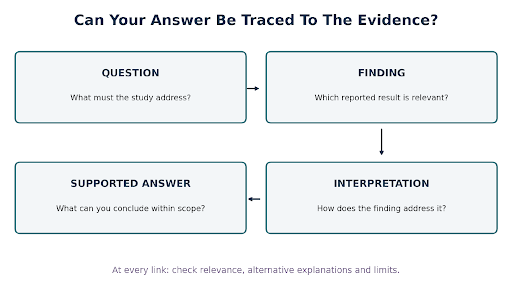
In results, present the relevant findings. In analysis or discussion, explain the reasoning connecting them to the question. In conclusion, bring that reasoning together into a concise answer with its important limits. Do not introduce previously unreported analysis in the final chapter.
The University of Portsmouth guidance on dissertation structure recognises different combinations of findings, analysis and discussion. The connection matters more than a universal chapter label.
Hypothetical conclusion answer to RQ1: “Within this sample, limited late transport and travel cost were reported barriers to evening campus activities, with transport availability selected more frequently. The study identifies perceived constraints but cannot determine their causal effect on attendance or their prevalence across the university.”
The University of Southampton guidance on conclusions recommends synthesising findings and discussion to show how the dissertation responds to its research purpose.
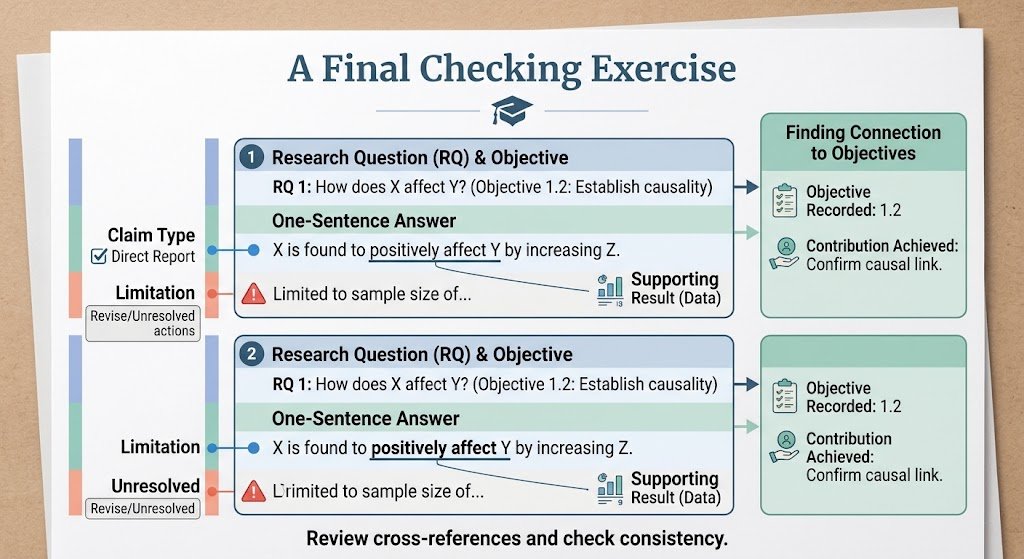
Write a one-sentence answer for every research question. Underline each substantive claim and identify the supporting result. Mark whether the claim is a direct report or an interpretation. Add the limitation that most affects it. If a claim has no reported evidence, revise or remove it; if the question is unresolved, say so.
For connecting findings to objectives, record the objective beside the question and state the contribution achieved. Check that the answer describes what the research established rather than only the activity completed. Review cross-references and use consistent wording across the introduction, discussion and dissertation conclusions.
If you want guided practice developing your own argument, explore Oxford Editors’ academic writing courses. Confirm the scope permitted for assessed work and retain responsibility for your interpretation and final decisions.
No study should pretend to resolve something its evidence cannot establish. Address every stated question by explaining the answer available, or precisely why it remains partial or unresolved. Check any substantial scope mismatch with your supervisor. An honest account of limits is stronger than a conclusion created to make the project look complete.
Yes, when it is genuinely relevant to each. Explain its distinct contribution in each discussion section and use cross-references to avoid repeating the full results account. A finding about reported travel cost might inform questions about barriers and experiences, but it cannot automatically answer a question about measured attendance.
Yes. Explain how the themes relate and what they establish together. Do not simply list their labels as the answer. A question about balancing work and study may involve planning, adjustment and conflict. Preserve variation across accounts and keep the interpretation grounded in the evidence supporting each theme.
Report relevant findings transparently and examine the interpretation rather than remove them. Consider alternative explanations, uncertainty and methodological constraints. Your expectations are not the standard the evidence must satisfy. A contradictory or inconclusive outcome can still contribute to the question when you explain what it supports and what remains unresolved.
Do not silently rewrite it to fit a preferred outcome. Questions can develop in some exploratory designs, but changes need to be documented and handled within supervision, ethics and assessment requirements. Distinguish the original question from later exploratory questions. Keep the reader informed about what the study was designed to address.
Treat the objective as the intended contribution and connect it to the question and evidence. If the objective is to identify barriers, state which barriers the analysis identified and the limits of that account. Collecting questionnaires is a research activity; it does not demonstrate that the objective was substantively achieved.
Repeat or clearly identify it when introducing the relevant discussion and giving the final answer. You do not need the full wording in every paragraph. Use clear section headings and signposting, then keep each paragraph focused on evidence and interpretation. Make the relationship visible without making the prose repetitive.
Literature can supply context, theory and possible explanations, but it cannot become an uncollected finding from your own study. Distinguish what previous work established from what your data shows. In an evidence-review dissertation, published sources may themselves be the analysed material, according to the declared methodology; label that role clearly.