
Before hiring a dissertation editor, check your university’s rules and ask who will review your work. Request evidence of relevant editorial training and subject experience. Agree on the permitted scope, delivery format, file handling, full cost and deadline. A professional profile helps you assess suitability, but it cannot guarantee the quality of a particular review.
You should be able to explain what you are buying and what the editor will leave to you. This guide gives you seven questions to ask, evidence to request and practical checks for reviewing the feedback. Your dissertation’s research, analysis and conclusions remain your responsibility.
Prepare your assessment brief, proofreading policy, subject, degree level, word count and deadline. Include your department’s referencing and formatting guidance. Explain whether the document is a final dissertation, a research thesis or a draft chapter for supervision. Permission can differ between these documents.
Read your institution’s current rules. For example, the University of Dundee’s proofreading guidance permits limited technical suggestions but excludes rewriting and changes to academic content. It generally requires comments rather than tracked edits, with an exception for specified reasonable adjustments.
Do not assume that permission at another university applies to you. If your policy is unclear, ask your supervisor or academic support team what external help is allowed. Resolve this before paying or sending a sample.
Ask: “Who will review my dissertation, and can I see their professional profile before the work starts?”
An agency’s description of its team does not tell you who will handle your document. Request a named reviewer or, where names are not disclosed, a sufficiently detailed assigned-editor profile. Ask who will answer questions about the feedback and whether another person may take over.
A useful answer explains the reviewer’s role, relevant experience and the process for any reassignment. Ask whether an assistant or subcontractor will access the file and who checks the final delivery. This is particularly useful when a tight deadline might lead to work being divided between reviewers.
Warning Sign: Repeated claims about a large expert team without information about your assigned reviewer. Ask for clarification before committing. If the provider cannot explain who is responsible, compare another option.

Ask: “What editing or proofreading training have you completed, and where can I verify your professional credentials?”
Check academic knowledge and editorial skills separately. A doctorate may show research experience, while an editing course may show training in correcting language and handling author queries. Neither tells you everything about the person’s work. Ask for the qualification, awarding institution and relevant course or professional profile.
If CIEP membership is claimed, check the CIEP Directory of Editorial Services and compare the name, membership grade and specialisms. CIEP states that listed members have demonstrated experience and training against its membership criteria. Its directory includes filters for dissertations and theses as well as subject areas.
A useful answer gives specific, checkable details rather than a badge or an unexplained “certified” label. Membership is one source of evidence, not a requirement that every suitable editor must meet. Absence from this directory alone does not establish that someone is unqualified.
Ask: “What experience do you have reviewing dissertations in my field and at my degree level?”
Give the editor your subject and a short description of the dissertation. Ask about comparable document types and terminology. Someone familiar with psychology should recognise that a relationship between variables does not automatically establish causation. An engineering language review should preserve units, symbols and defined technical terms. A humanities review should avoid changing the writer’s interpretation of a source.
These are illustrative checks of language handling. They do not authorise an editor to correct your methodology, calculations or interpretation. Subject familiarity should help the reviewer recognise when to ask a question instead of guessing.
A useful answer describes relevant experience without disclosing another student’s private work. An anonymised portfolio or a sample created for demonstration can help. Ask which referencing guide they will follow: “Harvard” alone may not identify your department’s required version.
Warning Sign: “We cover every subject” without explaining how your reviewer is matched. Ask what happens when the reviewer encounters unfamiliar terminology.
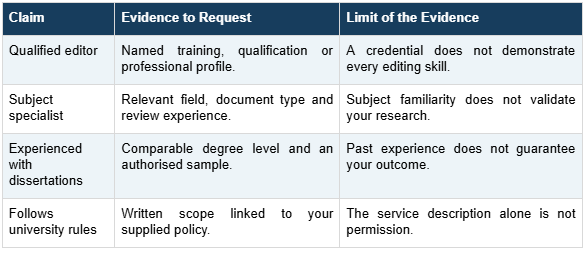
Table 1. Match the claim to evidence you can check.
Ask: “Will you review this policy and confirm in writing what you will and will not do?”
Send the actual guidance rather than asking only whether the service is “ethical”. Your agreement should identify the permitted actions, such as commenting on spelling errors, and any exclusions. Clarify how ambiguous sentences, reference inconsistencies and formatting issues will be handled.
A useful answer distinguishes identifying a problem from changing the document. It also explains when a request must be declined. Ask whether suggestions about organisation or argument are included, because these can exceed permitted proofreading even when delivered as comments.
Dundee’s guidance, for example, excludes rearranging paragraphs and changing ideas. Other institutions may restrict professional services altogether. Accepting a suggestion yourself does not automatically make the help permissible. Keep your supervisor’s clarification and the agreed scope with your project records.
Warning Sign: “It is allowed because we use Track Changes” or “Nobody will know.” A delivery tool does not establish permission. Pause until the proposed work matches your university’s rules.
Ask: “Can you review a short representative extract within my university’s permitted scope, and is there a charge?”
Where sample feedback is permitted, propose roughly 300–500 words as a manageable starting point. This is a practical suggestion, not a professional standard. Choose an extract with ordinary prose and some subject terminology. Agree on the fee, scope and delivery format first. The sample should come from the reviewer expected to handle the full document, where possible.
Read the comments rather than judging how polished the result looks. Check whether each suggestion identifies a real issue, explains it clearly and preserves your intended point. If the reviewer cannot know what a sentence means, a question is more useful than an invented interpretation.
For example, changing “The results were associated with improved performance” to “The results caused improved performance” alters the claim. Replacing a precise technical term with a familiar everyday word can also reduce accuracy. Ask the reviewer to explain questionable suggestions before deciding whether to proceed.
Warning Sign: New evidence, stronger conclusions or extensive rewritten passages offered as proofreading. Do not treat the sample as usable assessed content merely because it sounds fluent.
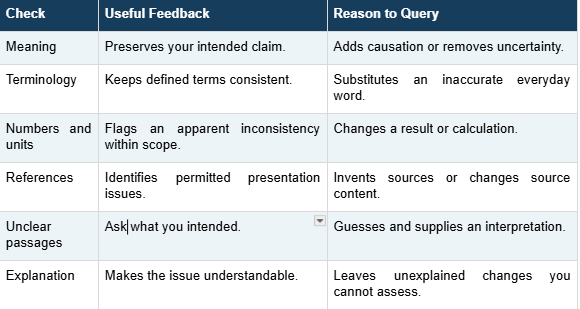
Table 2. Review a sample or returned chapter using these checks.
Ask: “What files will I receive, who can access my dissertation, and will any AI tools be used?”
Request the expected file format and review method. If your policy requires comments only, state that explicitly. Ask whether you will receive a comments file, a version with tracked suggestions or another format, and whether a clean copy is included where permitted. A clean copy alone makes it harder to inspect individual changes.
Ask specifically whether any content will be uploaded to an AI system or another external platform. Find out who has access, whether subcontractors are involved, how long files are retained and how deletion requests are handled. Do not infer these arrangements from a general confidentiality statement.
Remove unnecessary personal identifiers and participant details before sharing an extract. If your research has confidentiality or ethics restrictions, consult your supervisor before sending it externally. Ask what the provider needs rather than sending raw research data by default.
Warning Sign: The provider cannot explain file access or tool use. Pause sharing sensitive material until you have clear answers.
Ask: “What is the total price, what is included, and when will I receive the reviewed file?”
Provide the actual document or a clear description so the quote has a reliable basis. Ask whether the word count includes references, footnotes, tables, captions and appendices. Clarify whether formatting, reference presentation and follow-up questions are included, subject to your policy.
Confirm the delivery date, time and time zone. Leave yourself time to review suggestions before submission. Ask what happens if you send a revised chapter after work begins or request a second pass. A price for the original draft may not cover later additions.
A useful quote records the scope, exclusions, file format, full charge and arrangements for queries or missed errors. Ask about cancellation or rescheduling terms before committing. Editing should not come with promises of a particular mark or examiner decision.
Warning Sign: A low headline price with no written scope, or a guaranteed grade. Request a complete quote and compare equivalent services rather than prices alone.
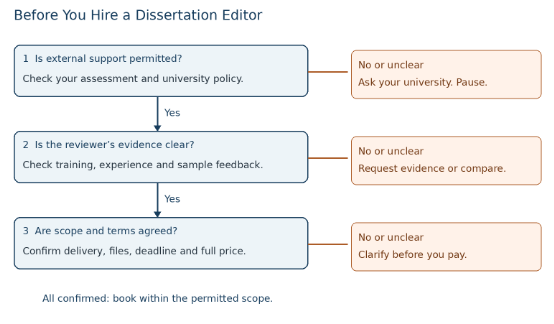
A Decision Guide Before You Book
Oxford Editors describes its proofreading and editing service as covering language and presentation. Ask how that support would be adapted to your specific dissertation policy.
You can also contact Oxford Editors and request details about the assigned reviewer rather than relying only on general team descriptions. To discuss suitable support, share your dissertation brief and university guidance with Oxford Editors and request a clearly defined review scope.
A PhD can provide evidence of research experience, but it does not by itself establish proofreading skill. Consider editorial training, relevant document experience and the quality of permitted sample feedback together. Ask for checkable details. Your choice should reflect the review you need and what your university allows.
An exact topic match may not be necessary for a limited language review. Familiarity with your field and terminology can still be useful. Ask how unfamiliar terms will be handled and assess the sample carefully. The reviewer should query uncertainty rather than change specialised wording or supply research interpretations.
Private student documents should not be treated as public portfolio material. Ask for an authorised anonymised example, a demonstration sample or permitted feedback on your own short extract. A refusal to share confidential work is not a warning sign by itself. Look for other evidence of experience and clear explanations.
Do not assume a language review includes research validation. Checking calculations, methods, evidence and conclusions is a different task and may be outside permitted support. Discuss academic questions with your supervisor or approved university support. Ask the editor to clarify the limits of the service before work begins.
Ask your supervisor or academic support team to explain what help is permitted for your specific document and assessment. Clarify the reviewer’s role and whether comments or direct changes are allowed. Keep the answer in writing where possible, then share it with the provider before commissioning a review.