
Harvard referencing becomes easier when you check two things together: the short citation in your writing and the full reference at the end. Each citation should identify the source clearly, and its matching reference should help the reader find the material you used. Before submitting, check names, dates, source details, quotation marks and consistency against your university’s guide.
This Harvard referencing checklist takes you through those checks with worked examples. The examples use Leeds Harvard, one university’s version of the author–date system. Your department may require different punctuation, date formats or details, so its instructions take priority.
All sample authors, publications, quoted sentences and source details below are fictional teaching examples. Web addresses using example.com are placeholders.They demonstrate formatting and must not be copied into an assignment as genuine evidence.
Table of Contents
ToggleCheck that you have identified the required Harvard variant; cited borrowed ideas as well as quotations; supplied page numbers where required; and recorded the version of each source you actually read. Then match citations to references, sort the reference list, inspect online details and remove duplicate entries.
Harvard is an author–date approach with institutional variations. Start with your assignment instructions and university library guide. If the module names a particular version, use that version throughout rather than combining templates from different websites.
For example, Leeds Harvard places the publication year after the author in a reference without surrounding it with round brackets. It also includes access dates for online journal articles. A template from another institution may look different without being incorrect for that institution.

An in-text citation is the short acknowledgement beside information from a source. In Leeds Harvard, a basic parenthetical citation gives the surname and year: (Taylor, 2024). A narrative citation places the name within the sentence: Taylor (2024) discusses the topic.
Put the citation where readers can tell which idea it supports. A single citation at the end of a long paragraph can be unclear if several sources or your own interpretations appear earlier. Make the source boundaries visible without attaching a citation mechanically to every sentence.
For two authors, include both names: (Taylor and Ahmed, 2024). For three or more authors, Leeds Harvard uses the first surname followed by et al.: (Taylor et al., 2024). The reference list normally includes all authors, in their published order; consult your tutor about unusually long author lists.
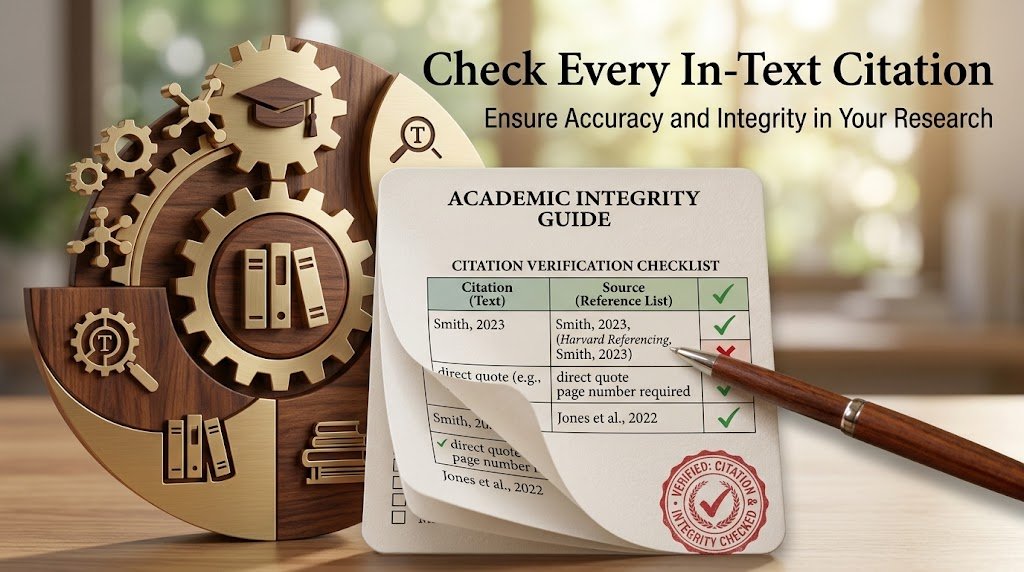
A quotation repeats the source’s exact wording. A paraphrase explains its meaning in your own words. Both need acknowledgement. Replacing a few words while keeping the original sentence structure is not a sound way to produce an independent paraphrase.
Fictional quotation example: Taylor (2024, p.18) writes that “planning makes the research process more manageable”. The quotation marks distinguish borrowed wording, and p.18 identifies its location. Check that the wording and page number match the source before using this pattern with a real quotation.
Fictional paraphrase example: Dividing research into planned stages can make the workload easier to organise (Taylor, 2024, p.18). There are no quotation marks because the sentence is newly worded, but the idea still belongs to Taylor.
Leeds Harvard requires page numbers for direct quotations and specific paraphrased ideas or explanations where pages exist. Use p. for one page and pp. for a range, such as pp.18–20. Do not assume page numbers are needed only for quotations.
For an unpaginated webpage, Leeds does not require a page locator in the citation. Other source types without pages have separate rules, so check the relevant guide. Never invent a page number or use a PDF viewer’s screen count without verifying the source’s printed pagination.
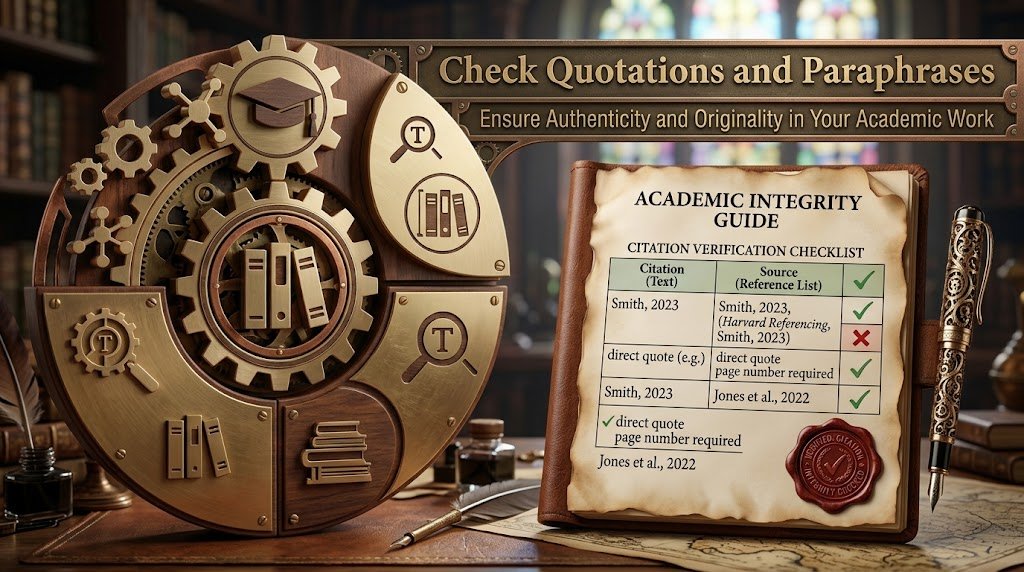
A complete reference records the details needed for that source type. Collect them while reading: author, year, title and publication information, plus page ranges or online details where appropriate. The following examples show how citations connect to references.

Missing information requires the guide’s convention, not a guess. First check the source, its publication information and the responsible organisation. A page’s general website copyright date does not automatically establish that page’s publication year.
For a genuinely undated source, Leeds Harvard uses [no date] in the reference and no date in the citation. Fictional citation: (Example Student Support Centre, no date). The reference begins: Example Student Support Centre. [no date]. Managing assignment deadlines.
If neither a personal nor an organisational author can be identified, Leeds allows Anon in both the citation and reference. Other Harvard variants may use the title instead. Use the rule from your chosen guide rather than switching conventions halfway through the assignment.
For two different works by the same author in the same year, distinguish them with letters: (Taylor, 2024a) and (Taylor, 2024b). Each must have a separate matching reference carrying the same letter. Follow your institution’s ordering instructions when assigning letters. Repeated citations of one work do not require new letters.
Check in both directions. First, work through the assignment and locate the matching entry for each citation. Then inspect each reference and find where you have cited it. This catches missing sources and leftover entries from deleted paragraphs.
Sort separate references alphabetically by author surname or organisational name under the relevant guide. For repeated authors, check the required date order. Keep names consistent and inspect any same-year letters after sorting or deleting sources.
A reference list generally contains works cited in the assignment. A bibliography may also include material consulted but not cited. Use the heading and scope your module requests; do not add uncited reading merely to make a reference list look longer.
Review italics, capitals, punctuation, author initials and spacing against the correct template. In the examples above, book and webpage titles are italicised; journal references italicise the journal title. Consistent appearance helps, but source accuracy comes first.
For online journal articles, Leeds Harvard requires [Online], an access date, and a DOI link where available, otherwise a URL. A DOI is a persistent identifier for a publication. Copy it from the source and check that it resolves to the right item; do not generate a plausible-looking identifier.
Use the source’s address, not a Google results link or a library discovery search URL. Reference the version you actually read. Check that an exported citation has not substituted a preprint, a different edition or an incorrect source type.
If using a reference manager or citation generator, inspect the result before submission. Imported metadata can leave out authors or put an article title in the wrong field. Choose the required style, correct the underlying records and refresh the bibliography before your final review.
The following corrections apply to the Leeds Harvard teaching examples in this article. A different institution’s required format may differ.
Table 1. Common mistakes and corrections
Mistake | Correction | Reason |
|---|---|---|
Missing year: (Taylor) | (Taylor, 2024) | Include the publication year. |
URL used as a citation | (Morgan, 2025) | Use author and year; put the URL in the reference. |
Chapter cited as (Wilson, 2022) | (Patel, 2022) | Credit the chapter author. |
Specific quotation without locator | (Taylor, 2024, p.18) | Add the page where the quotation appears. |
Undated source labelled 2026 after access | (Organisation, no date) | Access year is not publication year. |
Related support: Oxford Editors reference and citation checks
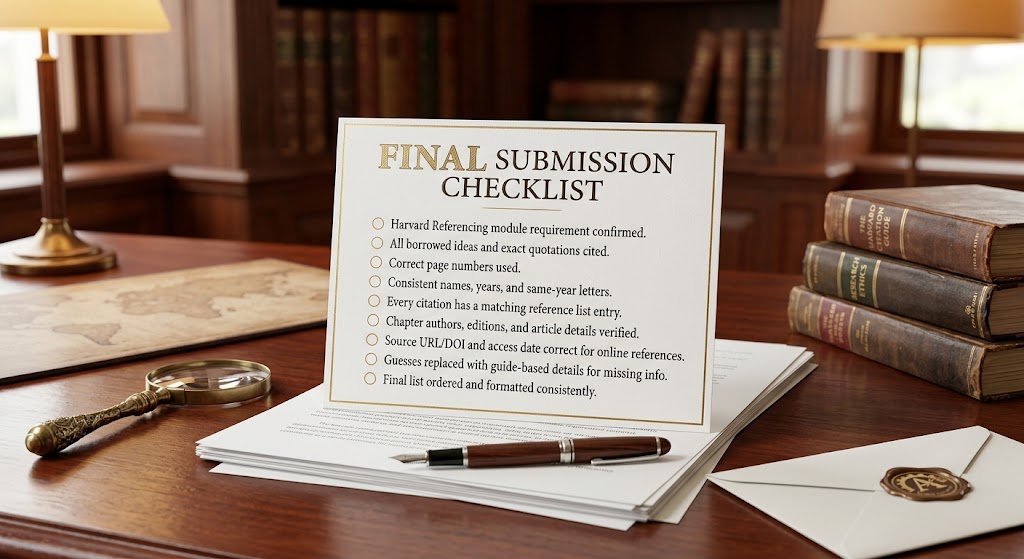
Treat each item as a task to confirm, not a box to tick without checking. Keep your sources open as you review the final draft.
Read the submitted version once more after making changes. Editing a paragraph can remove a citation’s context, while deleting a source can leave a same-year letter or an unused reference behind. Check the final exported document as well as the working file.
If you would like help checking your citations and reference list, share your draft and university Harvard style guide with Oxford Editors. Request a review within the support your institution permits, so you can understand and resolve inconsistencies before submission.
Yes. Expressing an idea in your own words does not make it your original idea. Cite the source beside the paraphrase and include its full reference. Under Leeds Harvard, add a page number for a specific idea or explanation when the source has pages. Check your own university’s requirements for other cases.
Check for a publication or relevant update date before treating the page as undated. Do not replace a missing publication year with the date you accessed it. Leeds Harvard uses [no date] in the reference and no date in the citation. Other guides use different notation, so follow your department’s version.
When using a chapter written by a named contributor, cite the chapter author. The full reference then identifies the chapter and the edited book containing it. If you are referring to the edited collection as a whole, the applicable template differs. Check the chapter’s opening page to identify the correct author.
Try to obtain and read the original first. If that is not possible, make the secondary citation explicit. A fictional Leeds-style example is (Taylor, 2020, cited in Morgan, 2025, p.12). Put Morgan’s work, which you actually read, in the reference list. Do not imply you consulted Taylor’s original publication.
Usually, a reference list records sources cited in your text, while a bibliography may include additional reading consulted. However, assignment terminology and requirements can vary. Follow the module instructions and ask your tutor if the heading or scope is unclear. Do not assume that both lists are required for every assignment.