
To fix tense changes in academic writing, first identify when each action happened and what each sentence is doing. Correct a shift that accidentally moves a completed event into the present. Keep a shift that deliberately moves from a past research activity to a current argument or interpretation. After editing, check that you have preserved the original timeline, the people or cases covered and the degree of uncertainty.
Tense consistency in academic writing does not mean using one tense throughout an essay or dissertation. A paragraph can correctly combine past and present tense. This guide gives UK undergraduate and master’s students a practical way to diagnose changes before correcting them. All worked research passages are fictional teaching examples; their observations are not claims about real studies.
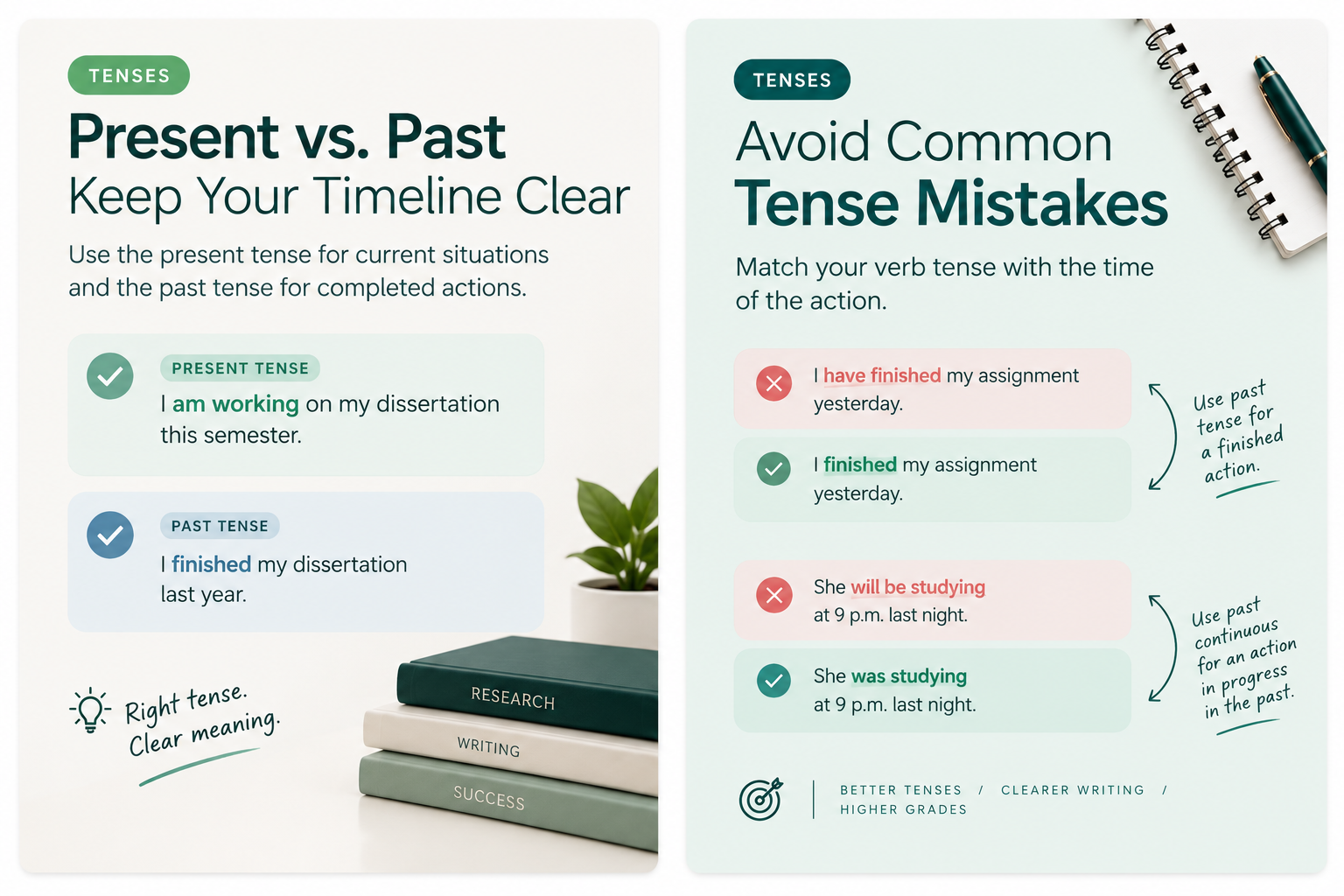
When Is A Tense Change Actually An Error
A change is suspicious when two verbs describe the same completed activity but switch time without a reason. For example, “The researcher measured the stream depth and records the readings” moves from past measured to present records. If both actions happened during the completed fieldwork, write “measured the stream depth and recorded the readings”. You have corrected the timing without adding an action or changing the result.
A change can be justified when the purpose changes. “The survey recorded longer journeys. This finding suggests that access may depend on location” moves from a completed observation to an interpretation offered now. There is no need to change suggests to suggested just to match recorded. The modal may also preserves the caution of the interpretation.
The Leeds guidance on tense and voice explains that context can require different tenses. Use your department’s instructions and disciplinary examples alongside this general guidance.
Before accepting a grammar suggestion, ask what the proposed edit would make the reader believe about time. If the answer differs from your intended meaning, revise the suggestion or leave the justified change in place.
Identify The Time And Purpose Before Editing
Mark The Complete Verb Phrase
Underline or highlight the verb phrase, including auxiliaries: collected, has collected, had collected, was collecting and may collect convey different relationships. Looking only at collected misses the work done by has or had. In passive phrases such as was recorded and has been recorded, include the whole phrase rather than treating recorded as the tense by itself.
Locate The Time Expression
Look for dates and expressions such as during the interviews, before recruitment, since 2022 and at the time of writing. They help identify the intended time frame. If the time is unclear, check your notes or source before editing. Do not invent a date or assume an observation still applies simply because you want the sentence to sound current.
Identify What The Sentence Does
Label the sentence’s function in your working draft: completed action, source argument, present interpretation, ongoing development or earlier past action. You can then judge neighbouring verbs by their function rather than their appearance. “The team interviewed commuters” reports an action; “The article argues that fares matter” presents a text’s argument; “The evidence may indicate a barrier” gives a qualified interpretation.
These labels are temporary editing notes, not headings to add to your essay. If one sentence performs several functions, check each clause. Different clauses can need different tenses, especially when a source’s continuing argument is discussed alongside what its researchers did.

Choose Tense By Meaning Rather Than Chapter Alone
Chapter conventions are useful starting points, but they cannot determine every verb. Methods often describe completed work, while a discussion can refer both to past observations and their present significance. A literature review can describe a dated study, an argument available in a published text and a research trend extending to the present.
| Function | Usual Choice | Illustrative Wording |
|---|---|---|
| Completed action or specific past finding | Past simple | The team recorded journey times in March. |
| Argument or interpretation presented now | Present simple | The article argues that access is uneven. |
| Research or development linked to the present | Present perfect | Researchers have examined this question in several settings. |
| Action before another past event | Past perfect when useful for clarity | Participants had completed the diary before the interview. |
| Document or displayed table as it stands | Present simple | Table 1 shows the recorded categories. |
| Planned research | Future wording where appropriate | The proposed study will compare two routes. |
Table 1. Tense choices by function. These are common conventions rather than compulsory choices for every discipline.
See Oxford’s summary of academic tense use for the functions of past, present, present perfect and future forms. The guide also notes variation by discipline and purpose.
Present perfect links earlier activity to the present; it does not automatically prove that a conclusion is accepted or correct. “Several studies have examined access” identifies a body of work with current relevance. “One study examined access in 2018” locates a specific completed study. Choose between them according to the information you intend to convey, not because one sounds more academic.
Keep tense separate from voice. “The researcher recorded the responses” and “The responses were recorded by the researcher” are both past tense. You do not have to convert an active sentence into a passive one to repair its timing. A tense check should not needlessly change who performed the action.
Fix Common Tense Changes Without Altering The Claim
Completed Methods And Dated Studies
If the procedure is complete, check that its action verbs represent that completion. A method that “will recruit” participants belongs to a plan, whereas “recruited” reports what happened. Do not turn a planned sample into an achieved sample when updating a proposal: verify what was actually done, then revise the factual content as well as the tense.
| Original And Intended Context | Revision | Meaning Preserved |
|---|---|---|
| The team visited the sites and measures the flow.Both actions are complete. | The team visited the sites and measured the flow. | Both actions remain in the completed fieldwork. |
| In 2021, the study has interviewed drivers.The interviews occurred in that year. | In 2021, the study interviewed drivers. | The specific completed time is retained. |
| At interview, participants are working locally.Only their interview-time circumstances are known. | At interview, participants were working locally. | No unsupported claim about present employment. |
| Table 1 showed the categories.The writer is referring to the table in the submitted document. | Table 1 shows the categories. | The display is discussed as it stands now. |
| The proposal recruited volunteers.Recruitment is only planned. | The proposed study will recruit volunteers. | A plan is not reported as completed work. |
Table 2. Context determines the revision. Apply these edits only when the stated context matches your meaning.
Research Extending To The Present
Compare “Researchers examined the question between 2015 and 2020” with “Researchers have examined the question since 2015”. The first gives a closed period; the second connects the period to the present. Neither is a universal correction of the other. Check whether the period really continues and whether your reviewed evidence supports that description.
A Source’s Activity And Its Argument
“The authors interviewed drivers” describes a completed research activity. “The article argues that route design affects access” presents the argument in the text. “The authors argued” may also be suitable when describing an argument in its historical setting. Publication date alone does not tell you which function your sentence serves.
Hull’s guide to academic tenses distinguishes specific research activities from general statements and current interpretations. It also illustrates legitimate changes between past and present tense.
Avoid writing as if present tense makes an author’s claim true. “The article argues” attributes a position; it does not endorse it. Your evaluation still needs evidence and appropriate qualifications.
Preserve Timing Scope And Uncertainty
Do Not Turn A Past Observation Into A Current Fact
“Participants were employed at interview” reports employment at a particular time. “Participants are employed” claims something about their present circumstances. The second is not a harmless stylistic improvement unless you have information supporting it. Retain the time marker and past tense when the evidence concerns the interview period.
Keep The Order Of Past Events Clear
Past perfect can clarify that one action preceded another past event: “Participants had completed the travel diary before they attended the interview”. If you remove had, the word before still establishes the order, so the shorter version may retain the chronology. If you also remove before, the relation can become unclear. Check the complete sentence rather than protecting or deleting had automatically.
Retain Qualifications And The Relevant Population
May, might and could are modal verbs, not merely tense endings to standardise. Changing “The pattern may reflect route availability” to “The pattern will reflect route availability” changes the level and kind of commitment. Keep the original uncertainty unless the argument itself justifies revising it. Similarly, do not replace “participants reported” with “commuters experience” if the evidence only covers the interviewed group.
A present interpretation can retain limited scope: “Within this sample, the results suggest that route availability may matter”. The tense does not require a claim about all commuters. When correcting grammar, keep sample restrictions, conditions, negation and attribution attached to the claim they qualify.
Worked Corrections For Undergraduate And Master’s Students
Undergraduate Geography Fieldwork
Context: the student has finished a river fieldwork exercise and is reporting the procedure. The following passage contains accidental present-tense verbs in a completed sequence.
Fieldwork passage — Original: The group selected two sampling points and measures water depth at each point. We recorded the readings in a shared sheet and compare them after the visit.
Correction: The group selected two sampling points and measured water depth at each point. We recorded the readings in a shared sheet and compared them after the visit.
Measured and compared now locate both actions in the completed exercise. Selected and recorded already did so. The edit retains the two sampling points, the shared sheet and the comparison after the visit. It does not add a finding, improve the method or change first person to third person. Follow your course’s separate instructions on authorial voice.
Master’s Transport Policy Discussion
Context: interviews are complete. The evidence concerns participants at interview, and the student now offers a cautious interpretation. No follow-up information about current travel or employment is available.
Discussion passage — Original: The study interviewed commuters about their journeys. At the time of interview, several participants travel outside the peak period because they worked variable shifts. These accounts suggested that timetable flexibility may be relevant to access in this sample.
Correction: The study interviewed commuters about their journeys. At the time of interview, several participants travelled outside the peak period because they worked variable shifts. These accounts suggest that timetable flexibility may be relevant to access in this sample.
Travelled corrects the accidental shift within the interview-time account. Suggest expresses the interpretation being offered now; it is a deliberate choice rather than a compulsory replacement for suggested. Interviewed and worked remain past. May and in this sample preserve uncertainty and scope. The paragraph still reports participants’ accounts, rather than independently verifying every journey.
If you were discussing what an earlier analyst concluded at a past date, suggested might be the intended form. The correct choice depends on whose interpretation you are presenting and when. At master’s level, checking that distinction helps keep literature, observations and your own analysis separate without imposing one tense on the whole chapter.
Oxford Editors’ reference and citation support is relevant when you need help checking attribution and reference presentation alongside your language review.

Check The Revised Passage Against Your Intended Meaning
Read the corrected paragraph without looking at the original. Can a reader still identify what happened, what preceded it and what is only being proposed or interpreted? Then compare the two versions and check that no participant, condition, date or limitation disappeared. If the change makes you claim information you do not have, restore the qualification or rewrite the time frame explicitly.
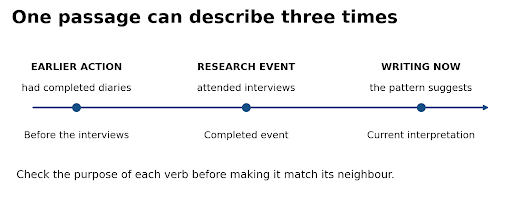
Search for recurring verb phrases such as is, was, has been and will, but inspect each occurrence in context. A bulk replacement can change passive constructions, quotations and statements about the document itself. Compare quoted wording against its source rather than editing it to match your surrounding tense. In a paraphrase, you can choose appropriate tense while preserving the source’s meaning and citation.
For guided practice, Oxford Editors offers academic writing courses. A useful exercise is to explain aloud why each verb belongs to its time frame before editing it.
Use your department’s guidance to settle disciplinary preferences. If a tutor flags “tense inconsistency”, ask which shift misrepresents time or function, then check similar passages. This is more useful than changing every verb in the chapter because one sentence needed correction.
Oxford Editors provides proofreading and editing support for language and consistency review. Check your university’s permitted scope of outside assistance and remain responsible for the meaning of your submitted work.
Frequently Asked Questions
Should An Entire Essay Use One Tense
Usually, no. An essay may report past events, discuss a published argument and offer a current interpretation. Those functions can require different tenses. Follow any disciplinary instructions, then check whether each change is justified by time or purpose. Consistency means applying those choices logically, rather than making every verb in the assignment look the same.
Can Past And Present Tense Appear In One Paragraph
Yes. “The interviews took place in March. The accounts suggest a possible barrier” combines a completed event with an interpretation offered now. The shift is justified if that is your intended meaning. A change between two verbs describing the same completed procedure is more likely to be accidental. Check the function of each clause before correcting it.
Should I Write The Author Argues Or The Author Argued
Use argues when presenting an argument available in the text as part of your current discussion, where your discipline permits that convention. Argued can be appropriate when describing a position in its past context. Neither form is correct solely because of the publication’s age. Make the attribution and intended time clear, and follow your required disciplinary style.
Which Tense Should A Literature Review Use
A literature review can use several tenses. Past simple often reports a particular study’s completed activity; present simple can present an argument or current interpretation; present perfect can connect a body of research to the present. These are tendencies, not a universal chapter rule. Check what each sentence says and consult your department’s examples or required style guidance.
Can I Write Table 1 Shows When The Data Were Collected Earlier
Yes, when you are directing readers to the table in the document as it stands. “Table 1 shows the categories” refers to the display, while “The team collected the data in March” refers to a completed activity. The two tenses can coexist. If you are describing an earlier version of a table, past tense may instead be appropriate.
When Should I Use Present Perfect
Use it when an earlier action or development is connected to the present: “Researchers have examined the issue in several settings”. If you are locating a specific completed event in a finished period, past simple is often clearer: “The team examined the issue in 2021”. Check the intended time frame rather than adding has or have to make the sentence sound formal.
Should I Change Tense Inside A Direct Quotation
Keep an exact quotation faithful to the original, including its verb forms. Its tense may differ from your surrounding sentence because it belongs to the source’s wording and context. Adjust your introduction to the quotation if necessary, or use an accurately attributed paraphrase. Do not silently change quoted verbs merely to make them match the tense of your essay.
Can A Grammar Checker Reliably Fix Tense Changes
Treat its suggestions as prompts for review. A checker may identify a grammatical mismatch, but your notes and sources establish whether an event is completed, ongoing or hypothetical. Review the whole verb phrase and time markers, then check attribution, scope and uncertainty. Accept a suggestion only if the revised sentence still expresses the meaning you intend.