
Dissertation proofreading is a final check for remaining errors and inconsistencies. Editing can go further, addressing wording, clarity and, depending on the service, organisation. The practical difference is how much intervention the draft needs—not whether one service is automatically better.
A dissertation with a settled argument and occasional errors may need a final proofread. A draft with unclear sentences or disconnected sections requires revision before a final check can be useful. However, identifying a need does not establish permission to use an external service: your university’s rules determine what support is allowed.
This guide compares the tasks, shows examples and helps you ask the right questions before booking. Examples are fictional teaching material, not research findings or model text to submit. Suggested revisions demonstrate levels of intervention; they do not imply that a third party may make those changes to assessed work.
Table of Contents
ToggleProofreading focuses on the remaining mistakes in an otherwise prepared document. Depending on the agreed scope, checks may include spelling, punctuation, grammatical errors, inconsistent terminology and presentation. It should not be expected to solve gaps in evidence or develop the dissertation’s argument.
In traditional publishing, proofreading checks the final text and layout after editing and typesetting. Student-facing services sometimes use the term more broadly for checks on a Word manuscript. This difference in usage makes it important to ask what the package actually includes.
For example, a final review might identify a repeated word, inconsistent capitalisation or a heading style that changes between chapters. A check for presentation does not mean the reviewer will investigate whether a finding is accurate. The student must resolve content questions through their own work and appropriate academic guidance.
Agree whether the output will contain comments, suggested changes or corrections. Some university policies permit identifying an error but restrict implementing a correction. A tracked change makes an intervention visible; it does not automatically make that intervention permissible.

Editing is an umbrella term. A provider may use it for detailed language work, a review of structure, or a combined package. Understanding the level matters because the tasks and university restrictions can differ considerably.
Copyediting generally works on the detail of the text, including correctness, consistency and clarity. Language editing may address awkward wording, repetition or sentence flow. These labels overlap between providers, so ask for specific tasks and sample deliverables rather than assuming the name defines the scope.
An editor might identify an unnecessarily long sentence and suggest a clearer arrangement. If the meaning is uncertain, they should ask the author. They should not turn uncertainty into a confident claim simply because the revised sentence reads more smoothly.
Structural or developmental editing addresses broader organisation and content relationships. In a general publishing context, it can involve the order of sections and the shape of an argument. That scope is particularly sensitive for assessed dissertations, where authorship and academic reasoning must remain the student’s responsibility.
A draft that needs substantial reorganisation is often a reason to return to self-revision, supervision or permitted writing instruction. Do not assume a commercially available structural editing package is suitable for your assessed work.
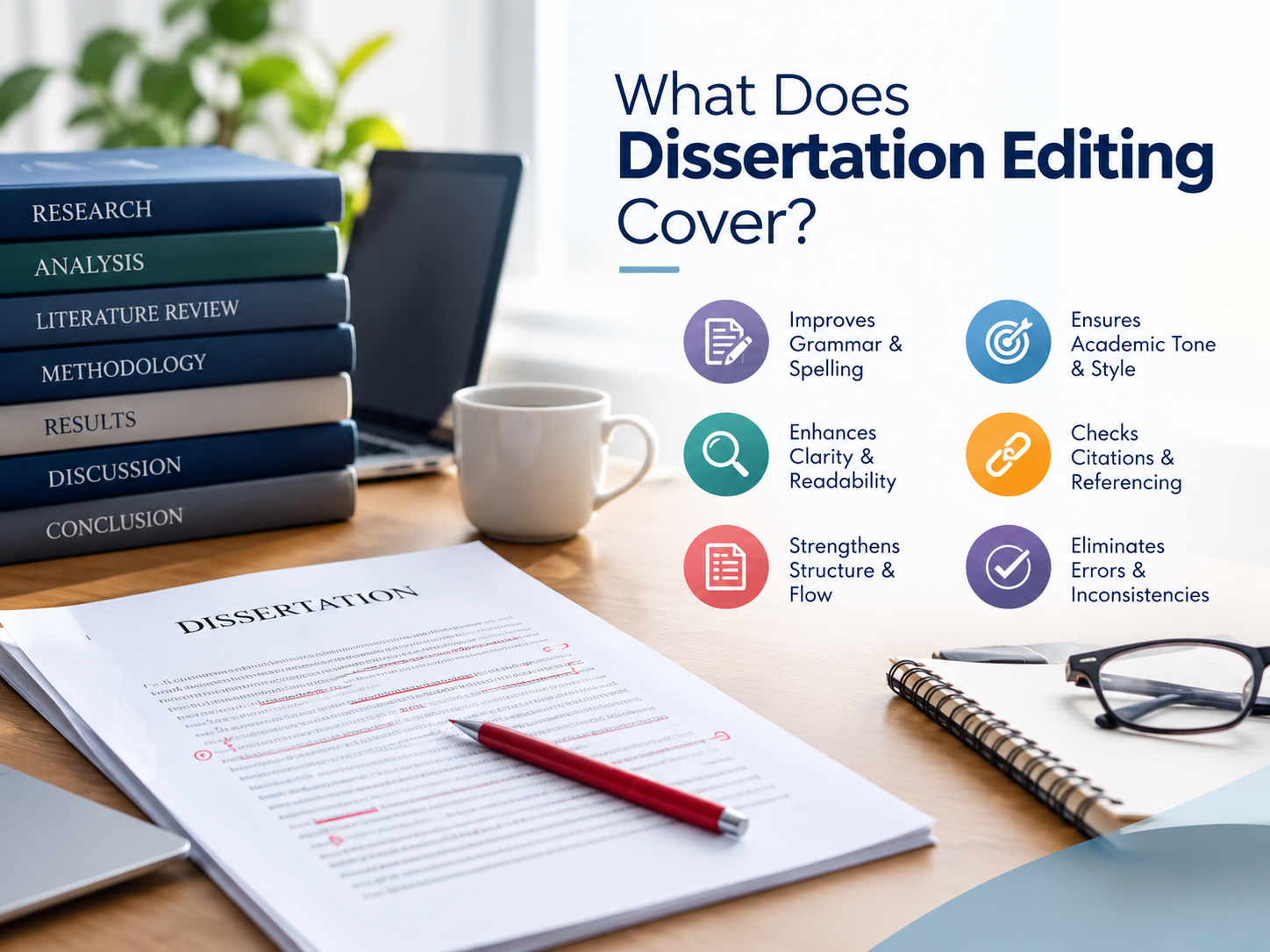
Table 1 describes general service distinctions. It is not a university permission checklist, and the exact inclusions depend on the written agreement.
Table 1. Proofreading and editing compared
Aspect | Proofreading | Editing |
|---|---|---|
Main aim | Find remaining errors | Improve expression or organisation within scope |
Draft stage | After text and presentation are settled | Before the final check |
Typical tasks | Spelling, punctuation and consistency | Clarity, sentence flow; broader work only if agreed |
Meaning | Do not decide academic meaning | Query uncertainty; do not invent meaning |
Deliverables | Agreed comments or visible suggestions | Agreed queries and visible proposed revisions |
Permission | Check your university policy | Check permitted level of intervention |
Notice that grammar and consistency can appear in both services. The difference is not a strict rule that proofreading handles spelling while editing handles grammar. Consider the document’s stage, the depth of work and whether meaning or organisation would be affected.
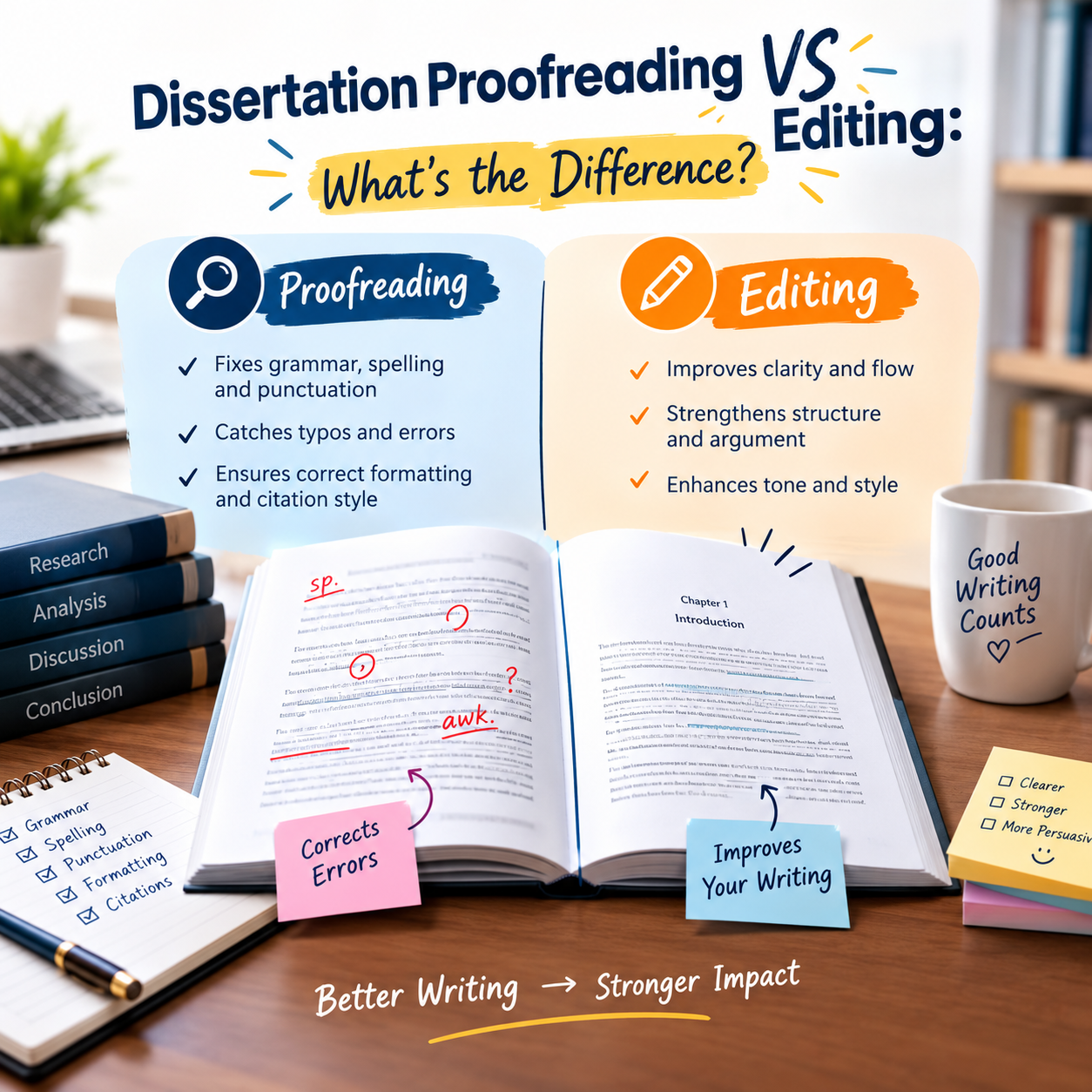
The examples below distinguish an error correction from a broader revision. They are learning illustrations. Apply your institution’s rules when deciding who may identify, suggest or implement a change in your own dissertation.
Table 2. Teaching examples of different interventions
Original or Problem | Correction or Response | Type of Work |
|---|---|---|
recieved | received | Spelling correction |
The participants was interviewed. | The participants were interviewed. | Grammar correction |
The purpose was to carry out an examination of X. | The study examined X. | Language revision; verify meaning |
Advantages followed abruptly by limitations | Comment: Explain how the next point relates. | Student revises the transition |
New unsupported claim in the conclusion | Student reviews evidence and revises the claim. | Content revision; beyond proofreading |
Suppose a paragraph describing advantages is followed abruptly by one about limitations. A comment might ask you to explain the relationship. You could then write an appropriate link based on your own argument. Inserting “however” alone does not fix a missing explanation of why the limitation matters.
If a conclusion introduces a new claim unsupported by earlier discussion, proofreading cannot supply its evidence. Your next step is to assess the claim, consult relevant academic guidance and revise the dissertation yourself. Polishing the sentence would leave the underlying problem unresolved.
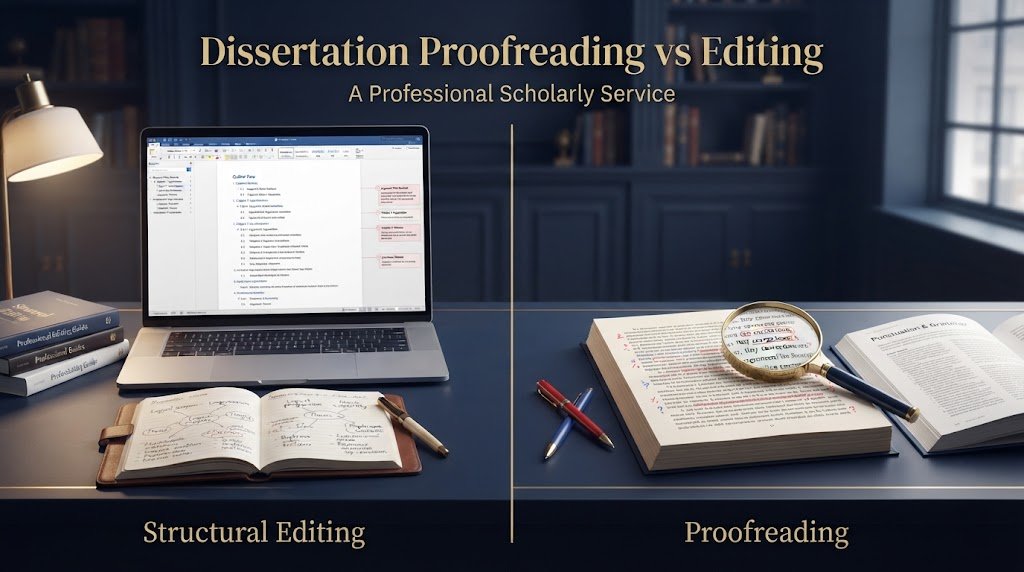
Consider this fictional sentence: “The second group performed better because of the support.” Which group is meant? Better on which measure? What support? Does the study establish causation, or only an association? Different answers would produce different sentences.
A responsible query might say: “Please identify the groups, measure and support, and check whether the causal wording matches your evidence.” The student must resolve those questions. A reviewer should not invent details or replace “because of” with another expression without understanding the intended claim.
This distinction matters in dissertations because language and academic meaning are closely connected. Correcting an obvious error is different from deciding what a finding means. If a change alters interpretation, magnitude or certainty, check it carefully with the original evidence and your supervisor where appropriate.
Start with your institution’s rules, then assess the document. Look at a representative section rather than only the introduction. Ask whether the main difficulty concerns remaining mistakes, expression or the underlying research and argument.
Table 3. Draft problems and next steps
Draft Problem | Support to Consider |
|---|---|
Settled content with occasional errors | Permitted final proofread or self-check |
Awkward wording with clear intended meaning | Self-revision or permitted language support |
Unclear intended meaning | Author clarification; reviewer query |
Weak evidence or unsupported conclusions | Student revision with academic guidance |
Uncertain chapter organisation | Supervisor discussion and student revision |
Inconsistent reference formatting | Check style guide and permitted scope |
Do not buy a deeper service simply because it sounds more comprehensive. If the allowed task is a limited check, a broad editing package may be unsuitable. Equally, requesting proofreading of an unsettled draft can create false confidence that unresolved content issues have been addressed.
If uncertain, describe the difficulty and ask for a written explanation of the proposed work. A useful recommendation should state what will remain outside scope. For assessed work, confirm that scope with your institution before committing.
In a typical editorial sequence, substantial revision comes before language editing, and proofreading follows once the text and presentation are settled. Otherwise, a reviewer may check sentences or page numbers that disappear during later changes.
For a dissertation, begin by responding to supervisor feedback and resolving research or argument questions yourself. Where permitted, arrange the agreed language support next. After reviewing suggestions, settle the formatting and carry out the final error check. This is a planning approach, not a requirement to purchase two services.
A later revision can introduce fresh mistakes. If you add a paragraph after a proofread, check that paragraph and its effects on citations, numbering and references. Ask whether another review is included or separately quoted; an earlier check cannot cover material added afterwards.
Ask explicitly about citations and references. Checking inconsistent punctuation is different from confirming that a source exists, matching every citation to a reference, or rebuilding a referencing system. A package described as proofreading may not cover all these activities, and university rules may restrict some of them.
Likewise, checking the spelling in a table is different from verifying calculations. A figure caption can be inconsistent with the numbering without its underlying data being wrong. Specify what presentation checks are included and retain responsibility for the research content.
Oxford Editors’ service page describes language and formatting checks and distinguishes referencing inconsistencies from full citation verification. Treat that description as a starting point for discussing scope. Your department’s rules still determine which activities are appropriate for your dissertation.
Before sending the file, confirm whether references, footnotes, appendices and captions are included. Explain the referencing style and provide the current departmental guide. Do not assume the dissertation’s assessment word count describes all the material a reviewer would need to examine.
Broader intervention can require more work, but the service label alone does not determine price or turnaround. Document length, condition, format, specialism and deadline all matter. Compare quotes for the same manuscript and the same permitted scope.
The Chartered Institute of Editing and Proofreading identifies level of intervention and urgency among the factors affecting fees. Its rate guidance is not a fixed dissertation tariff. Rather than assuming editing costs a set percentage more, request an itemised quote showing the tasks, chargeable count and final total.
Leave time to evaluate the returned comments and check the final file. A delivery date immediately before submission gives little room to resolve queries. Confirm the return date and time, and clarify charges for new material or a second review before booking.
There is no single answer for every UK university or degree. Read the current policy for your institution, programme and assessment type. Check both who may provide support and what they may do. A provider’s statement that its work is ethical does not replace those rules.
Cambridge’s proofreading statement permits identifying specified errors but prohibits changes to ideas, arguments and structure, and distinguishes advice from making corrections. Swansea’s policy restricts professional third-party proofreading for taught undergraduate and postgraduate students unless specifically approved; it gives separate rules for postgraduate research students.
These examples show why general permission claims are unreliable. They are not rules for students at other institutions. If you cannot establish the allowed scope, ask your department before sending the manuscript. Where acknowledgement or supervisor notification is required, follow that procedure.
You remain responsible for understanding and approving the submitted work. Neither proofreading nor editing establishes that the methodology is sound, the analysis is correct or the dissertation meets every marking criterion. A language review cannot guarantee a grade or an assessment outcome.
Use these questions to turn a general service description into a clear agreement:
Keep a copy of the agreement and review the returned file rather than accepting every suggestion automatically. If a query exposes a content problem, resolve it yourself with appropriate academic guidance. Do not treat the clean version as ready for submission until you have checked it.
If you would like help understanding the appropriate scope for your draft, share a short sample and your university’s proofreading policy with Oxford Editors. Discuss the checks you need and confirm what is permitted before arranging dissertation support.
It may include overlapping language checks, but a separate final proofread is not automatically part of every editing package. Ask whether the service covers a later version after you respond to comments and complete formatting. The quotation should identify the number of passes, the document version and any limitations.
Not necessarily. Assess your draft and university rules first. A settled manuscript may need only permitted final checks, while a draft with unresolved reasoning needs your own revision and academic guidance. Do not assume paying for both services solves every problem. Agree the tasks you need and are allowed to receive.
No. A final error check does not develop the reasoning or provide evidence missing from your dissertation. If your feedback identifies weak analysis, revisit the research and argument with appropriate academic support. A well-written sentence can still make an unsupported claim, so address the substance before focusing on remaining language errors.
Sometimes, but the depth varies. A check may identify typographical inconsistencies without verifying each source or rebuilding references. Ask precisely what is included and consult your university policy, since citation-related intervention can be restricted. Provide the required style guide and retain responsibility for the accuracy of every source you cite.
Language work can affect expression, particularly when sentences are extensively revised. Ask how changes are queried or shown and review whether the wording still represents your meaning. For assessed work, institutional limits take priority. Do not accept a sentence you cannot explain or one that alters the certainty of your findings.
Software may flag spelling or grammar issues, but it cannot establish what you intended or validate your argument. Review suggestions carefully, particularly around technical terms and causal claims. Check university rules on writing tools and AI, as well as document privacy, before uploading research. Automated suggestions remain your responsibility to assess.