
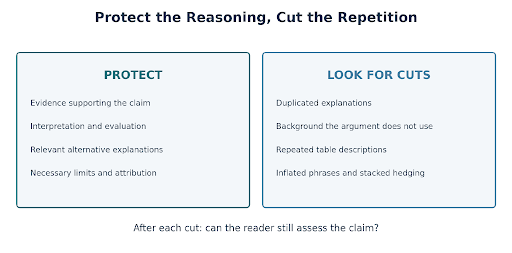
To reduce dissertation word count, first remove repeated explanations and material that does not advance your argument. Then tighten paragraphs and sentences.
Keep the evidence, interpretation, methodological justification and necessary qualifications that allow readers to assess your conclusions. After each substantial cut, check that the reasoning still makes sense.
This guide helps UK undergraduate and master’s students edit an over-length draft. All examples and reduction budgets are hypothetical. Your current handbook determines the word limit and counting rules.
Table of Contents
ToggleRead the assessment brief before editing. Check whether the stated limit is a maximum, a target or a range. Identify what counts: the abstract, headings, in-text citations, quotations, footnotes, captions, text in tables, reference list and appendices may be treated differently. Do not assume that an exclusion used on another module applies here.
Use this calculation: counted draft words minus permitted maximum equals the minimum reduction needed. For example, a counted draft of 10,800 words against a maximum of 10,000 needs a reduction of at least 800 words. This example assumes a strict maximum; it does not imply an additional allowance.
Keep a dated copy of the original draft and record the count using the method your programme requires. Recount the same included sections after each pass. Otherwise, a change in counting method can appear to be an editing saving when you have removed nothing.
Ask your supervisor or programme team about ambiguous exclusions. Moving prose into a table or appendix does not automatically remove it from the count. Even where appendices are excluded, the main text must contain the reasoning and evidence needed to assess your argument.

Before deleting words, identify what each analytical paragraph contributes. Write a short note beside it stating its main claim, evidence and explanation. Then ask which qualification changes the claim’s meaning. This makes it easier to distinguish a redundant sentence from the sentence that explains why the evidence matters.
Paragraph Function | Question Before Cutting |
|---|---|
Claim | What specific point does this paragraph establish? |
Evidence | Can readers still see the basis for that point? |
Interpretation | Have I explained how the evidence supports the claim? |
Critical evaluation | Have I retained relevant disagreement or an alternative explanation? |
Qualification | Would removing this boundary make the claim stronger than the evidence permits? |
Table 1. A paragraph audit for analytical passages. Not every paragraph needs all five functions; use the questions where relevant.
For instance, a sentence explaining why a comparison is unreliable may look less informative than a sentence reporting a percentage. Yet deleting the explanation can leave readers with a misleading comparison. Preserve the analytical relationship, even if you shorten its wording.
See Newcastle University’s guidance on concise writing for advice on expressing complex ideas clearly while retaining nuance.
Create a reverse outline: write one sentence describing the purpose of each paragraph in your completed draft. Read these sentences together. Where two paragraphs make the same point with no added evidence, qualification or development, merge them or retain the stronger one.
Distinguish repetition from progression. Defining a concept in the literature review and using it to interpret a finding later can be necessary. Repeating its full definition and history in the discussion usually adds less. Keep the later application and use a brief reference to the earlier explanation.
Ask what would become harder to understand if you deleted a background passage. A history of an entire industry may be interesting but unnecessary for a narrow study of one decision process. Keep the context that establishes the problem or explains the analysis. Remove tangents that the dissertation never returns to.
When merging paragraphs, choose one clear topic sentence and arrange the remaining evidence around it. Check that the citations still attach to the correct claims. Do not place several unrelated source names at the end of a compressed paragraph and leave attribution ambiguous.
The University of Reading’s academic style guidance suggests ranking paragraph summaries by their importance to the overall answer and checking that deletions preserve essential meaning.
If you need only a small reduction and the structure works, phrase edits may be enough. If you need hundreds of words, examine paragraphs that repeat a point or provide excessive description. A much larger excess calls for reviewing scope and structure against the assessment requirements before polishing sentences.
Do not cut the same percentage from every chapter. An already concise methods chapter may need its remaining detail, while a lengthy background section may repeat material found elsewhere. Allocate cuts according to redundancy and relevance.
Editing Pass | Illustrative Target | Illustrative Actual Saving |
|---|---|---|
Repeated background explanations | 250 words | 270 words |
Duplicated findings descriptions | 200 words | 180 words |
Overlong procedural narrative | 150 words | 160 words |
Sentence and phrase edits | 200 words | 210 words |
Total | 800 words | 820 words |
Table 2. Hypothetical reduction budget for a 10,800-word draft with a 10,000-word maximum. The illustrative savings leave 9,980 words. These are planning figures, not promised savings or recommended chapter allocations.
Keep a reduction log with the original count, revised count and a note on what changed. A target guides attention; it should never force you to remove an essential justification just to complete a row.
Use the table to locate plausible cuts rather than treating every item as a deletion instruction. Adapt the chapter names to your discipline. A humanities dissertation may integrate evidence and interpretation throughout, while an empirical project may separate findings and discussion.
Chapter Or Section | Look For Cuts Here | Protect This Content |
|---|---|---|
Introduction | Broad scene-setting; repeated aims; an overlong chapter roadmap | Research problem, scope and reason for the study |
Literature review | Repeated definitions; detailed accounts of sources not used in the argument | Relevant comparison, disagreement and evaluation |
Methods | Diary-like descriptions of routine tasks; duplicated procedural detail | Design rationale, sampling, ethics and details needed to assess the work |
Results or findings | Prose reproducing every table entry; multiple extracts making an identical point | Main findings, relevant exceptions and sufficient supporting evidence |
Discussion | Full retelling of results; repeated theory summaries; stacked cautious phrases | Interpretation, relevant scholarly connections and competing explanations |
Conclusion | A chapter-by-chapter recap; repeated lists of minor findings | Supported final answer, contribution and essential boundaries |
Table 3. Chapter-specific editing opportunities. Programme requirements override these general suggestions.
Methods need particular care. “The interviews were analysed” may be shorter than a methodological account, but readers still need to understand how the analysis was conducted and why the approach was appropriate. Shorten administrative narrative before removing decisions that affect credibility.
Likewise, retain findings that complicate your preferred explanation when they are relevant. A conflicting case is not expendable merely because it makes a paragraph longer. You can reduce its presentation while preserving its effect on the argument.
For a broader review, consult Loughborough University London’s dissertation editing guidance. It emphasises checking structure and content before proofreading the wording.
These fictional examples use space-separated word counts, which may differ from your required software. Your own scholarly claims still need appropriate citations.
Original (64 words): In the interviews, students repeatedly mentioned that the library closed before they finished their evening shifts. This was a point that occurred several times in the interviews. These accounts suggest that restricted opening hours can limit access for students who work late. However, because the study interviewed only students from one course, the finding cannot establish how common this difficulty is across the university.
Shortened (41 words): Interviewees reported that the library closed before their evening shifts ended, suggesting that opening hours can restrict access for students who work late. Because participants came from one course, the study cannot establish how common this difficulty is across the university.
The edit saves 23 words by removing a repeated statement about the interviews and tightening the wording. It keeps the reported difficulty, the interpretation and the sample boundary. It also preserves “suggesting” because the accounts support a cautious interpretation.
Over-cut version: “Library opening hours prevent working students from studying.” This loses the source of the evidence, broadens the claim and removes its limitation. It also changes restricted library access into a claim about studying generally. A shorter passage must retain the actual subject of the research.
Original (75 words): The managers interviewed described supplier familiarity as an important consideration in their purchasing decisions. They explained that they preferred suppliers whose routines they already understood. This suggests that established relationships may reduce perceived coordination demands. An alternative explanation, however, is that familiar suppliers were also those offering more reliable delivery. Since the interviews did not independently compare delivery performance, the study cannot determine whether familiarity itself shaped supplier choice or whether it reflected perceived reliability.
Shortened (41 words): Managers preferred suppliers with familiar routines, suggesting that established relationships may reduce perceived coordination demands. However, familiarity may also reflect perceived delivery reliability. Without independent delivery comparisons, the study cannot distinguish familiarity from perceived reliability as an explanation for supplier choice.
The edit saves 34 words. It combines the initial finding and explanation while retaining the competing interpretation and the reason it remains unresolved. “Perceived” matters because the interviews do not establish actual delivery reliability.
Over-cut version: “Supplier familiarity reduces coordination demands and determines purchasing decisions.” This turns an interpretation into a causal conclusion and eliminates the alternative explanation. At master’s level, removing this reasoning can sacrifice the critical evaluation that gives the paragraph value.
Original Wording | Possible Shorter Form | Check Before Replacing |
|---|---|---|
In order to examine | To examine | The purpose stays the same. |
Due to the fact that | Because | The sentence still expresses the intended reason. |
Conducted an analysis of | Analysed | The actor and action remain accurate. |
It could perhaps possibly indicate | It may indicate | Retain appropriate uncertainty. |
A number of participants | Several participants | Use the exact number if it matters and is known. |
At this point in time | Now or at that stage | Keep the time reference clear. |
Table 4. Phrase edits to consider in context. These are options, not automatic replacements.
One suitable uncertainty marker often does more work than several stacked together. However, “may increase” cannot become “increases” merely to save a word. Nor should “was associated with” become “caused”. Check the strength of the revised claim against the original evidence.
Do not remove technical terms solely because simpler words are shorter. “Statistically significant” has a specific meaning that “important” does not preserve. Retain comparison groups, time periods, units and conditions when they change the interpretation. A precise sentence may need more words than a misleading one.
Paraphrase a lengthy scholarly quotation when the idea matters more than its exact wording. Preserve the meaning and citation. Retain direct wording when it is the object of close analysis, a definition requiring precision or participant evidence whose expression matters.
Where your conventions permit shortening a quotation with an ellipsis, check the full passage so the omission does not distort its meaning. Do not silently rewrite quoted words. For participant extracts, retain the context needed to understand the statement and follow your discipline’s reporting conventions.
Use tables for genuine comparisons or repeated records. Keep prose explaining the analytical point rather than describing every cell. Appendices can hold suitable supplementary material when permitted, with accurate references in the body. Essential reasoning must remain visible in the main text; relocation is not a substitute for editing.

Read the changed paragraph beside the paragraphs before and after it. Check whether a pronoun such as “this” has lost its referent, or whether a later section relies on a definition you removed. Repair links with concise wording where needed.
Check citations against the revised claims, then audit cross-references, table numbers and appendix labels. If a source has disappeared entirely from the text, review its reference-list entry according to your referencing requirements. Recalculate the count using the same rules as your initial calculation.
Finally, read the introduction and conclusion together, then trace the main argument through the body. Confirm that each important conclusion still has support. Stop cutting when further reductions would remove required evidence or explanation; seek guidance if you remain over the limit.
For broader organisation, see Oxford Editors’ dissertation guide alongside your departmental instructions.
Oxford Editors describes its reference and citation support for students checking attribution and consistency after revisions.
For developing your own editing skills, explore its academic writing courses.
If you need feedback on clarity and repetition in your own draft, explore Oxford Editors’ proofreading and editing support. Check the assistance permitted by your assessment and retain responsibility for all analytical decisions.
Only if your current assessment rules explicitly allow it. There is no universal UK allowance that applies to every dissertation. Check whether the number is a strict maximum, a target or a range, and read any penalty rules. If the wording is unclear, obtain guidance from your programme team rather than relying on advice from another course.
They may do, depending on the assessment rules. Check in-text citations separately from the reference list, since their treatment can differ. Also check quotations, captions and footnotes. Record the programme’s requirements before counting so that your original and revised totals use the same included sections and counting method.
Do not move essential interpretation into an appendix just to reduce the count. Readers need the reasoning supporting your conclusions in the main text. Supplementary material may be suitable for an appendix if your programme permits it and you refer to it clearly. Check both its academic purpose and its treatment in the word count.
Begin with the structure rather than removing isolated words. Summarise each paragraph’s purpose, identify duplication and review unnecessary background or description. Set a provisional reduction budget across those areas, then tighten the remaining prose. The available savings depend on the draft; do not remove required analysis simply to reach a numerical target.
Review long quotations, but judge their function before replacing them. A scholarly idea may be paraphrased with a citation if its exact wording is unnecessary. Close textual analysis or qualitative findings may need direct extracts. Keep sufficient evidence and explain its significance rather than applying a blanket rule against quotation.
Follow your discipline’s conventions for representing participant speech and marking omissions. Check the original extract so that shortening preserves its meaning and relevant context. Do not combine fragments to suggest something the participant did not say. An extract used as evidence should remain faithful even when its presentation becomes more concise.
Tools may count document elements differently, and their handling of word boundaries may differ. Compare which sections each includes, especially footnotes, text boxes and captions. Use the method required by your programme rather than selecting whichever gives the lowest figure. If conflicting totals affect compliance, ask the programme team how to report the count.
Ask when the rules are unclear or when substantial cuts would affect the project’s required scope, evidence or methodological account. Bring a paragraph audit and proposed cuts so the discussion is specific. You can seek guidance on priorities while retaining responsibility for revising the argument and checking the final submission.