
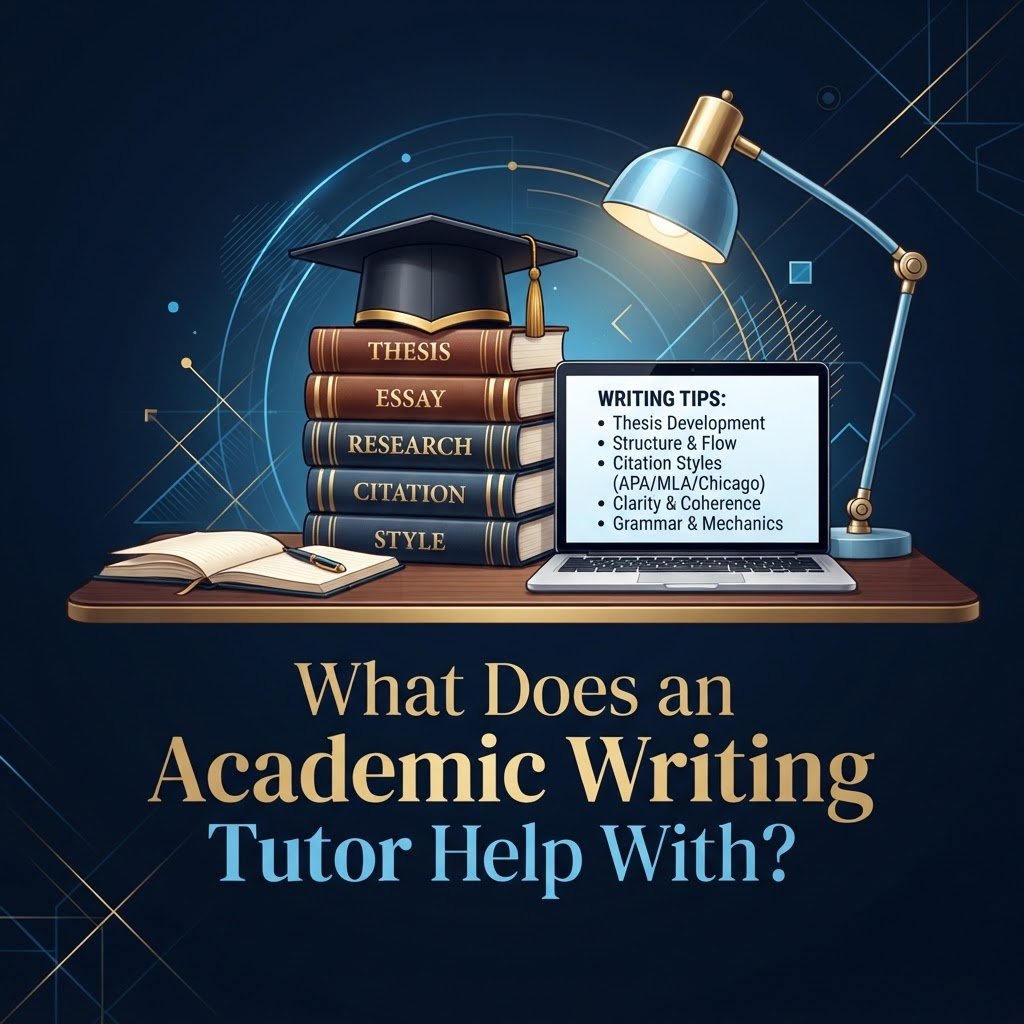
An academic writing tutor helps students develop the skills needed to plan, write and revise university work. Support may include understanding an assignment question, organising ideas, building paragraphs, evaluating evidence, using sources and expressing a point clearly. The aim is for you to understand the writing decisions and apply them yourself.
You do not need a complete essay before seeking support. A question, outline, short draft or piece of lecturer feedback can provide a starting point. What a tutor can review depends on the service and your institution’s rules, so agree the scope before sharing assessed work.
This guide explains common areas of academic writing support, what a session might involve, and how tutoring differs from other services. All student situations and sample sentences are illustrative teaching examples, not accounts of real clients or published research findings.
Table of Contents
ToggleA tutor can help you read the instructions carefully and separate the topic from the task. Knowing that an essay concerns remote working is different from recognising that it asks you to evaluate its effects. The second tells you what kind of response to develop.
Consider this fictional question: “Evaluate the benefits and limitations of remote working for new employees.” A tutoring discussion might identify three elements: evaluation rather than a list, both benefits and limitations, and a focus on new employees. You would then decide which course concepts and evidence could address those elements.
Useful questions include: What needs defining? What does the marking rubric emphasise? Which claims require support? Is the proposed scope manageable within the word limit? A writing tutor can help you formulate these questions, but your module lecturer remains the person to ask about ambiguous assessment requirements.
When your notes are extensive but your argument is unclear, tutoring can help you develop a plan. You might group material into themes, test the order of sections and identify where an idea does not answer the question. You still select the position you intend to defend.
For the remote-working example, a plan might compare opportunities for flexibility with challenges around learning from colleagues. The tutor could ask why those sections belong in that order and how they contribute to your overall answer. This checks the reasoning behind the structure, rather than simply assigning headings.
A useful exercise is to write one sentence describing what each section contributes. If two sections do the same job, you may need to combine them. If a section provides background without helping the argument, decide how much of that background the reader actually needs.

A tutor can help you see why a paragraph feels incomplete even when its sentences are grammatically correct. The issue may be a missing point, unexplained evidence or no connection to the question. University guidance on structure addresses these relationships, rather than treating paragraphs as containers of a fixed length.
Imagine a draft says: “Remote working offers flexibility. New employees need support. Organisations use online meetings.” These statements name relevant topics, but they do not explain how the ideas connect. A tutoring discussion could ask: What claim are you making? What evidence have you read? Why does it matter for new employees?
A possible teaching revision is: “Flexibility alone may not meet a new employee’s learning needs. To evaluate remote working, the discussion must also consider access to guidance and opportunities to ask questions.” This illustrates a clearer connection; it does not establish an empirical finding. A real assignment would need relevant evidence.
You could practise revising one paragraph during a session, then apply the same questions to another independently. A point–evidence–explanation pattern can be a useful starting exercise, but it is not a compulsory structure for every paragraph or discipline.
Students often seek academic writing tutoring after receiving feedback such as “too descriptive”. A tutor can help you understand the difference between reporting what a source says and evaluating its contribution to your question. Critical analysis involves judgement supported by reasons, rather than simply finding faults.
A description might explain that a study used interviews. Analysis would consider what those interviews help the researcher understand, what they cannot establish and how that affects your use of the findings. The appropriate questions depend on the discipline and research you have actually read.
For example, you might ask whether evidence from experienced staff answers a question about new employees. That question identifies a possible limit in applicability. It does not automatically make the study weak. A tutor can help you express the distinction while you make the subject-specific judgement.
Useful practice questions are: What does this evidence support? What assumptions does the explanation depend on? How does it compare with another source? What conclusion is justified? The goal is to develop your reasoning, not to insert critical-sounding phrases into every paragraph.
A writing tutor can help you integrate reading into your discussion instead of producing a sequence of disconnected summaries. You might practise introducing a source, explaining its relevance and comparing its contribution with another. You remain responsible for reading and understanding the material.
Tutoring can also address paraphrasing. A useful exercise is to explain an idea without looking at the original sentence, then compare the meaning and add the appropriate citation. Changing individual words is insufficient if the structure and expression still closely follow the source.
Referencing support should use your department’s guide. You might learn how a citation connects to a reference-list entry, identify missing information or recognise the difference between citing a chapter and its edited book. Ask whether the service teaches these skills or offers a separate reference-checking service.
Do not expect a writing tutor to supply sources you have not read or manufacture references for unsupported claims. If you need help finding literature, your university library can advise on search tools and databases. Subject relevance may require discussion with your lecturer or supervisor.
Academic writing support can help you make a sentence precise without making it unnecessarily complicated. A tutor may discuss vague terms, excessive certainty, long sentence structures or inconsistent terminology. Students writing in an additional language may also want focused practice on recurring patterns.
Compare the teaching sentences “This proves the approach always works” and “The evidence supports this approach in the setting examined.” The second sets a narrower scope. It is appropriate only if that wording accurately represents the evidence; cautious language must not disguise uncertainty you have not investigated.
You might keep a personal record of recurring issues and practise checking for them in new work. Whether first-person language, passive voice or particular terminology is appropriate depends on the discipline and task. A tutor should explain choices in context rather than impose blanket rules about academic style.
A comment such as “unclear argument” tells you there is a problem but may not tell you how to address it. Tutoring can help you identify where the issue occurs and turn feedback into a manageable practice task. Bring the marked work as well as the comments.
Table 1 gives illustrative actions to discuss with a tutor. They are starting points, not definitive interpretations of a marker’s intentions. If the meaning remains uncertain, ask the person who provided the feedback.
Table 1. Illustrative feedback and learning actions
Feedback | Possible Tutoring Task |
|---|---|
Too descriptive | Examine one paragraph and identify the missing evaluation. |
Unclear argument | State your proposed answer and test each section against it. |
Claims need support | Mark unsupported statements and decide what evidence is needed. |
Poor flow | Explain the relationship between adjacent paragraphs. |
Choose one or two priorities for the next piece of work. Trying to fix everything at once can leave you without a clear focus. After revising, explain what you changed and why; that explanation helps you distinguish learning a method from following someone else’s instructions.
For longer work, a tutor may help you examine whether chapters connect and whether terminology remains consistent. A discussion could focus on explaining the purpose of a literature review, maintaining the thread of an argument or making a chapter introduction easier to follow.
This support complements the supervisor’s role. Research design, ethics requirements, subject interpretations and approval of the project belong with the appropriate academic staff. A writing tutor should not independently validate your methodology or replace supervisory decisions.
For example, if you are unsure whether your sample supports a particular claim, ask your supervisor about the research judgement. You might then work with a writing tutor on expressing the agreed limitation clearly. Keep these responsibilities distinct when choosing dissertation writing support.
Oxford Editors describes online academic writing courses that include an initial writing assessment, dedicated tutoring, language support and guidance on longer documents. Confirm the current scope and how it fits your institution’s rules before arranging support.

The format varies, but a useful session has a defined learning goal. You might arrive wanting to explain why your paragraphs feel disconnected. The tutor could first ask you to describe the argument, then discuss a short section and help you identify its missing links.
An illustrative session could involve agreeing one priority, examining a sample, practising a revision and setting an independent task. You might leave with two paragraphs to review using the same questions. This is an example of a learning approach, not a confirmed session schedule for Oxford Editors or another provider.
Ask in advance whether the tutor reviews material before the meeting, how much text you can send and whether written notes are included. A short appointment may support focused discussion rather than a review of an entire dissertation. Be realistic about what can be covered.
Bring the assignment brief, marking criteria, institution’s rules on external support and a manageable writing sample. Previous feedback is helpful when you want to work on recurring difficulties. If you have no draft, bring your notes and specific questions about the task.
Choose questions such as “Where does my explanation stop short?” or “How can I show why these sources disagree?” These are easier to work through than a request to improve everything. Include your deadline so the tutor understands how much practice time remains.
The services below serve different purposes, although some providers offer more than one. Check the actual activities included instead of relying solely on a label.
Table 2. Purposes of academic support
Support | Main Purpose |
|---|---|
Writing tutor | Teaches writing decisions through discussion and practice. |
Proofreader | Checks final language and presentation within an agreed scope. |
Editor | Reviews or changes expression and organisation as permitted. |
Subject tutor | Helps with disciplinary concepts and understanding. |
Supervisor | Guides the research project and relevant academic decisions. |
For assessed work, keep authorship and academic decisions with yourself. Check the permitted level of external advice, draft review and correction. If a service proposes rewriting your argument or producing submission content for you, that falls outside the learning-focused tutoring described here.
First check what your university already offers through writing centres, libraries or study-skills teams. Eligibility, booking arrangements and scope vary. If considering private tutoring, ask about relevant teaching experience, familiarity with your assignment type and how sessions help you practise independently.
Clarify fees, session length, preparation time, cancellations and document handling before booking. Ask how the tutor adapts to your goals rather than assuming a standard programme suits every student. A tutor cannot know your marker’s decision or guarantee a particular grade.
Progress can be practical: you can explain your paragraph’s purpose, identify a missing citation or recognise when a conclusion exceeds its evidence. Compare a new sample with an earlier one and describe the decisions you made. Grades provide context, but they are not a direct measure of one tutoring session.
If you would like guidance on a recurring writing difficulty, share your goals and a short sample with Oxford Editors to discuss its online academic writing tutoring. Include your university’s support rules so you can agree on a suitable learning focus before starting.
Not necessarily. You may want help understanding a question or organising an outline before writing. Ask what the tutor accepts and whether they need material in advance. Bring a focused goal and your assignment instructions. A draft is useful for paragraph-level discussion, but it is not the only starting point.
Yes, where the service includes relevant language and writing instruction. Support may address sentence patterns, academic vocabulary or unfamiliar conventions. International students can also need help with argument and structure, just like other students. Agree your actual learning goals rather than assuming nationality or first language determines the support required.
Learning-focused tutoring should help you make and understand your own revisions. Activities may include questions, feedback and practice exercises within institutional rules. Do not assume that every form of draft correction is permitted. Check the allowed scope and retain responsibility for your ideas, evidence, wording and final submission.
There is no universal number. A specific difficulty may suit a focused discussion, while recurring problems may need practice and follow-up. Ask for a learning plan based on your sample, goals and available time. Review whether you can apply the methods independently before deciding whether further sessions are useful.
No. Assessment depends on the submitted work and the relevant criteria, including subject knowledge, evidence and analysis. Tutoring can provide opportunities to develop writing skills, but outcomes vary. Agree learning objectives you can evaluate, such as clearer source integration or a more focused plan, rather than relying on a grade promise.
An online session can support discussion of a shared draft and focused writing practice. Its usefulness depends on the teaching approach, preparation and your participation. Confirm the platform, document-sharing arrangements and what happens afterwards. The delivery format alone does not show whether the support matches your goals or university requirements.