
When you have read an assignment too many times, another ordinary reread may miss the same mistakes. Change the way you inspect it: take a break if possible, alter the viewing format temporarily, listen while following the text, or check one sentence at a time. Give each pass a specific job. Then verify your corrections and inspect the file you will actually submit.
This guide explains how to proofread an assignment that has become too familiar to read closely. It is for UK undergraduate and master’s students who know what they meant to write but need to check what is actually on the page. The methods are options to try, not guarantees of an error-free submission. The examples are fictional teaching extracts.
Why Another Normal Reread Can Miss The Same Mistakes
You may recognise a paragraph so quickly that you anticipate its wording. A missing word, repeated phrase or incorrect number can then fit into the version you remember. Newcastle’s proofreading guidance describes the difficulty of seeing what you think your writing says rather than what it does say. The practical response is to change the task you give your attention.
See Newcastle’s proofreading guidance for techniques that create distance from a draft and encourage slower inspection.
Notice what happens during your next read. Are you reaching the end of a sentence before looking at every word? Are you making stylistic changes because you cannot decide whether anything is wrong? Are you repeatedly checking the introduction while overlooking captions and references? These are reasons to choose a more specific pass rather than start at the beginning again.
Proofreading checks the final draft for language, small errors and presentation. If you discover a missing argument or an unsupported conclusion, record it as a substantive revision. After revising that material, proofread the changed passage again. Trying to rewrite the argument and inspect every comma at once makes the purpose of the read unclear.
Create Distance Before You Start Again
Take A Break That Your Deadline Allows
If you can plan ahead, finish the main revisions early enough to leave the draft alone before proofreading. Newcastle suggests a day or two where possible. That is a planning suggestion, not a minimum waiting period or a promise that errors will become visible. Canterbury Christ Church also notes that even a short break can help you return with a fresh view.
Read Canterbury Christ Church’s proofreading and editing advice for practical approaches including breaks, reading aloud and reverse sentence order.
If the deadline is close, save the draft, step away briefly where feasible and return with one defined task. Do not spend all remaining time waiting for an ideal break. Avoid using the break to rehearse the same paragraph on your phone; the aim is to interrupt the immediate editing routine.
Change The View Without Damaging The Submission Version
Try a printed copy, a different zoom level or a temporary change of font or spacing. Choose a view that is comfortable and accessible for you. You do not need to make the writing difficult to read. A different view may help you slow down, but it is useful only if you continue inspecting the words.
Save the submission version first. If you change formatting in a working copy, record corrections and transfer them carefully, or restore the required format before submission. A font change can alter pagination and table wrapping. The temporary checking view is not evidence that the final document layout is correct.
Choose A Method That Interrupts Your Usual Reading
Read Aloud Or Listen While Following The Text
Read exactly what is written, including awkward wording, rather than repairing it as you speak. Pause when a sentence is hard to say, when an expected word is absent or when two words repeat. Mark the location before editing so you do not lose the problem. A text-to-speech reader offers another way to hear the draft without relying entirely on your own delivery.
Follow the displayed words while listening. Audio alone cannot reliably distinguish words that sound the same, such as principal and principle, or confirm spelling in a source title. Numbers, abbreviations and formulae may also be read unexpectedly. Use listening to identify passages to inspect, then verify the written form.
Inspect One Line Or Sentence At A Time
Use a ruler, a sheet of paper or the on-screen selection to guide your attention. Read the visible unit before moving down. Check short words as deliberately as long ones: not, of and to can change or complete the meaning. Keep enough surrounding text available to interpret the sentence correctly.
Reverse Sentence Order For Local Errors
Start with the final sentence of a paragraph, then check the preceding sentence, continuing backwards. Keep each sentence’s words in their normal order. This interrupts the familiar sequence and can help you inspect local wording without following the argument automatically. It is not a suitable final test of paragraph logic; reread the passage in normal order afterwards.
| Method | Useful Target | Limit To Remember |
|---|---|---|
| Read aloud or follow text-to-speech | Missing words, repetition and awkward sentence boundaries | Sound alone does not verify homophones or source details. |
| Line-by-line inspection | Small words and local punctuation | Keep enough context to understand the claim. |
| Reverse sentence order | Local errors hidden by familiar paragraph flow | Return to normal order to check connections. |
| Temporary visual change | A draft you skim automatically in its usual layout | Restore submission formatting and inspect it. |
| Compare against a record | Numbers, names, quotations and reference details | Check the authoritative record; do not guess. |
Table 1. Choose the method for the problem you want to detect. You do not need to use every method on every page.
See Coventry’s polishing and proofreading tips for reading aloud and inspecting sentences individually from the end.
Give Each Proofreading Pass One Job
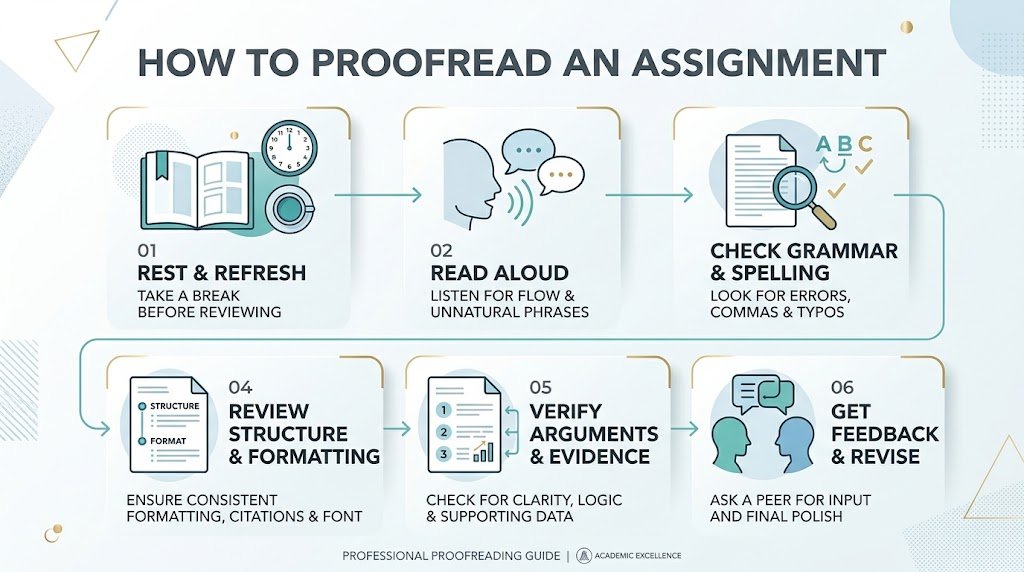
Instead of asking “Is this all correct?”, identify a target you can actually check. Use previous tutor feedback to select two or three recurring issues. If you often omit articles, inspect noun phrases. If feedback highlights long sentences, inspect sentence boundaries. A personal list is more manageable than trying to memorise every possible academic writing error.
Keep a separate pass for information that needs comparison: author names, years, quotation wording, table numbers and numerical statements. These can sound fluent even when wrong. Open the relevant source or working record and compare the details side by side. Remembering what a figure probably was is not verification.
Then check the presentation in its own view: headings, figure captions, table labels, page numbers and references. Material outside the main paragraphs can be easy to overlook after repeated essay reading. Follow your assessment’s actual formatting instructions rather than a generic checklist found elsewhere.
Keep a short record of completed checks, such as “main text checked for repeated words” or “sample totals compared against the final data record”. This helps you resume after a break and gives the next pass a purpose. Do not describe the entire assignment as checked when you only reviewed a few pages.
Worked Examples Of Errors Familiarity Can Hide
Undergraduate Example With A Missing Word And Repetition
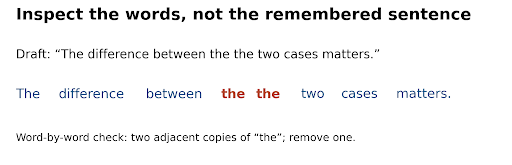
Assume the student’s supported argument is that a proposed explanation fails to account for a difference between two cases. The draft says: “The explanation does account for the difference between the two cases.” A fluent reread may overlook both the missing negation and the duplicated article.
Corrected teaching extract: “The explanation does not account for the difference between the two cases.” Checking the words individually exposes the repeated the. Reading the sentence against the paragraph’s established argument identifies the missing not. A reader cannot safely insert not from grammar alone: the original sentence is grammatical and could express a different argument.
Before making the correction, confirm the intended position from the analysis and evidence. If the explanation actually accounts for the difference, adding not would be wrong. Proofreading must preserve the supported meaning, even when the sentence you remember differs from the sentence on the page.
Master’s Example With A Numerical Mismatch
Imagine a completed master’s project in which the verified final participant record lists 42 interviewees and Table 2 correctly reproduces that total. The discussion mistakenly says “The 24 interviewees described the service differently”. Both numbers are plausible, so neither listening nor a grammar checker establishes which is correct.
Compare the prose, table and final record. In this teaching scenario, change 24 to 42 because the verified record supports 42. Also check whether the sentence refers to the full sample or a subgroup. If 24 participants answered that particular question, it could be the relevant count even when the total sample is 42. Match the number to the exact population being described.
| Overlooked Problem | How To Check | Verified Correction |
|---|---|---|
| The the two cases | Inspect the sentence word by word. | Remove one repeated the. |
| Does account when the supported argument says it does not | Compare the sentence with the analysis and evidence. | Insert not only after confirming the intended claim. |
| 24 interviewees when the verified relevant total is 42 | Compare prose and table with the final participant record. | Use 42 for that same population; retain subgroup counts where relevant. |
Table 2. A technique finds a candidate problem; the context or original record confirms the correction.
Oxford Editors’ reference and citation support is relevant when you need help checking reference presentation. Whether outside assistance is allowed depends on your university’s requirements.
Use A Short Routine When The Deadline Is Close
If you have approximately 30 minutes for a short assignment, use a focused allocation rather than start an unlimited reread. The example below is an editorial suggestion, not a university requirement or enough time to check every long dissertation. Reserve any upload time separately and adapt the priorities to your draft’s known problems.
| Suggested Time | Task | Completion Check |
|---|---|---|
| First 3 minutes | Save the draft and choose the most relevant error targets. | You know which version and sections you are checking. |
| Next 12 minutes | Inspect priority passages slowly or follow read-aloud playback. | Mark and correct specific wording errors. |
| Next 8 minutes | Verify key names, quotations, citations and numerical statements. | Corrections agree with the source or relevant record. |
| Final 7 minutes | Reread changed passages; inspect required final format. | The correct file opens and the changed text makes sense. |
Table 3. Suggested 30-minute routine. The allocations sum to 30 minutes; they are not measured effectiveness data.
Prioritise passages edited most recently and details whose errors could materially change the meaning. Do not assume the introduction deserves all the time because it appears first. If you find a substantive problem, address it honestly and recheck the revision. Do not replace careful verification with a hurried rewrite that adds unsupported content.
Recheck Your Changes And The Actual Submission File
After a correction, read the whole sentence and its neighbouring sentences in normal order. Removing a duplicated word may be simple; changing a number or negation requires checking the associated claim. Make sure a local correction did not create a new punctuation problem or leave a reference to an old table label.
Restore the required font, spacing and margins if you changed them for checking. Open the actual file you intend to upload. If your course requires a PDF, inspect the exported PDF as well as the editable draft. Check that tables, symbols, captions and page breaks survived conversion and that the file contains the intended final version.
Use a stopping point based on completed checks: your selected error categories have been reviewed, important details verified, changes reread and final format inspected. This does not prove there are no remaining errors. It gives you a defensible end to the task instead of another aimless reread or unnecessary last-minute stylistic change.
For practice building your own editing routine, explore Oxford Editors’ academic writing courses.
Oxford Editors also offers proofreading and editing support. Check your course’s rules before involving another person or using editing tools; permitted assistance varies, and you remain responsible for the submission.
Frequently Asked Questions
Why Do I Keep Missing Mistakes In My Own Assignment?
A familiar draft can be difficult to inspect because you already know what you intended to write. University proofreading guidance recommends creating distance or slowing attention to the actual words. Try a defined pass with a different method, such as listening while following the text or inspecting sentences individually. Do not treat repeated reading alone as evidence that the draft is accurate.
How Long Should I Leave A Draft Before Proofreading?
Where your schedule allows, finishing early enough to leave it for a day or two can create useful distance. There is no universal required waiting period. Even a short break may help, but it cannot guarantee better checking. If the deadline is close, use the available time for targeted inspection and leave enough time for the required submission process.
Does Changing The Font Help?
It is a technique to try when the usual layout encourages skimming. Use a readable, accessible alternative or change zoom or spacing instead. The point is to inspect the text differently, not to make it uncomfortable to read. Preserve your submission version and restore required formatting afterwards. Check the final layout because a font change can affect pagination and tables.
Should I Read Words Or Sentences Backwards?
For a useful local check, work through sentences from the end while keeping the words inside each sentence in normal order. This interrupts the familiar paragraph sequence. It does not establish whether the argument flows well. Afterwards, read the passage normally. A word-by-word inspection is another option for repeated words or spelling, but still needs a meaning check.
Is Listening To The Assignment Enough?
No single method checks every kind of error. Listening can help you notice missing words, repetition or awkward phrasing, especially if you follow the displayed text. It cannot reliably distinguish homophones or verify a number, author name or source title. Use visual inspection and comparison with original records for those details, then reread any corrections in context.
What Should I Check When Only 30 Minutes Remain?
Choose known recurring errors and passages changed recently, then verify important source details and numerical statements. Recheck your corrections and open the final submission file. Adapt the suggested routine to the assignment’s length and risks; it is not a complete dissertation review. Reserve upload time separately rather than allowing proofreading to consume the entire remaining period.
Can Someone Else Proofread My Assignment?
Do not assume permission. Universities and assessments can place different restrictions on third-party proofreading, editing and automated tools. Check your current institutional and module guidance before asking a friend or paying for help. If assistance is allowed, agree to the permitted scope and any acknowledgement requirements. You remain responsible for the wording, evidence and meaning of the submitted work.
How Do I Know When To Stop Rereading?
Stop when you have completed your planned checks, verified important details, reread changes and inspected the final file. If a specific unresolved error remains, check it directly. Another unrestricted reread is less useful when it has no target. Avoid making optional stylistic changes at the last moment unless you can recheck their meaning and the resulting layout.