
A dissertation conclusion should give readers the final answer established by your work, the most important insights behind it and a clear statement of the study’s value within its limits. Include implications, recommendations or future research when your task requires them and your evidence supports them. Leave out new results, lengthy procedures and claims that the dissertation has not justified.
Deciding what a dissertation conclusion includes is therefore an editing task as much as a writing task. You are choosing what the reader needs to retain, rather than compressing every chapter into a smaller version. A strong ending makes the completed argument clearer without opening a different investigation.
This practical guide is for UK undergraduate and master’s students. It uses fresh, fictional examples about reusable cups and digital archives. All project details and sample conclusions are teaching illustrations. Your handbook and supervisor’s guidance take priority over a general template.
Table of Contents
ToggleMaterial In Your Draft | Editing Choice | Reason |
|---|---|---|
The final supported answer | Keep | It tells readers what the work established. |
The decisive findings | Condense | Retain their combined significance, not every detail. |
A limitation changing the conclusion | Keep briefly | It sets the boundary on the final message. |
Full data tables or lengthy extracts | Move | Present evidence in the appropriate earlier chapter. |
Detailed recruitment or coding procedures | Move | Method detail belongs in the methodological account. |
A previously justified implication | Keep if relevant | It explains why the work matters. |
A recommendation requiring new evidence | Remove or justify earlier | The ending cannot supply a missing case. |
An entirely new theory or analysis | Move and develop earlier | The conclusion should not introduce a fresh argument. |
Generic praise of the topic | Remove | It obscures the specific contribution. |
Table 1. A content-selection aid. “Move” means revise the material in its appropriate location, not relocate it without checking its relevance.
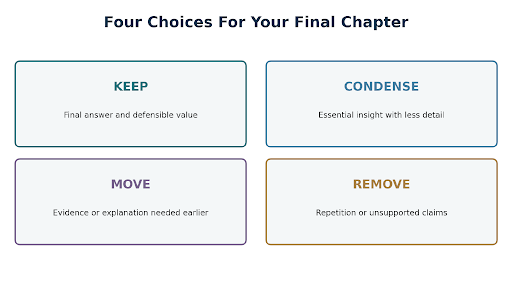
Keep asks whether the sentence contributes to the final answer. Condense asks whether its detail exceeds that purpose. Move asks whether the reader needed it before reaching the conclusion. Remove asks whether the passage contributes anything justified at all.
The University of Portsmouth guidance on writing conclusions recommends selecting significant points rather than narrating the assignment’s structure or overstating its impact.
Start with the study’s purpose and the answer your dissertation supports. Bring together the few findings or arguments that make that answer understandable. Explain the contribution in specific terms, preserve the limitation that most affects the message and include any justified next step required by your programme.
The University of Westminster guidance on dissertation structure advises that the conclusion should follow logically from the preceding work and avoid a new direction or excessive detail.
Your dissertation conclusion structure should serve those functions. You may use short subsections where the chapter is substantial or the handbook asks for them. A shorter conclusion may work as connected paragraphs. Neither format excuses a vague answer or a list of chapter contents.
A useful drafting order is to write the final answer first, then choose the supporting insights, contribution, essential boundary and closing message. You can arrange them differently in the finished chapter. Avoid keeping a paragraph simply because it took time to write.

A dissertation contribution can be a focused account of a local context, a careful comparison, a clarification of an assumption or an application of an established approach. You do not need to announce that you transformed the field to communicate value. State the contribution the work actually demonstrates.
Weak: “This groundbreaking research solves the problem of reusable-cup use.” More precise, if supported: “The project identifies practical difficulties reported by students using reusable cups at the two campus outlets studied.” The revised statement identifies the contribution and its setting. It makes no unsupported promise of a solution.
“This is the first study…” requires evidence from a sufficiently thorough review. Do not equate not finding a paper during an initial search with proving that no earlier work exists. If a first-of-its-kind claim is unnecessary, describe the specific contribution instead.
At master’s level, your programme may expect more developed engagement with theory or method. Explain that engagement precisely. A contribution is stronger when readers can see what was clarified and why it matters, rather than being told the research is highly original.
Retain the limitation that changes how the final answer should be understood. A single-site study may support a contextual account while leaving broader applicability uncertain. A short observation period may identify a pattern without establishing whether it persists. Explain that consequence rather than repeating a checklist of every practical difficulty.
Weak: “There were many limitations, including time, money and sample size.” Better, if applicable: “Because the project examined two outlets during one teaching period, its account cannot establish whether the same difficulties occur across other campuses or seasons.” The second sentence tells readers where the conclusion stops.
If the discussion already evaluates limitations in detail, summarise only what the conclusion needs. Some programmes locate limitations elsewhere; follow that arrangement. Do not add a serious methodological problem for the first time at the end and leave its effect unexplained.
An implication answers what follows conceptually or practically from the supported conclusion. For example, a finding that students report difficulty remembering cups could imply that accounts of adoption need to consider routines as well as attitudes. That interpretation should already have been developed in the discussion.
A recommendation goes further by proposing what someone should do. To make it proportionate, identify the actor, action, scope and evidential basis. An exploratory study might support considering a local pilot, while offering insufficient evidence for compulsory campus-wide change.
Overstated: “Every university must introduce a reusable-cup deposit scheme.” More proportionate, if the discussion supports it: “The outlets studied could evaluate a small returnable-cup pilot, with monitoring of uptake and operational demands.” A pilot is still a recommendation that needs a reason; cautious wording alone does not justify it.
“More research is needed” tells readers little. Identify the unanswered issue and why it matters. For instance, if your project relied on reported behaviour, further work might examine observed use over time. Do not provide a full new research proposal in the closing chapter.
Recommendations in dissertation conclusions are not compulsory in every discipline. A theoretical dissertation may close with the implications of an argument instead. Check whether your programme expects recommendations here, in the discussion or in a separate section, and avoid duplicating them.
A blanket rule banning citations is misleading. Necessary attribution can remain important when you refer to a previously discussed concept, claim or argument. The key distinction is between acknowledging work used in your established argument and introducing a new source to build an argument the reader has not seen.
The University of Southampton guidance on dissertation conclusions allows secondary references when necessary, including when revisiting work discussed earlier. Apply your required referencing style and departmental expectations.
For example, if the conclusion states that your archive analysis qualifies a particular theoretical account, retain the attribution needed to identify that account. Do not use the conclusion to explain the theory for the first time. Remove a citation only when the accompanying claim no longer requires it, not because citations supposedly make a conclusion weaker.
Fictional project basis: interviews at two campus outlets identify accounts of forgotten cups and uncertainty about cleaning them. Participants describe environmental concern, but the study does not measure actual uptake or the effectiveness of any intervention. Assume these findings and their implications have already been discussed.
“This project examined the practical difficulties students reported when using reusable cups at two campus outlets. The accounts identify forgotten cups and uncertainty about cleaning as difficulties alongside expressed environmental concern. The project therefore contributes a local account of how routine and practical concerns can accompany favourable attitudes. Because the study relies on interviews at two outlets, it cannot establish actual rates of use or whether a particular intervention would improve uptake. Its main value is to identify issues for local investigation rather than demonstrate a proven behaviour-change solution.”
Sentence 1 restores the purpose and scope. Sentence 2 selects the decisive insights without repeating interview extracts. Sentence 3 names the contribution. Sentence 4 retains the boundary that matters most. Sentence 5 closes with the project’s defensible value. It does not manufacture a recommendation simply to complete a template.
This is a compact illustration, not a required chapter length. A real conclusion may need fuller coverage of multiple questions or programme-specific content. Its strength depends on whether the preceding dissertation actually supports these statements.
Fictional project basis: analysis of two digital archive interfaces finds that thematic navigation makes curated collections visible, while missing contextual descriptions complicate interpretation of some items. The analysis examines interface features and records, not observed user performance. Assume the dissertation has already discussed the relationship between access and interpretation.
“The dissertation argues that visibility and contextual understanding should be distinguished when assessing the two digital archives examined. The interface analysis identified opportunities for thematic discovery alongside uneven contextual descriptions. Its contribution is to show how these features support different aspects of access, rather than treating an item’s online availability as sufficient evidence of interpretability. The analysis cannot determine how particular users navigate or understand the records because no user study was conducted. A focused next step would be to investigate how users interpret items with differing contextual descriptions. The dissertation consequently offers a basis for examining access more precisely, within the limits of the archives and analytical approach studied.”
The opening states an argument, not the sequence of chapters. The contribution identifies a distinction established through analysis. The limitation separates interface inspection from user evidence. Future work addresses that precise gap. The final sentence preserves the value without asserting that the study proves better user understanding.
These dissertation conclusion examples show different kinds of contribution. The master’s model is not better because its sentences are more complex; it is useful because it states the conceptual contribution and its evidential boundary clearly.
New results or additional analysis need to be reported and examined in the appropriate earlier chapter before they can support the ending. Do not insert an undisclosed calculation or a newly noticed theme into the conclusion because it makes the final message more impressive.
Detailed procedures belong in the methods account. Long source comparisons belong in the literature review or discussion where their relevance can be established. Extended participant extracts belong with the findings they support. A conclusion can remind readers of an established point without recreating its full evidential presentation.
Personal reflection belongs where your programme requests it. An account of what you learned about time management can be appropriate in a required reflective section, but it should not replace the dissertation’s academic conclusion. Keep the two purposes distinct even if they sit within the same final chapter.
Avoid generic statements such as “This topic is extremely important in today’s world” unless they communicate something precise and justified. Also avoid thanking readers, apologising for the project or introducing a rhetorical question that leaves a new task unresolved. Use the space to clarify what the completed work contributes.
Weak: “Hopefully this research will change the world and inspire more work.” Specific alternative for the cup project: “The project identifies local practical concerns that can inform further investigation of reusable-cup use.” The revised sentence leaves readers with the contribution the work supports.
Weak: “Although the results were disappointing, the study was still useful.” Specific alternative for an inconclusive study: “The analysis did not establish a clear difference under the conditions studied, leaving the proposed effect unresolved.” That ending reports uncertainty rather than apologising or inventing a positive result.
A good closing sentence usually returns to the central message and its significance. Avoid attaching a broad prediction simply to make the ending memorable. Confidence comes from precision, including an honest account of uncertainty.
Read the conclusion on its own, then compare it with the introduction and discussion. Does it communicate the completed answer? Does its scope match the actual project? Can each contribution or recommendation be traced to material already developed? Does the essential limitation qualify the message without overwhelming it?
Next, label each paragraph by purpose. Remove those that only describe chapter order. Condense supporting details that do not change the final answer. Check whether any sentence introduces a new claim requiring evidence or analysis. If so, develop it earlier or remove it.
Finally, check length against your programme’s instructions. There is no universal UK conclusion percentage that overrides the handbook. Reserve space for the required functions rather than padding the chapter to meet a rule found online.
For broader project organisation, see Oxford Editors’ dissertation guide. Apply its general guidance alongside your programme requirements.
For help with the presentation of necessary attribution, Oxford Editors describes its reference and citation support. Keep source verification and your argument under your own control.
If you need help identifying repetition or clarity problems in your own final chapter, explore Oxford Editors’ proofreading and editing support. Confirm the scope of assistance permitted by your assessment.
Yes. An abstract gives a compact overview of the whole project so readers can understand its purpose, method and main outcome. The conclusion closes the argument after the evidence has been presented. It selects the final message, contribution and appropriate implications rather than trying to summarise every aspect of the research process.
Yes, when necessary and permitted by your programme conventions. Attribution may still be required for a previously discussed theory or scholarly argument. Avoid introducing new literature to build a case the body has not developed. Check that each citation serves the final message and follow the required referencing style.
No. Select the findings or arguments essential to understanding the overall answer. Explain their combined significance rather than working through each chapter or table. Important detail should remain available in the earlier analysis. The conclusion can be complete without reproducing the full evidence that supports it.
State the contribution your work actually makes and follow your degree’s criteria. That contribution might be contextual insight, a comparison or a clarification. Do not claim to be the first or to transform the field without support. A specific account of value is more useful than an exaggerated statement of novelty.
Include reflection where your assignment requires it. It may belong in a separate section or chapter, depending on programme guidance. Reflection on your learning serves a different purpose from stating the academic conclusion. Do not replace the final answer with a diary of project difficulties or general comments about your personal growth.