
Your results chapter presents what your analysis found. Your dissertation discussion chapter explains what those findings mean for your research question, how they relate to existing knowledge and what limits your conclusions. The distinction is about the job the writing performs, not simply whether it contains numbers or opinions.
Understanding dissertation discussion vs results helps you avoid two common problems: interpreting findings before the reader has seen the evidence, and repeating the results without explaining their significance. Both chapters should form a connected account of your study.
This guide uses plain-language examples for UK undergraduate and master’s students. All study details, numbers and participant quotations in the worked examples are fictional teaching material. Your programme handbook, methodology and supervisor’s guidance determine the structure you should use.
Table of Contents
ToggleResults are findings produced through analysis, not a record of everything you collected. They might include differences between groups, statistical estimates, themes or patterns in documents. Discussion develops the meaning of those findings through reasoning and comparison with literature.
The Loughborough University London guidance on results and findings makes this distinction and recognises that findings can include some analytical commentary. Do not apply an absolute “no interpretation” rule to every dissertation.
Content | Results Or Findings | Discussion |
|---|---|---|
Main purpose | Show what the analysis established. | Explain the meaning and significance of those findings. |
Evidence | Your analysed data and supporting displays or extracts. | Reported findings considered alongside literature and theory. |
Typical question | What pattern, theme or outcome was found? | What does it suggest, and how confidently? |
Limits | Report relevant issues affecting the analysis or data. | Explain how those issues constrain interpretation. |
Main risk | A data dump or unsupported explanation. | Repetition or claims that exceed the evidence. |
Table 1. Typical roles in separate chapters. Placement can differ by discipline and research approach.
A useful test is to ask: “Am I showing the reader the finding, or explaining its wider meaning?” Qualitative work complicates the boundary because constructing and explaining themes is itself analytical. The findings still need to show how claims are grounded in the material.
Begin with a short orientation explaining how the chapter is organised. Present findings in an order that matches your research questions, hypotheses, themes or analytical framework. Use the approach that helps the reader trace the evidence, rather than the order in which software produced the output.
For quantitative work, report the analyses relevant to the question, including descriptive information and inferential results where appropriate. Use the reporting conventions required by your discipline. Identify sample sizes and units, and explain missing data or exclusions where they affect interpretation of the reported analysis.
For qualitative work, explain the themes or categories developed through the stated analytical approach. Use well-chosen extracts to show how the claims are grounded in the data. A list of quotations without an analytical account leaves the reader to do the work.
Use a table when exact values need comparison and a figure when a pattern becomes clearer visually. Number and caption displays according to your required style. Refer to each in the text and explain the important feature without copying every value into a paragraph.
Do not move essential evidence into an appendix simply to make the chapter shorter. Appendices can hold supplementary material, while the chapter needs enough evidence to support the argument. Follow confidentiality and submission requirements when deciding what material can be included.

A dissertation discussion chapter answers the “so what?” question. Briefly remind readers of the relevant finding, explain its meaning, compare it with existing work and assess the limits of the interpretation. Avoid treating these as headings to repeat mechanically for every paragraph.
The Loughborough University London guidance on writing a discussion recommends interpreting findings rather than transferring data wholesale or restating a pattern in different words.
Explain whether the findings support, challenge or refine an expectation. If you propose an explanation, distinguish what the study demonstrates from what remains plausible. Use literature to examine that explanation and relevant alternatives; do not manufacture certainty through confident wording.
Discuss limitations through their consequences. “The sample was small” is incomplete. Explain whether the design limits the precision of an estimate, the range of experiences represented or the applicability of conclusions. A limitation matters because it changes what the findings allow you to say.
Include implications where the evidence justifies them. A practical recommendation should follow from the study and its scope. A local exploratory project does not automatically support a national policy proposal. Future research suggestions should address a specific unresolved question rather than end with a generic request for more studies.
Fictional scenario: a questionnaire asks 40 undergraduate students whether written feedback clearly identifies a next step. Twenty-six select “agree”. There is no comparison group, no measure of later performance and no claim that the respondents represent all UK students.
“Of the 40 respondents, 26 (65%) agreed that written feedback clearly identified a next step. The remaining 14 respondents did not select ‘agree’. Table 1 presents the full response distribution.”
Why it belongs here: it reports an observed response. The percentage is calculated from the fictional numbers. The display reference illustrates how to link text to a table; it does not refer to this blog’s comparison table. A real dissertation must provide the complete distribution rather than merge different responses without explanation.
“The finding suggests that a majority of respondents perceived a clear next step in their feedback. However, this measures perceived clarity rather than whether students acted on the comments or improved their later work. The discussion should therefore compare the finding with relevant literature on understanding and using feedback, while limiting the conclusion to what this questionnaire assessed.”
What changed? The discussion identifies the construct measured and the boundary on the claim. It does not assert that feedback caused improvement. In your own dissertation, cite the literature you actually compare and explain whether its context and measures are similar.
Fictional scenario: interview analysis develops a theme called “clarification before action”. Some participants describe needing to ask what a comment means before deciding how to revise their work. The example does not supply participant counts or measures of learning outcomes.
“The theme ‘clarification before action’ captures accounts in which participants described checking the meaning of a feedback comment before revising. One fictional participant explains: ‘I could see that something needed changing, but I wanted to ask what the comment meant first’ (fictional Participant P3). The extract illustrates the distinction between noticing a problem and understanding the requested change.”
Why it belongs here: it names the theme, describes its analytical meaning and supports it with an extract. The quotation is explicitly invented for teaching; never insert it into a dissertation as participant data. The chapter would also need evidence of how the theme appears across the actual material, including variation where relevant.
“This theme suggests that interpreting feedback may be a step between receiving comments and applying them. Its relationship to existing accounts of feedback use should be examined through the relevant literature. The interviews describe participants’ experiences, however, and do not establish that clarification causes improvement or that the same sequence occurs for every student.”
What adds depth? The discussion moves from the local analytical finding to a possible broader explanation, then states the evidential boundary. A master’s task may require more detailed engagement with theory and competing explanations, but both degree levels need accurate, justified interpretation.
For the wider chapter sequence and planning process, see Oxford Editors’ dissertation guide. Your programme may require a different structure from a general guide.
Use precise reporting to distinguish an observed difference, statistical evidence and practical importance. A difference in sample averages is not automatically a reliable population difference or a causal effect. Report the planned analysis transparently and interpret it according to the design and uncertainty.
Qualitative dissertation findings can include analytical interpretation of what participants’ accounts or documents mean within the study. Themes are not simply headings copied from interview questions. Explain the pattern identified through your method and show the evidence supporting it.
Select extracts for their analytical contribution, not only because they are vivid. Do not let one quotation imply universal agreement. Use participant identifiers according to your ethics arrangements and reporting conventions, and preserve meaning when presenting extracts.
Plan how quantitative and qualitative evidence relate. You might present them in separate sections and integrate them in discussion, or organise both around research questions where your methodology supports that choice. Make clear when the strands support, extend or differ from one another. Avoid treating interview accounts as automatic proof of why a numerical pattern occurred.
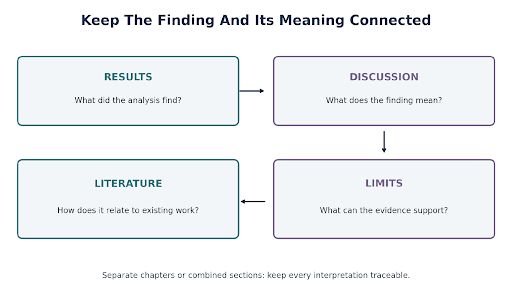
The University of Southampton guidance on results and discussion describes separate chapters and combined arrangements, while emphasising departmental requirements.
Combined results and discussion can work when readers benefit from seeing each finding and its interpretation together. It is not automatically the best choice for qualitative work or an easier way to reduce the word count. Check the permitted format before restructuring.
Layout | How It Works | What To Check |
|---|---|---|
Separate chapters | Present relevant findings, then discuss their wider meaning. | Readers can trace interpretations to reported results. |
Combined with separate sections | Include a results section followed by a discussion section within one chapter. | The boundary between evidence and interpretation remains clear. |
Integrated by question or theme | Present and discuss each set of findings before moving to the next. | Each section shows the evidence before developing wider claims. |
Table 2. Possible arrangements subject to programme approval.
In an integrated chapter, use signposting such as “The analysis identified…” and “In relation to the literature…”. This makes the change of purpose visible. You still need accurate evidence, supported interpretation and a coherent overall answer.
Repeating results: “Participants valued clarification” followed by “This means clarification was valued” adds no interpretation. Explain what the finding suggests for the question, why it matters and what it cannot establish.
Explaining too confidently: “Students struggled because lecturers wrote poor comments” introduces a cause not established by the fictional interviews. A defensible alternative is to describe the reported difficulty and examine possible explanations without presenting them as proven.
Introducing hidden findings: do not reveal a new analysis for the first time while discussing its implications. Return to the findings section and report it transparently, including any relevant distinction between planned and additional analysis.
Selecting only expected outcomes: include relevant unexpected or inconclusive findings. Do not remove them because they complicate your argument. Their interpretation belongs in the discussion, with attention to design and uncertainty.
Using quotations as decoration: introduce an extract, explain what it illustrates and relate it to the theme. Keep the explanation grounded in the wording and wider analysis.
A practical dissertation results chapter outline is: orientation; relevant information about the analysed material; findings organised by the chosen questions or themes; and a brief summary leading into discussion. Adapt it to the method rather than treating it as a universal template.
For discussion, start with the overall answer emerging from the findings. Develop the main interpretations alongside literature, alternatives and limitations. Address implications supported by the evidence, then bring the argument together. Some programmes place limitations or recommendations elsewhere; follow their guidance.
When deciding how to discuss dissertation findings, make a working note for each major result: finding; proposed interpretation; supporting literature; alternative explanation; limitation; implication. A blank item tells you what needs further thought, not what you should invent.
Before submission, check that each finding addresses the project; each table and figure is explained; each interpretation has reported evidence; and the claim strength matches the method. Check units, identifiers and cross-references across both chapters. Make sure the discussion answers the question rather than merely describing the data again.
For assistance with source presentation and consistency, Oxford Editors describes its reference and citation support. Verify that cited sources support the statements attached to them.

If you need help identifying clarity or presentation problems in your own completed draft, explore Oxford Editors’ proofreading and editing support. Confirm the assistance permitted by your assessment and retain responsibility for the analysis and final argument.
They are often used for the chapter presenting outcomes of analysis. Findings is common in qualitative work, but terminology varies across programmes. Use the term your guidance recommends. More important than the label is showing the patterns, themes or statistical outcomes established by your analysis rather than presenting an unorganised collection of raw data.
Yes, depending on the analytical approach and programme conventions. Explaining a theme can involve interpretation grounded in the data. The wider discussion often extends that account through literature, theory and implications. Avoid a rigid ban on all interpretation, but make the distinction between local analytical claims and broader conclusions clear.
Brief reminders help readers follow the argument, but reproducing every value or extract is unnecessary. Refer to the relevant finding and then explain its meaning, relationship to literature and limits. If a discussion paragraph only restates the finding in new words, ask what further understanding it contributes to the research question.
Relevant sources can help interpret a finding, subject to your programme’s expectations. Do not introduce an entirely new framework without explaining its role or let discussion become another unrelated literature review. If a source is essential to the study’s foundation, check whether it also belongs in an earlier chapter.
Placement varies. Methods may explain design constraints, results may report issues affecting analysis, and discussion may examine what those issues mean for conclusions. Some dissertations use a separate limitations section. Follow your handbook and avoid repeating the same list. Explain the effect of each limitation on the interpretation.
Report the relevant analysis accurately and discuss what it allows you to conclude. Lack of support does not automatically prove the opposite, nor does it make the project worthless. Examine uncertainty, the measures and design before proposing explanations. Avoid changing the hypothesis after seeing results without transparently explaining that change.
There is no universal UK percentage or word count. The appropriate balance depends on the total limit, methodology, complexity of findings and marking criteria. Use your programme guidance first. Allow enough space to present essential evidence and develop the interpretation, removing repetition rather than cutting necessary analysis to fit an arbitrary ratio.
It depends on the project. Analysis of existing datasets or a formal evidence review may produce results to report. A theoretical or humanities dissertation may use analytical chapters instead of a separate results section. Distinguish reviewing background literature from analysing the material central to your project, then follow the approved structure.