
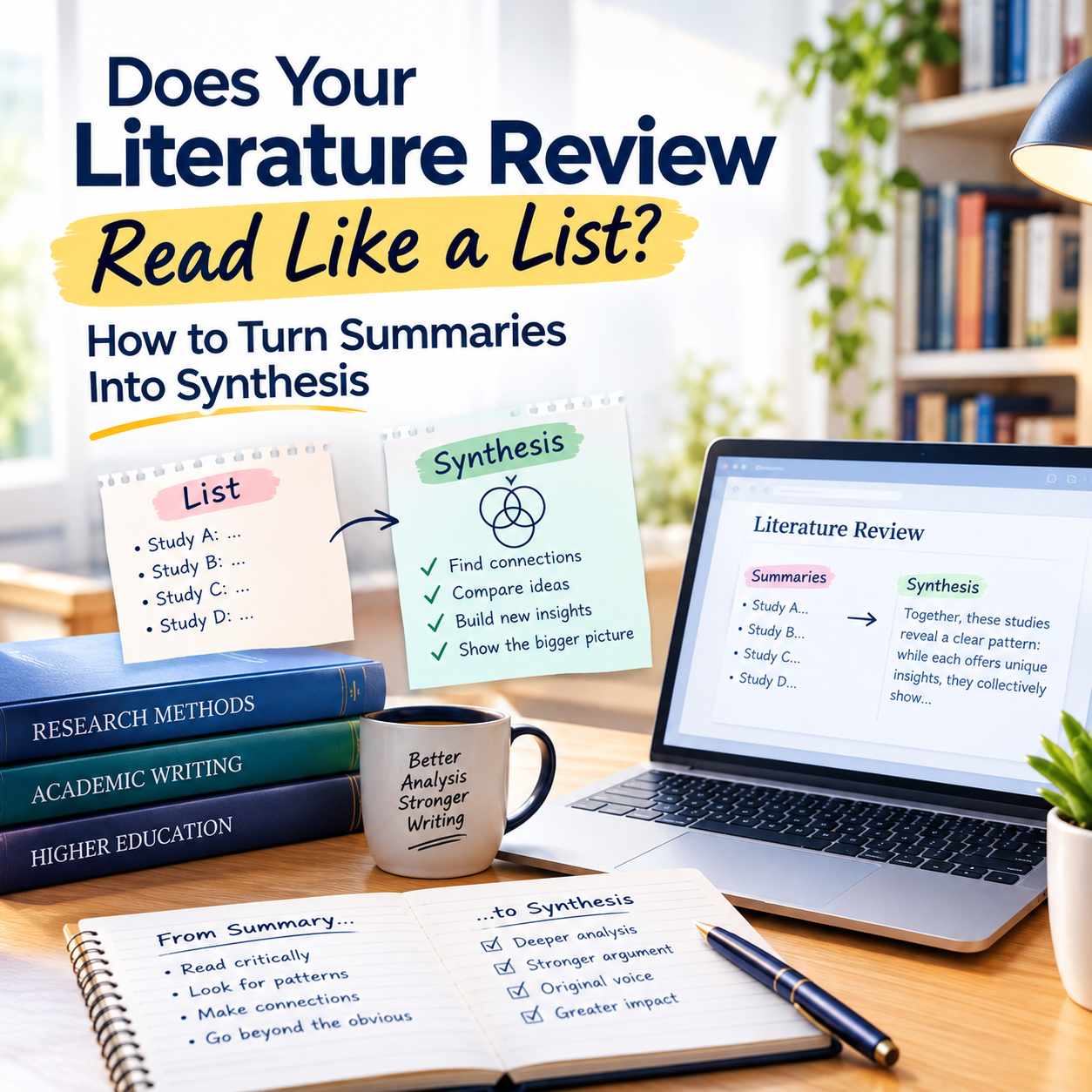
If each paragraph introduces a new author but never connects their findings, your review may read like a list. The solution is literature review synthesis: explain how sources relate to one another and what that relationship contributes to your research question. Keep the summaries readers need, but give them a clear purpose.
Good literature review synthesis does not mean putting several citations after one sentence. It means identifying a shared issue, comparing relevant evidence and explaining what you can reasonably conclude. Sources may agree, disagree, develop an idea or address different parts of a problem. Your job is to make those relationships visible.
This guide helps UK undergraduate and master’s students revise source-by-source writing into connected reasoning. All studies and passages in the worked examples are hypothetical teaching material, not published findings. Follow your assessment brief and use verified sources when applying the techniques to your own work.
Table of Contents
ToggleA list-like review often follows your reading order: first one article, then another, then a third. That is useful for private notes, but the reader is left to work out why the articles belong together. A paragraph can contain accurate summaries and still fail to explain the wider picture.
Look for three warning signs. Most paragraphs begin with an author’s name; the transition to the next study is simply “another study”; and the final sentence repeats the findings without explaining their significance. None of these features is automatically wrong, but a repeated pattern suggests that sources are controlling the structure.
The University of Portsmouth guidance on writing literature reviews distinguishes a connected review from an annotated bibliography. It recommends relating sources around shared issues and examining the strength and relevance of their evidence.
Try a quick test: write the purpose of each paragraph in the margin. If the answer is only “summarises Study A”, ask what question Study A helps answer. That question can become the basis for a paragraph which brings relevant sources together.
The distinction of synthesis vs summary is easiest to understand through the work each sentence performs. Summary explains a source accurately. Synthesis builds an account from relationships across sources. You need the first to do the second responsibly; removing every summary would leave readers without enough evidence to follow your reasoning.
Activity | Question It Answers | Example Of Its Purpose |
|---|---|---|
Summary | What does this source say? | State the findings relevant to your topic. |
Comparison | How do these sources relate? | Show that they examine different outcomes. |
Synthesis | What does their relationship help us understand? | Explain why the findings can coexist. |
Critical evaluation | How strong and useful is the evidence? | Assess what the methods allow you to conclude. |
Table 1. Different but connected tasks in a literature review. These are writing functions, not compulsory paragraph sections.
A critical literature review connects these tasks. You may explain a finding, assess its limits and relate it to another study in the same paragraph. Evaluation should tell the reader why a limitation matters to the argument, rather than adding a routine complaint that the sample was small.
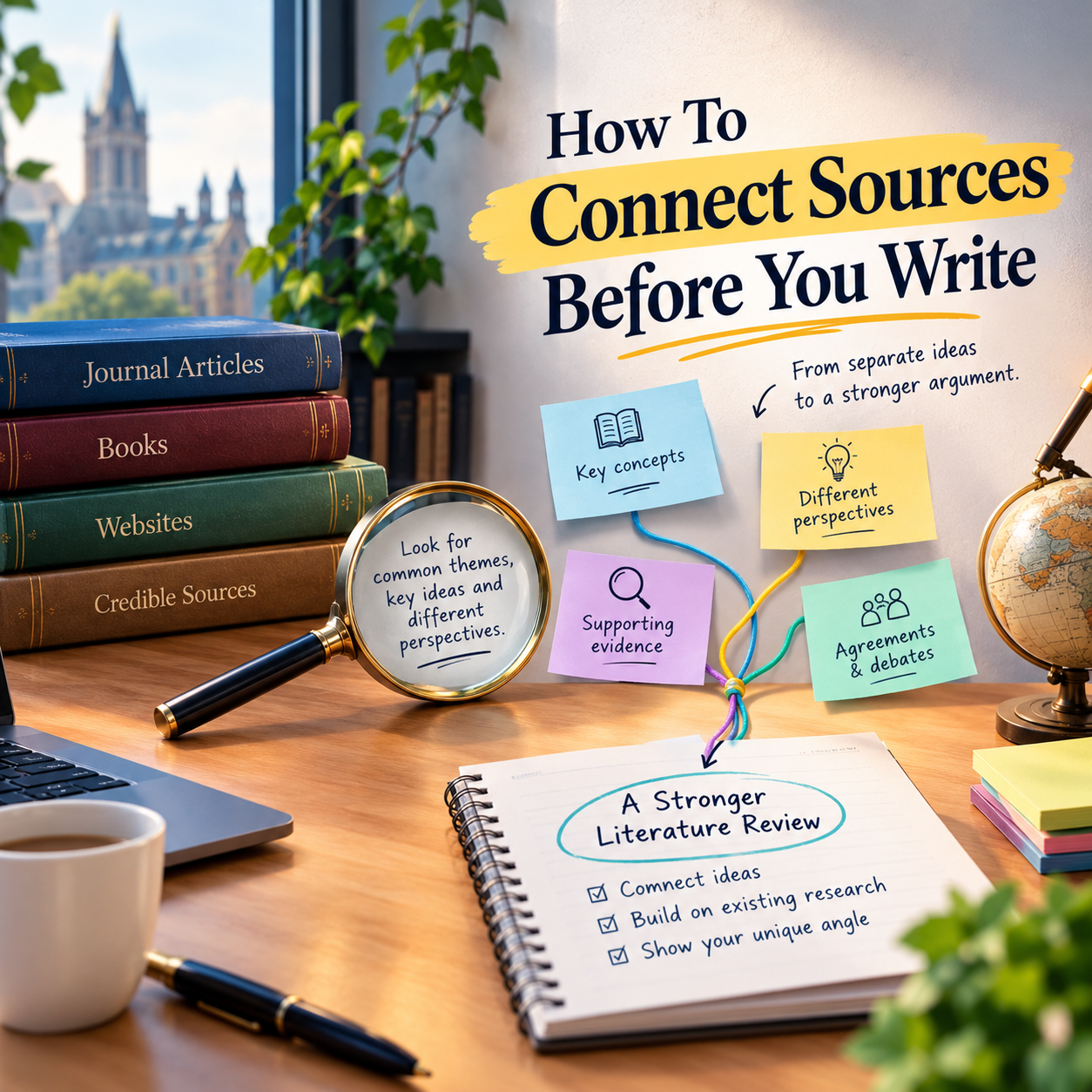
Learning how to synthesise sources begins with your reading notes. Record what each study examines, how it investigates the issue, what it reports and what the authors say about limitations. Keep the source details and relevant page numbers so that you can check the original material later.
Choose a question narrow enough to compare meaningfully. “Student feedback” is a topic; “What helps students apply feedback to later work?” is a more useful paragraph focus. Put relevant sources beside that question and check whether they actually address it.
Ask whether sources support a similar interpretation, challenge one another, examine different conditions or supply different kinds of evidence. Agreement requires more than sharing a topic. Two papers on feedback may measure appreciation in one case and later behaviour in another.
Complete this sentence in your notes: “Taken together, these sources suggest…, because…, although…”. Treat this as a thinking prompt, not wording you must repeat in every paragraph. If you cannot complete it responsibly, you may need closer reading, a narrower theme or more relevant evidence.
The University of Sheffield guidance on synthesising information encourages examining how sources develop or challenge each other. Linking words can make those relationships clearer, but they cannot replace the reasoning behind them.
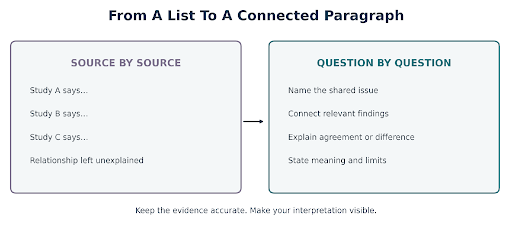
Assume your question concerns how students use written feedback. The following literature review examples use labelled study placeholders. They are not real references.
“Study A found that students appreciated detailed written feedback. Study B found that students sometimes struggled to apply comments to their next assignment. Study C reported that students valued opportunities to ask questions about feedback.”
This passage tells the reader what each study says. It does not explain whether the findings conflict or how they help answer the question.
“The three studies distinguish receiving useful feedback from being able to act on it. Although students in Study A appreciated detailed comments, Study B indicates that application could remain difficult. Study C adds a possible support mechanism: opportunities to ask questions. Together, these findings suggest that reviewing feedback quality should include both the comments themselves and students’ opportunities to understand their use. However, reported preferences alone do not establish whether later work improved.”
The opening names the shared issue. The middle explains how the studies contribute to different parts of the account. The final sentences state an interpretation and its boundary. The paragraph does not claim that asking questions causes improvement, because the hypothetical findings do not establish that.
In your assignment, replace the placeholders with verified citations and check each clause against the actual studies. If Study C measured learning outcomes rather than preferences, the wording and conclusion would need to change. Synthesis must preserve the evidence, not reshape it to fit a neat story.
Assume your research question concerns remote working and collaboration. Study D surveys fully remote staff about the frequency of informal contact. Study E interviews hybrid teams about experiences of joint problem-solving. These fictional study descriptions provide the complete basis for the example; no other results are implied.
“Study D reported fewer informal interactions during remote work. Study E reported positive experiences of collaboration in hybrid teams. The studies contradict each other, so further research is needed.”
“The apparent disagreement depends partly on how collaboration and working arrangements are defined. Study D examines informal contact among fully remote staff, whereas Study E explores joint problem-solving in hybrid teams. Less frequent informal interaction and positive accounts of collaborative tasks can therefore coexist. The studies inform different aspects of collaboration rather than directly testing the same proposition. Their distinct measures and contexts limit a single overall conclusion about whether remote working improves or weakens collaboration.”
The revised paragraph examines the concepts, measures and context before declaring a contradiction. It also explains the limit on combining the findings. This is not a claim that surveys are inferior to interviews, or that different methods always explain disagreement.
For your own review, investigate whether a proposed explanation is supported. Differences in definitions can be observed from the papers; claiming those differences caused the results requires more evidence. Both degree levels need this care, while your rubric determines the depth expected.
For the wider relationship between your review and research question, see Oxford Editors’ dissertation planning guide. Use your programme’s requirements to decide how the chapter fits the project.
A synthesis matrix is a working table that makes relationships easier to inspect. The example below records one shared question, each source’s contribution and the boundary on what it establishes. You can add columns for design, setting, definitions or theoretical assumptions when these matter to your question.
Source | Contribution To The Feedback Theme | Boundary On Interpretation |
|---|---|---|
Study A — fictional | Students appreciated detailed comments. | Appreciation is not evidence of later improvement. |
Study B — fictional | Students reported difficulty applying comments. | Reported difficulty does not explain every cause. |
Study C — fictional | Students valued opportunities to ask questions. | A preference does not prove the support was effective. |
Table 2. A completed hypothetical planning grid for the undergraduate example.
Cross-source note: these studies separate the availability of comments from the ability to use them. The planned paragraph should explain that distinction and avoid treating preferences as measured improvement. This cross-source note is the important step: copying rows directly into prose would recreate the original list.
The University of Sheffield guidance on literature reviews recommends organising notes around themes and adding your interpretation of sources considered together. Adapt the table to your project rather than collecting fields you will never use.
A thematic literature review groups discussion around issues that recur in the evidence. It works well when your question concerns several connected factors, but it is not the only useful structure. Organisation by debate, method or developments over time can also help when it serves the task.
For themes, choose headings such as “Understanding feedback” and “Applying feedback” rather than author names. For a debate, organise around the competing explanations. For methods, explain how approaches shape what is known. For chronology, show how ideas develop or change rather than merely listing publication dates.
Make the structure serve a line of reasoning. Start with what readers need to understand, then move towards the issue your research addresses. Avoid repeating the same finding under multiple headings without a clear new purpose. One source can appear more than once when it contributes genuinely different points.
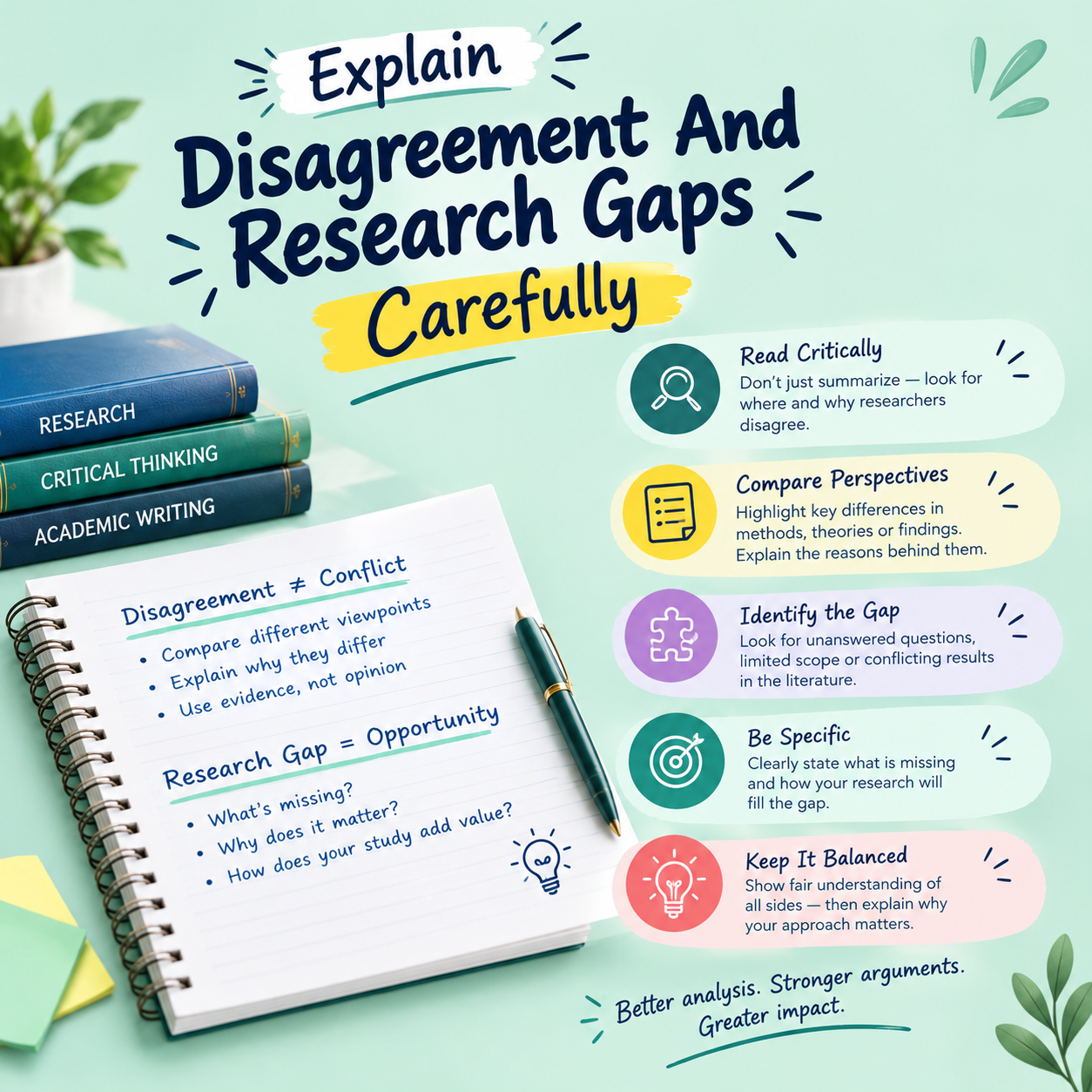
Before writing “in contrast”, compare the question, population, setting, outcome and method. A study of short-term satisfaction does not directly contradict one about long-term attainment. Genuine disagreement can remain after these checks; explain it honestly rather than forcing a consensus.
Do not settle a debate by counting papers on each side. Their relevance and quality matter, and several papers may report the same underlying sample. State when the available evidence leaves an issue unresolved. Explain what is uncertain and why it matters to your research.
“No research exists” is a strong claim. A few papers from one database cannot usually justify it. Keep a record of where you searched, the terms and limits you used, and the sources you included. Follow any required review methodology.
A more careful statement might be: “Within the studies included in this review, most examine students’ immediate responses; fewer address later application.” Use that wording only if the reviewed material supports the pattern. Explain why later application matters instead of treating any unstudied detail as a valuable gap.
This guide concerns ordinary coursework and dissertation reviews. Formal systematic or scoping reviews require their specified search, selection and reporting procedures. A planning grid alone does not make a review systematic.
Oxford Editors’ reference and citation support describes assistance with citation presentation and consistency. Check source accuracy yourself and confirm which help your assessment permits.
Choose a paragraph that currently introduces authors one after another. Write its shared question in the margin. Check the original sources, then highlight only the evidence relevant to that question. Move unrelated material elsewhere or remove it if it does not serve the review.
Write a topic sentence expressing the issue or pattern. Arrange the relevant findings according to their relationship. Add an explanation of why the connection matters, then state any limit on the conclusion. Place citations close enough that readers can identify which source supports each claim.
Useful prompts include “These studies agree on…, but differ in…” and “The findings address different outcomes because…”. Complete them with a verified relationship. Words such as similarly and however only help when the underlying comparison is accurate.
Before finishing, check five things: the paragraph answers a relevant question; it represents the sources accurately; it explains their relationship; its interpretation follows from the evidence; and its limits are visible. There is no fixed number of sources required in every paragraph.
If you want guided practice in developing your own reading and argument skills, explore Oxford Editors’ academic writing courses. Agree an assessment-appropriate scope and retain responsibility for your analysis and final wording. Get our academic writing assistance for your assignments help.
Start with one paragraph rather than reorganising the whole chapter at once. Successful literature review synthesis gives the reader an account of what the evidence means together, while making clear where that account stops.
No. Some paragraphs need to explain a key theory or examine one important study in detail. The review as a whole should connect the relevant literature, but synthesis is not a citation quota. Use as many sources as the point requires, and explain how focused discussion contributes to the broader argument.
Yes. Naming an author can clarify whose claim or method you are examining. The problem is a repeated source-by-source structure with no relationship explained. Alternate wording according to your purpose, not a rule banning names. An idea-led opening is useful when the paragraph concerns a shared theme or debate.
No. However, it signals a contrast but does not establish that one exists. Check whether the studies address comparable questions and explain the relevant difference. If they examine different outcomes, say so. Linking language should make your reasoning easier to follow, rather than conceal a comparison you have not justified.
Follow your required referencing style and make the support for each claim traceable. Multiple citations can support a shared statement when all the sources genuinely support it. If different clauses rely on different studies, position citations accordingly. Do not attach several references to a broad conclusion that none of them establishes.
No. Readers need enough source information to understand your comparison and judgement. Keep the finding, concept or methodological detail relevant to the question. Cut lengthy background that does not contribute to the argument. Summary becomes useful when you explain why it matters and connect it to the wider evidence.
Preserve genuine disagreement. Compare definitions, designs, populations and context before interpreting it. Explain which evidence is more relevant or convincing where you can justify that assessment. If the issue remains unresolved, state the uncertainty precisely. You do not need to invent a compromise or make all sources support one answer.
Both need accurate reading, relevant evidence and connected reasoning. A master’s task may require deeper attention to theory, methodological differences and the boundaries of existing knowledge. This does not mean using more complicated sentences. Follow your programme’s criteria rather than assuming that degree level creates a universal structure or source count.
Not automatically. Few results may reflect narrow search terms, database coverage or inconsistent terminology. Check the search before interpreting absence. Frame the gap within the material you reviewed and explain its significance. For formal reviews, follow the required methodology and document selection decisions rather than relying on an impression from initial searches.